
Bacopa's 12-Week Delay Problem: Why Most People Quit Before the Cognitive Benefits Begin
New meta-analysis reveals why timing—not the supplement—determines who sees results
The surprising truth is Bacopa fails when you quit too early. Most people stop at week 3 or 4. They feel nothing and assume it did not work. But the best studies run 12 weeks or longer.
This means you should treat Bacopa like a slow build. You track it over time. You look for better task switching, not “perfect memory.” If you stay consistent, the gains are easier to spot.
Take 300 mg daily with food for 12 weeks. Test yourself at week 0, week 6, and week 12. Use Trail Making Test B each time. In studies, Trail B time dropped by 17.9 ms on average.
- Standardized extract
- A Bacopa product made to a set bacoside percentage for consistent dosing.
- Placebo-controlled trial
- A study that compares a supplement to an inactive pill to measure real effects.
- RCT
- The gold standard for clinical research.
- Executive function
- Skills your brain uses to plan, stay on task, and switch between tasks.
- Task switching
- How well you shift attention between two different tasks without slowing down.
- CRP (C-reactive protein)
- A blood marker linked to inflammation; higher numbers suggest more inflammation.
- SUCRA ranking
- A score from a network meta-analysis showing how highly a supplement ranks versus others.
- bacoside
- Active chemical compounds found in Bacopa monnieri believed to enhance cognitive function.
- Caffeine
- A fast-acting central nervous system stimulant commonly used to increase alertness.
- PMID
- A unique reference number assigned to articles indexed in the PubMed database.
The 12-Week Threshold: Why Bacopa's Timeline Differs
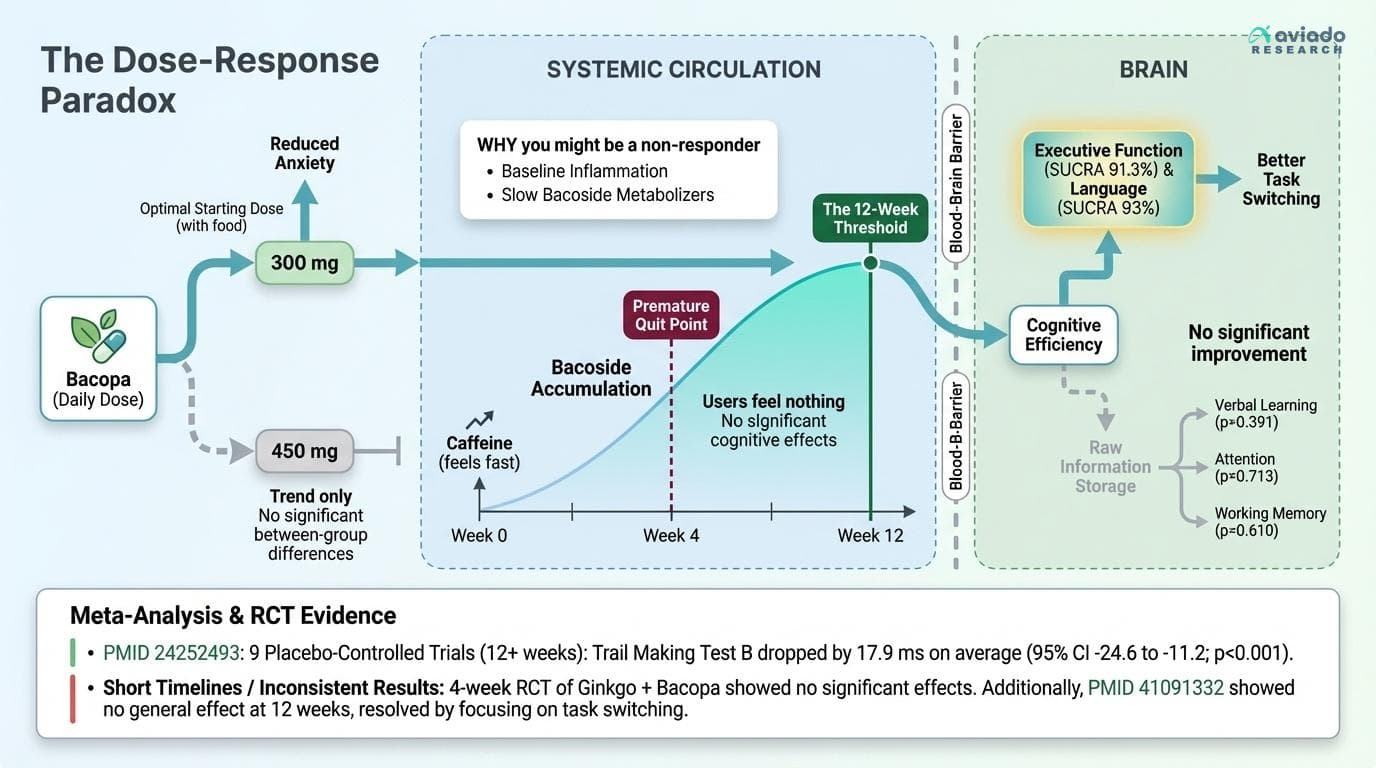
Bacopa works on a slower timeline than most “feel it now” nootropics. Caffeine can feel fast. Bacopa does not. Its key compounds, called bacosides, may need steady exposure before changes show on tests.
A meta-analysis of 9 placebo-controlled trials found Bacopa improved Trail Making Test B performance. People on Bacopa finished faster by 17.9 ms on average (95% CI -24.6 to -11.2; p<0.001) [1]. That points to better task switching speed, not a sudden memory boost.
Short timelines can miss this. In a 4-week RCT, a combined Ginkgo (120 mg) + Bacopa (300 mg) product showed no significant cognitive effects versus placebo [2]. If you stop at week 4, you may be judging Bacopa before it has a fair shot.
The Executive Function Discovery: What Bacopa Actually Improves
Recent network meta-analysis data reveals that Bacopa's reputation as a 'memory herb' misses its true strength. When researchers ranked 25 plant-derived nootropics across multiple cognitive domains, Bacopa scored highest for executive function (SUCRA 91.3%) and language function (SUCRA 93%) [3].
Executive function encompasses mental flexibility, task switching, and cognitive control—skills that become increasingly important in complex work environments. Unlike simple memory recall, these higher-order cognitive abilities determine how well you can juggle multiple projects, adapt to changing priorities, and maintain focus under pressure.
This finding explains why many users report feeling 'mentally clearer' or 'more organized' on Bacopa rather than having dramatically improved memory. The supplement appears to enhance cognitive efficiency—how smoothly your brain transitions between different types of thinking—rather than raw information storage and retrieval.
The Dose-Response Paradox: Why More Isn't Always Better
Two solid 12-week trials used different doses and got different mood results. In one RCT, 300 mg daily reduced combined state+trait anxiety scores versus placebo (no effect size reported in the abstract) [4]. In another RCT, 450 mg daily showed only a trend toward lower state anxiety, with no significant between-group differences reported [5].
This pattern suggests “more” is not always “better” with Bacopa. For many people, 300 mg daily is a practical starting dose because it is the most common study dose and lines up with the clearest mix of cognitive and mood signals.
Not every cognitive test moves. A 12-week RCT of 300 mg daily did not improve verbal learning (p=0.391), attention (p=0.713), or working memory (p=0.610) versus placebo [6]. That matters because it hints Bacopa’s strongest effects may cluster in task switching and related executive skills, not all memory domains.
Individual Response Variation: Why Some People Don't Respond
Not everyone responds to Bacopa the same way. Part of this may be biology, and part may be what you measure.
Inflammation could matter for some people. In a 12-month RCT, a polyherbal formula that included Bacopa lowered C-reactive protein (CRP) from 5.887 to 4.751 mg/L (P < 0.0001) [7]. This does not prove Bacopa alone lowered CRP, but it supports a plausible link between Bacopa-containing formulas and inflammation markers.
Baseline matters too. Many positive Bacopa trials enrolled older adults or people with cognitive complaints. If you are young and already sharp, the change may be smaller and harder to detect without timed testing.
Claims about genetics and “bacoside metabolism” are still speculative. The safer takeaway is simple: response varies, and timeline and testing choice can decide what you see.
Measuring What Matters: Tracking Bacopa's Real Effects
Many Bacopa users track the wrong thing. They expect a big memory jump. Then they miss smaller, useful gains in task control.
If you want an objective check, use Trail Making Test B. It targets task switching and mental flexibility. That lines up with where Bacopa looks strongest in research.
Do it the same way each time. Test once at baseline, then again at week 6 and week 12. Also track simple real-life signals, like how often you lose your place after interruptions, or how long you can stay focused on complex work.
Bacopa's 12-Week Delay Problem: Why Most People Quit Before the Cognitive Benefits Begin
New meta-analysis reveals why timing—not the supplement—determines who sees results
Diagram glossary
- bacoside:
- Active chemical compounds found in Bacopa monnieri believed to enhance cognitive function.
- Caffeine:
- A fast-acting central nervous system stimulant commonly used to increase alertness.
- PMID:
- A unique reference number assigned to articles indexed in the PubMed database.
- SUCRA:
- A statistical ranking metric used in network meta-analyses to evaluate treatment efficacy.
Conclusions
Bacopa tends to reward patience and the right measurement. The strongest signal shows up in executive skills like task switching, not instant “feel it” effects. A practical way to test it is 300 mg daily with food for 12 weeks, while tracking Trail Making Test B at baseline, week 6, and week 12. If you stop at week 3 or 4, you may be ending the trial before Bacopa’s benefits are measurable.
Many Bacopa trials focus on older adults or people with cognitive concerns, so results may not translate cleanly to younger, high-performing readers. Some findings come from different tests and different Bacopa extracts, which makes results harder to compare. The CRP result comes from a polyherbal formula that included Bacopa, so it cannot isolate Bacopa’s direct effect on inflammation. Longer-term safety data beyond about 12 months remains limited.
Track this in your stack
See how bacopa monnieri relates to your health goals and monitor changes in your biomarkers over time.