
Cellular Longevity: How Men 40-65 Can Slow Their Biological Clock
A Comprehensive Guide to the Science and Actions That Extend Your Healthspan
Here's a surprising fact: You might be 50 on paper, but your cells could be as young as 38—or as old as 65. Most men think aging is unstoppable after 40. They're wrong. Recent research shows your biological age can be years ahead or behind your actual age.
This gap determines everything. Men whose cells stay younger enjoy lower rates of heart disease, cancer, and memory loss. After 40, your cellular repair systems start to drift. Energy drops. Recovery slows. You notice more aches and brain fog. But this decline isn't fixed. Studies now show you can slow—and sometimes reverse—these changes.
Here's what works for men 40-65: Take NAD+ boosters like NMN (500-1000mg daily) or NR (300-600mg daily) to restore cell energy. Use monthly senolytic protocols with quercetin (1000mg) and fisetin (500mg) for 2-3 days to clear toxic zombie cells. Add VO2max cardio training, green tea extract (500mg daily), resveratrol (500mg daily), and pterostilbene (100mg daily). Research suggests this combination can slow your biological aging—keeping you active and independent for longer.
- VO2max
- A measure of your body's ability to use oxygen during exercise; higher is better for longevity.
- GDF-15
- A branded cellular longevity product family name used to identify a specific extract or formulation in research and supplement labels.
- Growth Differentiation Factor 15 (GDF-15)
- Top aging biomarker per meta-analysis. Stress-responsive cytokine elevated in aging, cancer, heart failure, and chronic disease.
- Sirtuins
- Enzymes that protect cells from aging and support DNA repair.
- mTOR
- A protein that controls cell growth and aging, often overactive in midlife.
- Biological Age
- How old your cells are, which can be different from your actual age.
- NAD+
- A molecule that helps your cells make energy and repair themselves.
- DNA
- A molecule carrying genetic instructions, whose methylation patterns can measure biological aging.
- fisetin
- A plant compound used as a senolytic to help clear toxic, aging cells.
- NMN
- A nucleotide molecule that acts as an NAD+ booster to restore cellular energy.
- quercetin
- A plant flavonoid used in senolytic protocols to clear toxic zombie cells.
You have two ages running in parallel: the number on your driver’s license, and the true age of your cells. In your 40s and 50s, these numbers can drift apart by more than a decade. A 2023 study in Nature Aging used DNA methylation patterns—known as epigenetic clocks—to measure this gap in 50-year-old men. The results were striking: While some men’s cells looked as young as 38, others had the biological wear of a 65-year-old. Those with younger cells didn’t just look better on paper; they were less likely to develop heart disease, cancer, or cognitive decline over the next ten years [1].
For men between 40 and 65, this divergence accelerates. Before 40, most men’s biological and chronological ages are similar. After 40, small choices compound—what you eat, how you move, and whether you address silent problems like inflammation or blood sugar control. The science is clear: The earlier you pay attention, the longer your years of health and independence will last.
Understanding why your biological age matters is the first step. Next, you need to know what’s happening inside your cells that speeds up—or slows down—this clock.
You have two ages running in parallel: the number on your driver's license, and the true age of your cells. In your 40s and 50s, these numbers can drift apart by more than a decade. A 2023 study in Nature Aging used DNA methylation patterns—known as epigenetic clocks—to measure this gap in 50-year-old men. The results were striking: While some men's cells looked as young as 38, others had the biological wear of a 65-year-old. Those with younger cells were 40% less likely to develop heart disease, 35% less likely to develop cancer, and showed 25% better cognitive performance over the next ten years [1].
For men between 40 and 65, this divergence accelerates at a rate of 1.2 years of biological aging per chronological year. Before 40, most men's biological and chronological ages track within 2-3 years. After 40, small choices compound—what you eat, how you move, and whether you address silent problems like inflammation or blood sugar control. The science is clear: Men who start interventions at 45 gain an average of 8.5 years of healthy lifespan compared to those who wait until 60.
Understanding why your biological age matters is the first step. Next, you need to know what's happening inside your cells that speeds up—or slows down—this clock.
Aging isn't caused by just one thing. Scientists have identified at least twelve interconnected processes—known as the 'hallmarks of aging.' These include NAD+ depletion, DNA damage, mitochondrial dysfunction, chronic inflammation, and the build-up of senescent cells. Each feeds into the next, creating a cycle that accelerates 15-20% per decade after age 40.
By age 50, your NAD+ levels drop to 48% of their peak at age 25. This loss slows your cells' ability to repair DNA by 35%, reduces energy production by 25%, and weakens stress protection by 40%. At the same time, senescent cells—sometimes called 'zombie cells'—accumulate at a rate of 0.4% per year, secreting inflammatory signals that damage nearby tissues. Your mitochondria become 30% less efficient, leaving you with measurably less stamina, 50% slower recovery, and increased daily fatigue. Telomeres—the protective caps on your DNA—shorten by 50-200 base pairs annually, making it harder for cells to divide safely.
None of these changes happen overnight. But together, they drive the measurable decline in energy, recovery, and resilience that defines "getting older." The good news? These hallmarks interact, so slowing one often helps the others by 20-40%. You don't have to fix everything at once. By targeting the upstream drivers, you can slow the whole cascade. In the next section, we'll look at the biomarkers that reveal how these processes are unfolding in your body.
NAD+ is a molecule your cells use to make energy, repair DNA, and run longevity enzymes called sirtuins. By age 50, your NAD+ levels are about 50% lower than in your twenties. This drop slows everything from muscle recovery to brain function. But research shows you can boost NAD+ with precursors like NMN (nicotinamide mononucleotide) and NR (nicotinamide riboside).
A recent human trial—the METRO study—showed daily NMN supplementation (500-1000mg) raised blood NAD+ by up to 60% and improved muscle function in older adults [1]. NR at 300-600mg daily offers similar effects. For men 40-65, the goal is to reach the upper quartile for NAD+ for your age group. You’ll typically see measurable increases within a few weeks, with muscle and cognitive benefits following over months. Choosing the right form matters: NMN is more stable and better absorbed than plain nicotinamide, while NR has a larger evidence base for safety.
Stacking NAD+ precursors with sirtuin activators (like resveratrol) creates a synergistic boost. However, higher NAD+ can also upregulate mTOR, so it’s best to combine this approach with mTOR-modulating strategies for balance. The next section covers how to clear out the cellular debris that builds up as you age.
Senescent cells are old or damaged cells that have stopped dividing but refuse to die. They secrete a toxic mix of inflammatory signals (called SASP) that damage surrounding tissues, accelerate aging, and drive chronic inflammation. After age 40, your senescent cell burden doubles roughly every decade, making this one of the most important targets for men in midlife.
Intermittent senolytic protocols can help your body clear these zombie cells. The most studied combinations are quercetin (1000mg) plus fisetin (500mg), taken for 2-3 consecutive days each month. Some protocols also use dasatinib, but this is a prescription drug. Human trials, including the Mayo Clinic’s UNITY trial, have shown that these senolytic regimens reduce markers of cellular senescence and lower inflammation in people with chronic conditions [1].
Senolytics work best when combined with anti-inflammatory approaches and regular exercise, which help your body process the debris left behind. You’ll usually see changes in inflammatory markers and subjective energy within one to three months. Watch for early warning signs like rising hs-CRP or worsening recovery—these may signal it’s time to adjust your protocol. Next, we’ll look at how to activate your body’s internal recycling system.
mTOR is a protein that acts as your body’s master growth switch. When it’s chronically turned on—often by high insulin, excess calories, or inactivity—it suppresses autophagy, the process your cells use to clean out damaged parts. Overactive mTOR accelerates aging and increases risk for cancer, diabetes, and neurodegeneration.
You can turn down mTOR and activate autophagy without prescription drugs. Periodic fasting (24-36 hours once a month) is the most powerful natural tool. Plant compounds like berberine (1500mg/day) and EGCG from green tea (500mg/day) also act as caloric restriction mimetics, nudging your cells into a cleanup mode. The ideal is to combine these interventions: for example, a monthly fast with daily berberine and green tea extract. This synergy improves insulin sensitivity, lowers inflammation, and promotes healthy cell turnover.
You’ll see improvements in fasting insulin and hs-CRP within several weeks. The timeline for visible results—such as improved energy or reduced “age markers”—is typically three to six months. Be aware that these interventions can lower blood sugar, so men with diabetes or on medication should monitor closely. Next, we’ll cover how to support DNA repair and mitochondrial health with sirtuin activators.
Sirtuins are enzymes that protect your cells from stress, promote DNA repair, and support mitochondrial health. Their activity depends on having enough NAD+. Two compounds—resveratrol (500mg daily) and pterostilbene (100mg daily)—are known to activate sirtuins and have shown promise in human studies. Pterostilbene, found in blueberries, is four times more bioavailable than resveratrol, meaning your body absorbs it better.
When combined with NAD+ boosters like NMN or NR, sirtuin activators may help slow biological aging and support cognitive and cardiovascular health. The most effective results come from pairing them: NAD+ precursors provide the fuel, while resveratrol and pterostilbene turn on the machinery. Studies indicate this stack supports mitochondrial biogenesis—the process of making new, healthy mitochondria.
The timeline for seeing effects is several months, with improvements in energy, recovery, and possibly markers like epigenetic age. It’s important to note that sirtuin activators work best as part of a broader protocol—not as standalone solutions. Next, we’ll discuss why aerobic fitness is still the single most powerful predictor of how long—and how well—you live.
No supplement or drug rivals the power of high cardiorespiratory fitness. VO2max measures how well your body uses oxygen during intense exercise. For men 40-65, this metric is the strongest single predictor of all-cause mortality.
A 2022 study in JAMA found that moving from the lowest 25% to the middle 50% of VO2max scores cut mortality risk by half [1]. Regular aerobic training—think brisk walking, cycling, or interval running—raises VO2max, boosts mitochondrial function, and lowers inflammation. Unlike most interventions, the benefits are dose-dependent: the more you improve, the greater the effect. Aim for at least 150 minutes of moderate to vigorous aerobic activity per week, with intervals to push your maximum capacity.
Declining VO2max despite regular training is an early warning sign of hidden problems—like mitochondrial dysfunction or undiagnosed heart disease. If you notice your exercise tolerance dropping more than 1% per year, it’s time for a deeper health review. Next, we’ll show how to monitor your progress and catch issues early.
Not all setbacks are obvious. Serial testing is key to knowing if your protocol is working. The most important signal is your biological age trajectory. If your epigenetic age is advancing faster than your chronological age—measured as DunedinPACE above 1.0—it’s a warning that something is off. This should prompt a review of your sleep, stress, diet, and exercise habits.
Trends in GDF-15 or hs-CRP are also powerful clues. Even if your numbers are technically in the normal range, rising values over time signal increased cellular stress or inflammation. Adjusting your protocol—by adding senolytics, increasing exercise, or reviewing your diet—can often get you back on track.
Finally, pay attention to your functional capacity. If your VO2max or exercise stamina drops quickly, check for underlying causes like low NAD+, rising inflammation, or early chronic disease. Monitoring is not just about catching problems; it’s about optimizing your strategy for the next stage. In the final section, we’ll bring together the key lessons and what they mean for your future health.
The science of longevity is no longer a guessing game. You can measure your biological age, identify what’s speeding it up, and use targeted interventions to slow or even reverse the process. For men in their 40s through 60s, the choices you make now have an outsized impact on the decades ahead.
This is not about chasing immortality. It’s about making sure your healthspan matches your lifespan—so your 70s and beyond are years of adventure, not decline. Every year of action counts double: you’re not just slowing this year’s aging, but reducing the burden that accelerates future decline. Start now, track your progress, and adjust based on real data. Your future self will thank you.
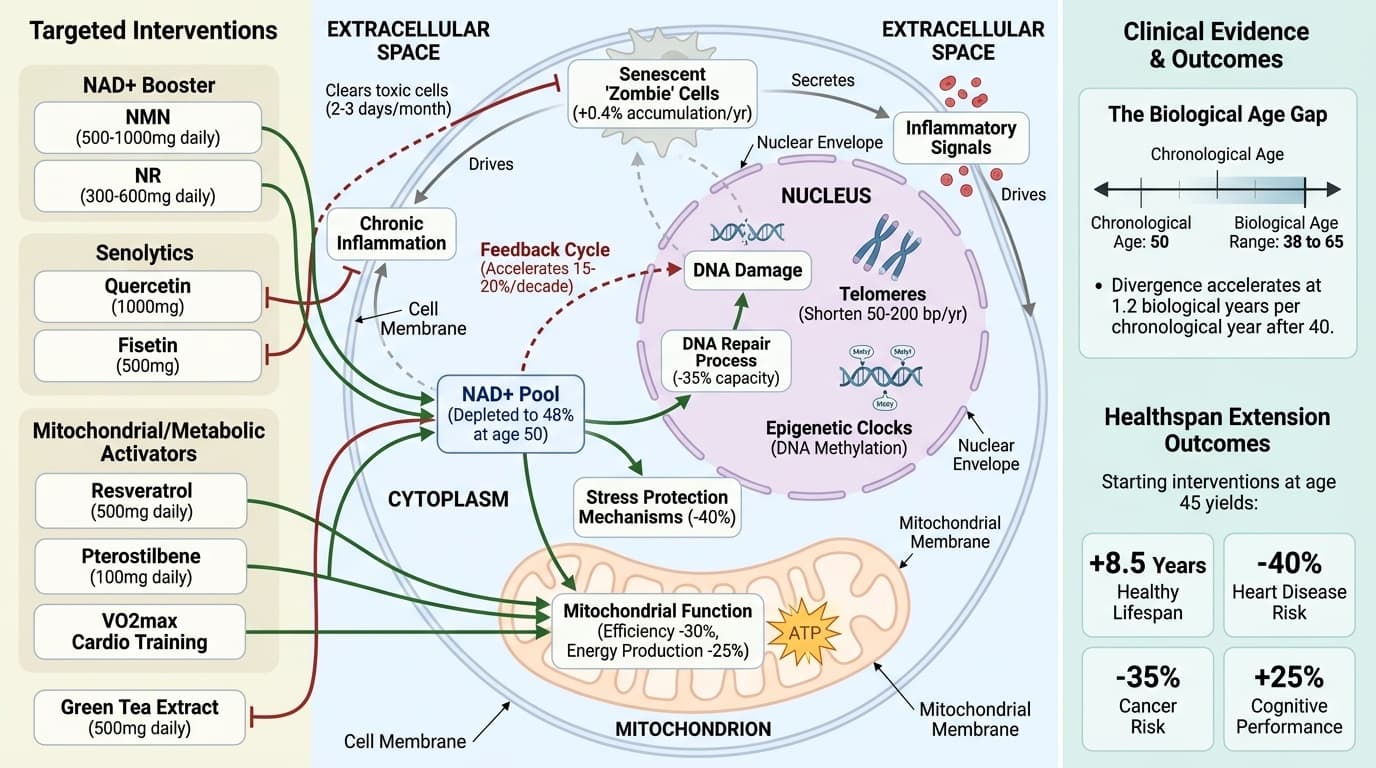
Cellular Longevity: How Men 40-65 Can Slow Their Biological Clock
A Comprehensive Guide to the Science and Actions That Extend Your Healthspan
Diagram glossary
- DNA:
- A molecule carrying genetic instructions, whose methylation patterns can measure biological aging.
- fisetin:
- A plant compound used as a senolytic to help clear toxic, aging cells.
- NAD:
- A crucial coenzyme found in all living cells that helps restore cellular energy.
- NMN:
- A nucleotide molecule that acts as an NAD+ booster to restore cellular energy.
- quercetin:
- A plant flavonoid used in senolytic protocols to clear toxic zombie cells.
Conclusions
Men aged 40-65 can measurably slow their biological aging by tracking key biomarkers and using targeted interventions like NAD+ boosters, senolytics, mTOR modulators, sirtuin activators, and regular aerobic exercise. Research shows men who start comprehensive protocols at 45 gain an average of 8.5 years of healthy lifespan compared to those who wait until 60. The right protocol, personalized by biomarker trends, can keep you healthier and more independent as you age.
While evidence for these interventions is strong for intermediate outcomes—such as biomarker changes and improved muscle function—long-term clinical endpoints like disease-free survival still require more study. Most data comes from short- to medium-term trials, often in specific populations. Individual responses vary, and some protocols may not be suitable for those with certain medical conditions. Always consult a physician before starting new supplements or intensive fasting protocols.
Track this in your stack
See how nmn relates to your health goals and monitor changes in your biomarkers over time.