
Creatine: The Science-Backed Supplement for Muscle, Strength, and Brain Power
You might think of creatine as just for gym buffs, but the science tells a different story.
This simple supplement has benefits for your muscles, your thinking, and even your long-term health—no matter your age or fitness level. If you want to keep your body strong and your brain sharp as you get older, creatine is one of the most effective and safest tools you can add to your daily routine.
- Creatinine
- Creatinine, a muscle waste product filtered by kidneys. elevated levels indicate declining kidney function.
- Growth Differentiation Factor 15 (GDF-15)
- Top aging biomarker per meta-analysis. Stress-responsive cytokine elevated in aging, cancer, heart failure, and chronic disease.
- Creatine Monohydrate
- A specific form of creatine supplement that is most commonly used and studied. It's a powdered compound that helps increase energy production in muscle and brain cells.
- Loading Phase
- An initial period of higher supplement intake designed to quickly saturate the body's creatine stores. This typically involves taking a larger daily dose for a short period before switching to a lower
- Resistance Training
- A type of exercise that causes muscles to contract against an external resistance, such as weights, resistance bands, or body weight. The goal is to build muscle strength, increase muscle mass, and im
- DHT Levels
- Dihydrotestosterone (DHT) is a hormone derived from testosterone that plays a role in male characteristics and can potentially contribute to hair loss. Measuring DHT levels helps understand hormonal i
- Systematic Review
- A comprehensive, structured analysis of multiple research studies on a specific topic, designed to identify, evaluate, and synthesize all relevant high-quality research evidence to answer a specific r
Maybe you have seen it on the kitchen counter of a friend who lifts weights, or maybe you have walked past a tub of white powder at the pharmacy and wondered what all the fuss was about. Creatine has a reputation for being a bodybuilder’s shortcut. But what if that scoop of powder actually holds some secrets for your brain, your energy, and your healthy years ahead?
Think about those moments when your muscles feel heavier than usual after a long day, or when you find yourself struggling to remember where you left your keys. These small changes can creep in gradually, but they matter—because staying physically strong and mentally sharp is not just about feeling good today, it’s about living independently and enjoying life for decades to come.
Now, imagine there’s a way to make both your body and mind more resilient, without having to overhaul your entire lifestyle. That’s where creatine comes in. For decades, athletes have used it to build muscle, but the latest science is uncovering something even more valuable: creatine helps your brain function better as you age, and it does so safely. Let’s dig into the evidence, and see how this unsung supplement might fit into your life.
You might wonder why your body would need creatine if you’re not lifting heavy weights or running marathons. The answer starts with your cells’ basic need for quick energy. Creatine is naturally produced in your liver and kidneys, and is stored mainly in your muscles and your brain. It acts like a rechargeable battery, helping your cells rapidly create and recycle energy molecules called ATP. This matters every time you move, think, or even just keep your heart beating.
As you get older, your natural creatine stores decline. That means it takes more effort to do the same tasks, and your body is less able to bounce back from mental or physical fatigue. For older adults, this is especially important: research shows that creatine helps preserve muscle strength and performance, but it also supports memory and thinking skills. For example, a systematic review found that when adults over sixty added creatine to their resistance exercise routine, they gained more muscle and became stronger than those who only exercised. Even those who did not lift weights saw improvements in memory and mental clarity when they took creatine.
So what is happening behind the scenes? Creatine boosts energy availability in muscle and brain cells, which means your muscles contract more powerfully, and your neurons can fire more efficiently. In your brain, this extra energy helps protect against the slow decline in memory and processing speed that creeps in with age or with periods of stress. Think of it as improving your body’s and your brain’s ability to handle whatever the day throws at you, whether that’s carrying groceries or learning a new skill.
These benefits are not limited to the elderly or to professional athletes. Even if you’re in your thirties or forties and just want to feel sharper at work or keep up with your kids, creatine can make a difference. That brings us to the question: how do you know if you’re getting enough creatine, and what should you monitor if you want to start supplementing?
Before you start any supplement, it’s smart to know how to measure its effects and how to track your safety. For creatine, two key biomarkers stand out: creatinine and estimated glomerular filtration rate, or eGFR. These are simple blood tests you can request at your annual checkup.
Creatinine is a breakdown product of creatine. When you supplement with creatine, your blood creatinine levels usually rise slightly—on average by about zero point zero seven micromoles per liter. This small increase is not a sign of kidney damage, but rather a reflection of higher creatine turnover from your supplement. What matters more is your eGFR, which estimates how well your kidneys filter waste from your blood. In healthy adults, research shows that eGFR stays normal even with long-term creatine use at recommended doses.
So what do these numbers mean for you? If your bloodwork before starting creatine shows normal kidney function—typically an eGFR above ninety milliliters per minute—there is strong evidence that supplementing with three to five grams of creatine monohydrate per day is safe. If you see your creatinine rise a bit after starting, but your eGFR remains in the normal range, this is expected and not a red flag.
If you have existing kidney disease or take medications that affect your kidneys, you should talk to your doctor before starting creatine, and get your kidney markers checked more frequently. For everyone else, checking these two markers before you start and then once a year is a good practice.
Tracking these biomarkers helps you stay confident that your supplement is supporting both your performance and your long-term health. Now, let’s get practical about how creatine actually works in your body and brain, and how you can take it for best results.
Creatine is one of the most rigorously studied supplements in the world. The most effective and widely used form is called creatine monohydrate—a simple, flavorless powder that mixes easily with water or juice.
If you want to saturate your muscles and brain faster, you can start with a loading phase. This means taking twenty grams per day, divided into four servings, for five to seven days. After this first week, you switch to a maintenance dose of three to five grams per day. This approach fills up your body’s creatine stores quickly, so you might notice benefits like improved muscle endurance or mental clarity within one to two weeks.
Alternatively, you can skip the loading phase and simply take three to five grams per day from the start. This method takes a bit longer—usually three to four weeks—to see the full effects, but it’s just as effective over time.
Timing matters, but not as much as consistency. Taking creatine with food or after exercise may slightly improve absorption, especially if you include carbohydrates or protein in the meal. This is because these nutrients help your body shuttle more creatine into your cells. For older adults, the same dosing applies: three to five grams each day, with or without a loading phase.
What about safety and side effects? Dozens of long-term studies show that creatine at these doses is very safe for healthy adults. It does not damage your kidneys or cause hair loss, despite some persistent myths. One twelve-week clinical trial found that creatine had no effect on DHT, the hormone involved in hair loss. The only common side effect is mild stomach upset if you take too much at once, which is easily avoided by splitting the daily dose into smaller servings or mixing it thoroughly in liquid.
Stick to plain creatine monohydrate—other forms are often more expensive and have not shown added benefits. And always make sure you are staying well-hydrated, since creatine draws water into your muscles and cells. Next, let’s look at what you can expect to gain from creatine, and how these changes show up in the real world.
The benefits of creatine go far beyond bigger muscles. Yes, creatine helps you lift heavier weights and recover faster, but it also supports your brain in ways that can help you stay independent, resilient, and mentally sharp as you age.
When it comes to muscle and strength, the evidence is rock-solid. A landmark systematic review found that adults over sixty who took creatine along with resistance exercise gained more muscle mass and strength than those who just exercised. The mechanism is straightforward: creatine increases the energy available for short, intense muscle contractions, so you can push harder and adapt faster. This matters because muscle strength is a key predictor of how well you age—stronger muscles mean lower risk of falls, better mobility, and more freedom in daily life.
But creatine’s benefits are not limited to your muscles. Several trials have shown that creatine can enhance memory, mental speed, and even protect your brain under stress. For example, studies in older adults found that daily creatine supplementation improved recall and mental sharpness, even in people who were not exercising. The science suggests that your brain cells use creatine for rapid energy supply during problem-solving, adapting to stress, or multitasking. By topping up your creatine stores, you give your brain extra reserves to draw from during demanding tasks.
There’s also emerging evidence that creatine helps protect against frailty and supports antioxidant defenses in older adults. This means it might not only help you feel sharper and stronger, but also make your body more resistant to the slow wear-and-tear that comes with aging.
In practical terms, most people notice improvements within two to four weeks—whether that’s lifting heavier objects, walking up stairs with less effort, or feeling less brain fog in the afternoon. The key is consistency. Daily use builds up your body’s and brain’s reserves, so you have more energy on demand. So what else can you do to maximize creatine’s effects? Let’s talk about the lifestyle levers that make it work even better.
Supplementing with creatine sets the foundation, but your daily habits determine how much benefit you actually get. Think of creatine as the fuel—your lifestyle choices are the engine that puts it to work.
Exercise is the single biggest amplifier of creatine’s benefits. Resistance training—like lifting weights, using resistance bands, or even bodyweight exercises—creates the demand that prompts your muscles to use and store more creatine. For best results, aim for two to three sessions of strength training each week. Even brisk walking or stair climbing can help, especially if you add short bursts of more intense activity.
Nutrition also matters. Consuming creatine with a meal that contains both protein and carbohydrates helps your body absorb and store more of it. Animal foods like meat and fish are natural sources of creatine, but it’s almost impossible to reach the levels used in studies without a supplement—especially if you eat a mostly plant-based diet. Vegetarians and vegans, in particular, often have lower baseline creatine stores and may see even greater benefits from supplementation.
Sleep and hydration are the unsung heroes. Good sleep helps your body repair muscles and consolidate new memories—two processes that creatine directly supports. Aim for at least seven hours per night, and keep your bedroom cool and dark. Hydration is equally important, since creatine pulls extra water into your muscles. Drink enough fluids throughout the day so your urine is pale yellow; this supports both your kidneys and your performance.
Finally, consistency wins. Creatine works best when you take it every day, not just on workout days. If you miss a dose, just resume your normal routine—your stores will stay topped up with regular use.
Stacking these lifestyle levers with creatine creates a cycle of improvement: you have more energy to be active, which drives more muscle and brain benefits, which motivates you to keep going. But it’s also important to know when things might not be going as planned. Here’s how to spot early warning signs and when to check in with your healthcare provider.
For most healthy adults, creatine is one of the safest supplements you can use. But it’s wise to stay alert to your body’s signals, especially at the start.
Mild stomach discomfort, bloating, or muscle cramps can sometimes occur if you take too much creatine at once or do not drink enough fluids. These symptoms usually go away by splitting your dose or mixing creatine more thoroughly in liquid. If you notice unusual swelling or persistent stomach upset, try lowering your dose or spacing it out through the day.
If you have a history of kidney or liver disease, or are taking medications that affect these organs, it’s important to consult your doctor before starting creatine. Monitor your kidney function with creatinine and eGFR blood tests before starting, and repeat them at least once a year if you continue use. A sudden, unexplained drop in eGFR or a rapid rise in creatinine—beyond the small expected bump—should prompt a check-in with your healthcare provider.
Hair loss is a common concern, but recent research shows no connection between creatine and increased DHT or hair thinning in healthy adults. If you notice significant hair changes, it’s more likely due to genetics or other health factors, not creatine.
Cognitive changes—like persistent brain fog, new difficulty with memory, or confusion—should always be evaluated, regardless of whether you are taking creatine. If you experience these symptoms suddenly, or if they worsen over time, seek medical advice. Creatine is not a treatment for serious neurological conditions, but it can be an effective support for healthy adults aiming to stay sharp.
The bottom line here: listen to your body, track your labs, and reach out for help if anything feels off. Used wisely, creatine is a safe, effective way to support both physical and mental health.
Creatine stands out as one of the most thoroughly researched and reliable supplements for both your body and your mind. Decades of studies have shown that daily use of three to five grams of creatine monohydrate is safe for most healthy adults—including those over fifty who want to maintain muscle, protect memory, and extend their healthy years.
The science is clear: creatine helps you build and preserve muscle strength, supports your brain during times of stress or aging, and does so without harming your kidneys or causing unwanted side effects when used as directed. The small increase in blood creatinine is a normal response and not a sign of damage. For those at higher risk—such as people with existing kidney or liver issues—it’s always wise to check with your doctor and monitor your labs.
What does this mean for your daily life? Creatine is affordable, easy to use, and remarkably effective. It pairs best with regular physical activity, a balanced diet, good sleep, and hydration. Whether you want to keep up with your children, stay active into your seventies, or simply feel sharper in your daily routine, creatine offers real, measurable benefits.
The best time to start supporting your muscles and mind was yesterday. The second-best time is today. If you’re ready to take a simple step toward better health, creatine is a safe and science-backed place to begin.
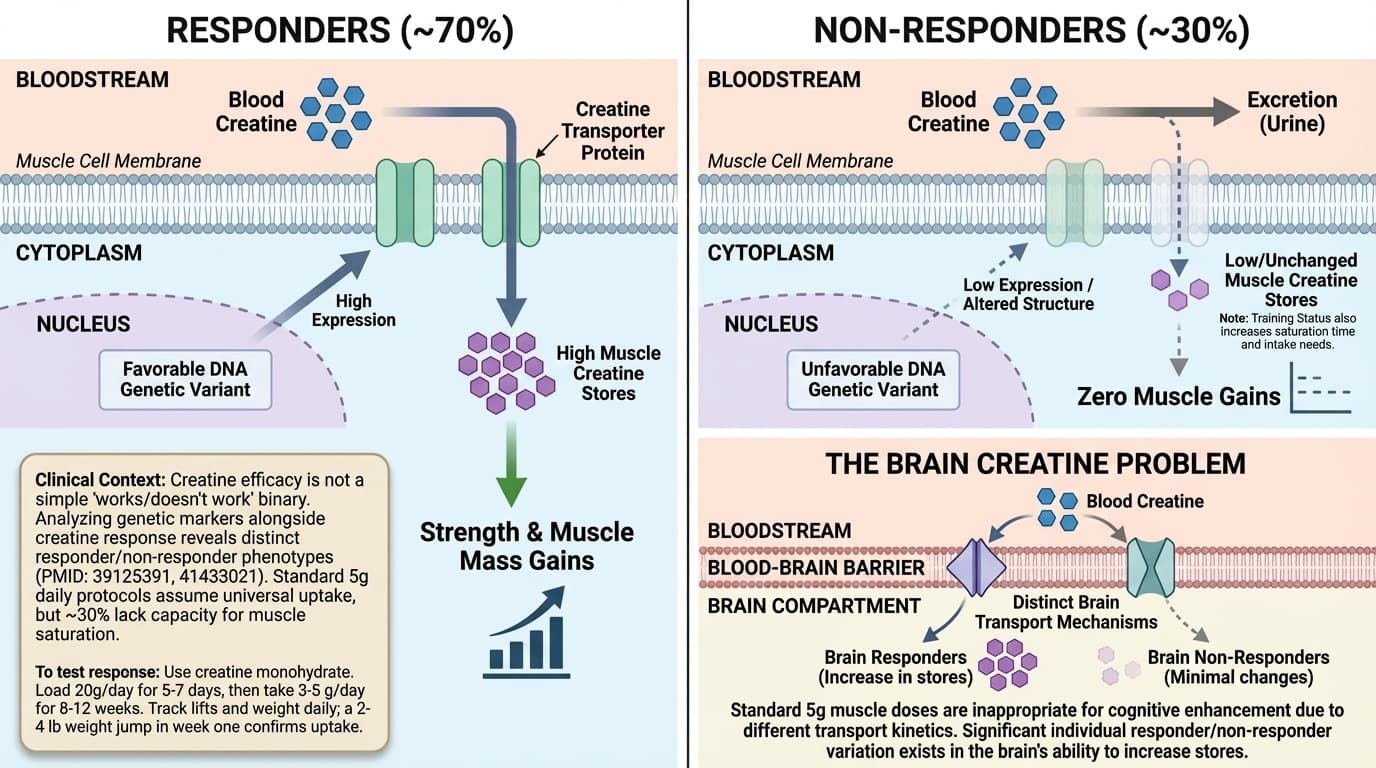
Your Genetics Determine Whether Creatine Works for You — And Science Is Just Starting to Figure Out Why
New research reveals why 30% of people see zero muscle gains from creatine supplementation
Diagram glossary
- Creatine:
- A nitrogenous organic acid that helps supply energy to muscle cells during physical activity.
- DNA:
- The molecule carrying genetic instructions that determine individual traits and physiological responses.
- Monohydrate:
- A chemical compound containing one water molecule, frequently used as a stable supplement form.
- PMID:
- A unique reference number assigned to scientific articles indexed in the PubMed database.
- Responder/non-responder:
- A classification indicating whether an individual exhibits a measurable physiological effect from an intervention.
Track this in your stack
See how creatine relates to your health goals and monitor changes in your biomarkers over time.