
Creatine's Brain Benefits May Depend on Whether Your Brain Is Actually Creatine-Deficient
Research reveals why cognitive enhancement works for some but not others
The surprising part about creatine is this. It helps muscles fast. But it may not reach your brain.
This means you may feel stronger. Yet you may not think faster. Brain gains show up most in older adults, vegetarians, and sleep loss.
For brain goals, try 20 g daily for 5–7 days. Then take 3–5 g daily. Track results for 8 weeks. For muscle goals, take 3–5 g daily.
- Creatine monohydrate
- The most studied creatine form. It is creatine plus water. Most research uses this.
- Blood-brain barrier
- A tight filter between blood and brain. It can limit how much creatine enters brain tissue.
- BUN
- Blood urea nitrogen, a waste product filtered by the kidneys. elevated BUN indicates reduced kidney function or dehydration.
- Magnetic resonance spectroscopy (MRS)
- A brain scan method that can estimate brain chemicals, including brain creatine.
- BUN (blood urea nitrogen)
- A blood marker that shifts with hydration and kidney filtering. It helps interpret creatinine results.
- Creatinine
- Creatinine, a muscle waste product filtered by kidneys. elevated levels indicate declining kidney function.
- Meta-Analysis
- A statistical technique combining results from multiple studies to find overall patterns.
- Creatine
- A nitrogenous organic acid that helps supply energy to cells, primarily muscle and brain.
- EFSA
- The European Food Safety Authority, an agency providing scientific advice on food risks.
- MRS
- Magnetic resonance spectroscopy, an imaging technique used to measure tissue biochemicals like brain creatine.
The Brain Creatine Penetration Problem
Creatine is famous for muscle energy. Many people expect the same brain boost. But brain uptake often looks small in healthy young adults.
In one 7-day randomized trial, creatine did not significantly raise brain creatine in healthy youth, even with typical dosing [1]. That matters because many cognition studies assume brain creatine rises the way muscle creatine does.
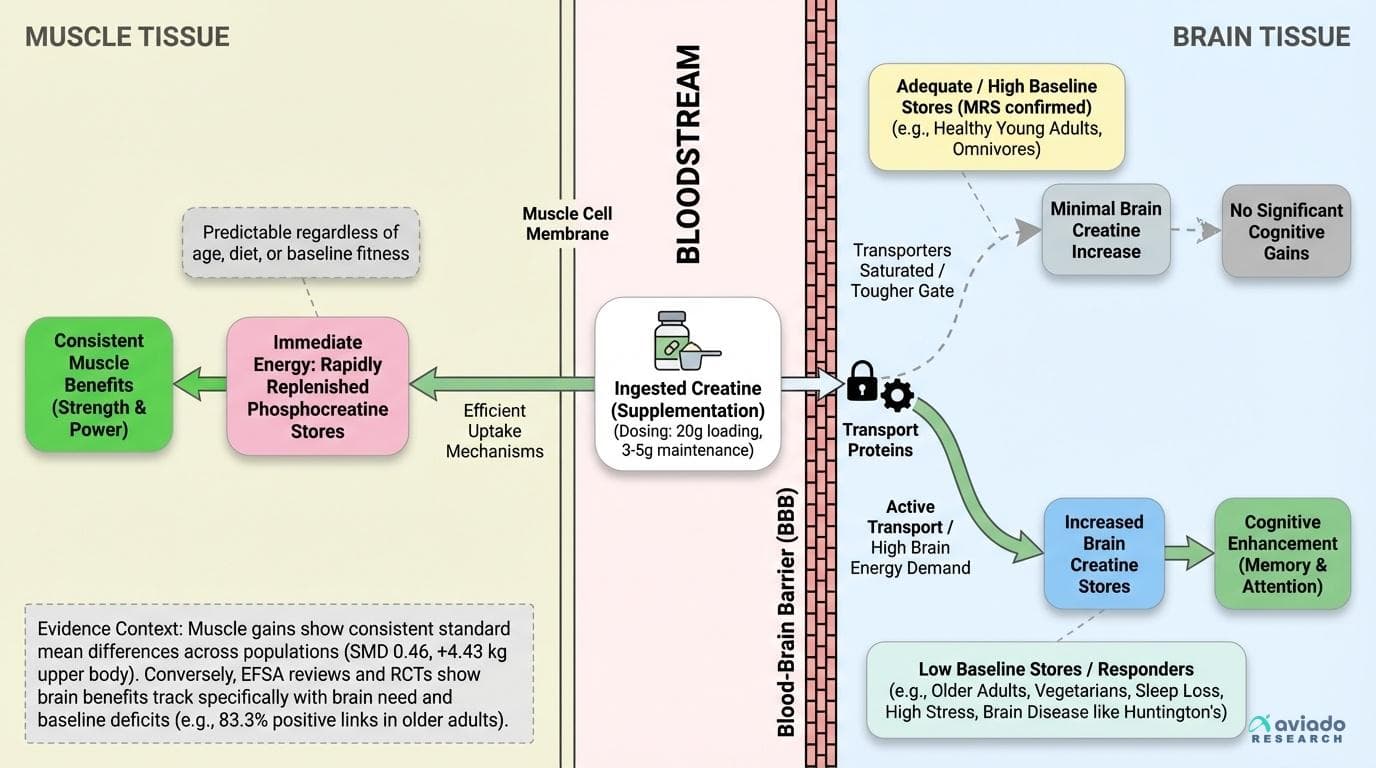
The brain has a tougher gate. Creatine must cross the blood-brain barrier. It also relies on transport proteins. If your brain stores already run high, those transporters may not move much more. So two people can take the same dose and get very different brain results.
MRS studies also show wide spread in starting brain creatine and in change after supplementation. That split can blur study results. Some participants are responders. Others are not.
Who Actually Responds to Creatine for Cognition
The clearest cognitive gains show up in people more likely to start low.
Older adults are a key group. A 2024 systematic review (6 studies, 1,542 people) found 83.3% of studies in older adults reported positive links between creatine and memory or attention [2]. That pattern fits aging biology. Creatine making and brain energy use can drop with age.
Vegetarians and vegans may also respond more. Food creatine mostly comes from meat and fish. With lower intake, body stores can run lower. Several trials report larger cognitive changes in vegetarians than in omnivores, especially on fast-thinking tasks.
Short sleep and high stress may also raise your odds of benefit. When brain energy demand climbs, extra creatine may help more.
Some brain diseases may change uptake too. In a 16-week randomized trial in Huntington’s disease, creatine increased brain creatine concentrations [3]. That supports the main idea: brain benefits track with brain need.
Muscle Benefits: More Predictable, Less Variable
Unlike the variable cognitive effects, creatine's muscle benefits show remarkable consistency across populations. Network meta-analysis of 35 trials involving 1,211 participants found creatine supplementation demonstrated superior effects for muscle strength with a standardized mean difference of 0.46 [4]. These effects appear regardless of age, diet, or baseline fitness level.
The muscle response follows a predictable pattern. Meta-analysis of 23 studies found creatine combined with resistance training increased upper-body strength by 4.43 kg and lower-body strength by 11.35 kg in adults under 50 years [5]. Even handgrip strength, a simple measure of overall muscle function, showed improvement with a standardized mean difference of 0.23 in a meta-analysis of 33 randomized controlled trials [6].
This consistency stems from muscle tissue's high creatine demand and efficient uptake mechanisms. During high-intensity exercise, muscles rapidly deplete their phosphocreatine stores. Supplementation increases these stores, providing more immediate energy for muscle contractions. Unlike brain tissue, muscle creatine uptake isn't limited by complex transport barriers or saturation effects in healthy individuals.
The muscle benefits also show a clear dose-response relationship. Loading with 20 grams daily for 5-7 days maximizes muscle creatine stores fastest, while 3-5 grams daily achieves similar saturation over 3-4 weeks. For most people seeking strength and power improvements, the lower maintenance dose provides the same long-term benefits without the digestive upset some experience with loading.
Optimizing Creatine for Your Goals
The evidence suggests a stratified approach to creatine supplementation based on your primary goals and likely responder status. For cognitive benefits, consider whether you fit the responsive phenotype: over 50 years old, vegetarian, frequently sleep-deprived, or dealing with high cognitive demands. If so, a loading protocol of 20 grams daily for 5-7 days followed by 3-5 grams daily may provide meaningful cognitive enhancement.
For muscle benefits, the approach is more straightforward. Three to five grams of creatine monohydrate daily, taken consistently, will maximize muscle creatine stores in most people within a month. Loading accelerates this timeline but isn't necessary for long-term benefits. Taking creatine post-workout with carbohydrates may enhance muscle uptake, though the timing is less critical than consistent daily intake.
The key insight is managing expectations based on your baseline status. If you're a healthy young adult with a mixed diet, expect reliable muscle benefits but variable cognitive effects. If you're older, vegetarian, or dealing with high stress demands, both muscle and cognitive benefits are more likely. The supplement works best when you're actually deficient—the challenge is knowing whether you are.
Creatine's Brain Benefits May Depend on Whether Your Brain Is Actually Creatine-Deficient
Research reveals why cognitive enhancement works for some but not others
Diagram glossary
- Creatine:
- A nitrogenous organic acid that helps supply energy to cells, primarily muscle and brain.
- EFSA:
- The European Food Safety Authority, an agency providing scientific advice on food risks.
- MRS:
- Magnetic resonance spectroscopy, an imaging technique used to measure tissue biochemicals like brain creatine.
- Phosphocreatine:
- A stored form of creatine phosphate that rapidly replenishes ATP in muscles and brain.
Conclusions
Creatine reliably boosts muscle performance, but brain benefits depend on whether your brain stores are low. Studies using brain imaging show some people do not raise brain creatine much, even when muscle stores rise. The most consistent cognitive gains show up in older adults, vegetarians/vegans, and people under heavy sleep or metabolic stress. If you want brain effects, a short loading phase (20 g/day for 5–7 days) followed by 3–5 g/day is the most evidence-based starting plan. If you want muscle effects, 3–5 g/day taken daily is usually enough.
Brain creatine is hard to measure outside research because MRS scans are not routine. Many cognition trials are short and use different tests, which makes results harder to compare. Studies also vary in dose, loading plans, and participant diet, which can change outcomes. Finally, “no effect” in healthy young adults may reflect already-high brain creatine rather than a true lack of potential in other groups.
Track this in your stack
See how creatine relates to your health goals and monitor changes in your biomarkers over time.