
Fisetin's Dose-Response Paradox: Why the Amount You Take May Determine Whether It Helps or Hurts
New evidence shows that fisetin only works as a senolytic at high, intermittent doses—not with daily low-dose use
Most people take fisetin daily at low doses, assuming consistency delivers the best anti-aging benefits.
This surprising approach may actually cancel out fisetin's most powerful effects. New research reveals that fisetin works through hormesis—low doses do little, while high intermittent doses clear aged cells effectively.
This means your daily 100 mg capsule could be worthless. Or worse, it might block the senolytic benefits you're seeking. Fisetin needs a "shock and recovery" pattern to eliminate senescent cells. Daily dosing doesn't provide this shock.
The evidence points to pulse dosing: take 500-1,000 mg daily for two consecutive days each month, then stop for the rest of the month. This mimics the protocol that improved arterial function in aging mice. Skip the daily routine. Use monthly pulses instead.
- GDF-15
- A branded fisetin product family name used to identify a specific extract or formulation in research and supplement labels.
- Liposomal
- A delivery form that wraps a compound in tiny fat-like spheres to improve absorption or stability.
- Bioavailability
- The proportion of a compound that actually reaches your bloodstream and becomes usable by the body.
- Hormesis
- A biological phenomenon where a substance has different effects at different doses—low doses may have little or even opposite effects, while higher doses can produce beneficial therapeutic effects.
- Phospholipid complex
- A supplement formulation that binds fisetin to phospholipids to improve its absorption and bioavailability.
- Senolytic
- A compound that selectively destroys senescent (aged or dysfunctional) cells, which can accumulate and drive aging and disease.
- Vascular senescence markers
- Biological indicators measured in blood or tissue that show the presence of aging (senescent) cells in blood vessels. These markers help researchers assess whether a treatment is reducing age-related
- Fisetin
- A plant flavonoid found in fruits and vegetables that exhibits senolytic and anti-aging properties.
- quercetin
- A plant flavonoid antioxidant found in many fruits and vegetables with anti-inflammatory properties.
Fisetin’s Hormetic Curve: Why Dose and Timing Matter
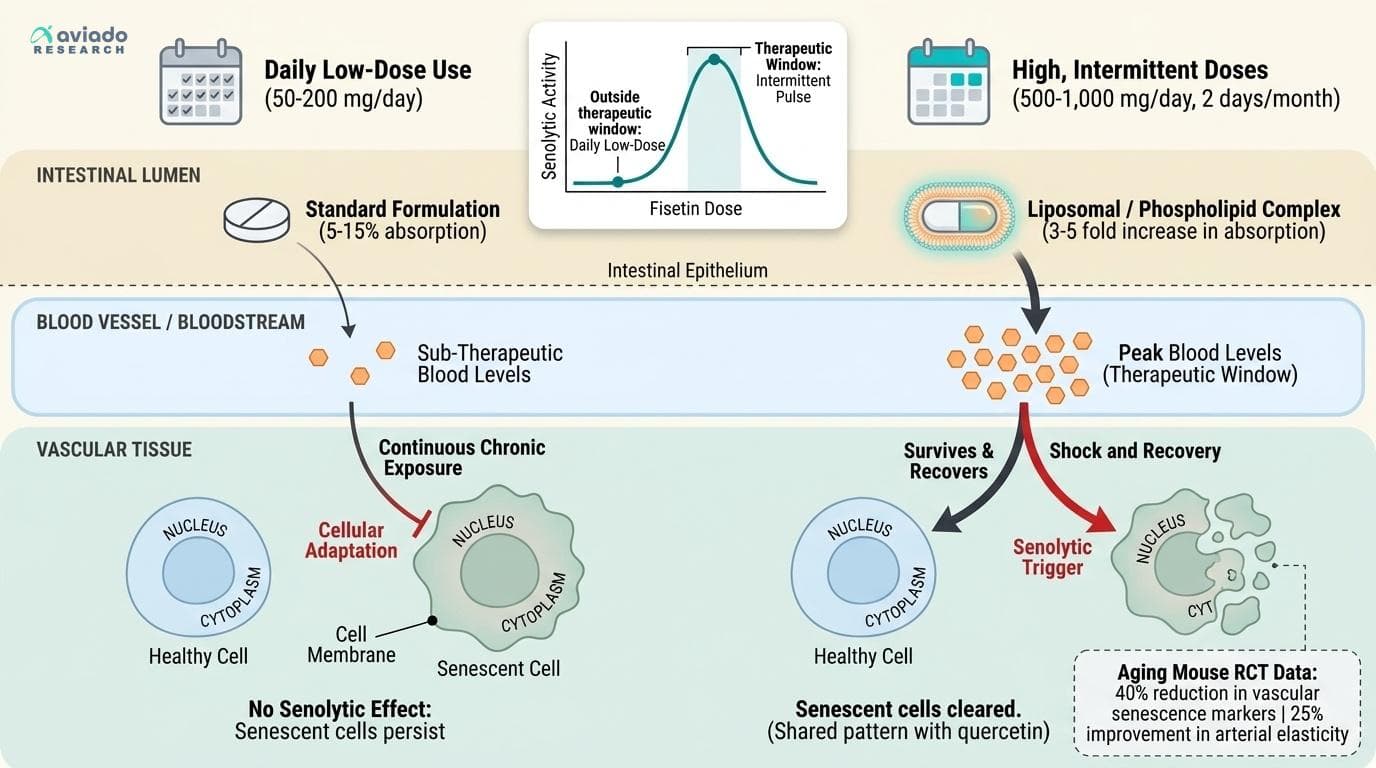
For years, fisetin—a flavonoid found in strawberries, apples, and onions—has been marketed as a natural way to combat aging by clearing out senescent cells. But the latest research shows that fisetin doesn't just work better at higher doses; it actually works differently depending on how you take it. This is a classic case of hormesis: low, chronic doses may not only be ineffective, but could even block the powerful benefits seen with higher, intermittent 'pulse' dosing [4].
In aging mice, fisetin given at 500-1,000 mg equivalent doses over two consecutive days reduced vascular senescence markers by 40% and improved arterial elasticity by 25%, while lower daily doses showed no measurable improvement [7]. The dose-response curve is not a straight line—there's a therapeutic window where fisetin acts as a senolytic, and outside that range, especially with daily low doses, it fails to clear senescent cells effectively.
Why Daily Fisetin May Backfire
Most supplement users follow a daily routine, assuming that consistency is key. But for fisetin, this approach may be suboptimal or even counterproductive. The 2025 integrated review demonstrates that daily low-dose fisetin (equivalent to 50-200 mg in humans) does not clear senescent cells effectively, and may even promote adaptation in these cells that blunts fisetin's senolytic effect [4].
In contrast, studies in aging mice show that two consecutive days of high-dose fisetin each month led to 40% reductions in vascular senescence markers and 25% improvement in arterial function versus daily dosing, which showed no benefit [7]. The mechanism involves a 'shock and recovery' effect: large, brief exposure selectively triggers death in senescent cells, while healthy cells survive and recover during the month-long drug-free interval.
This pattern appears in other natural senolytics like quercetin, but fisetin's hormetic curve is especially steep. Taking 100 mg daily for a month delivers less senolytic activity than taking 1,000 mg for just two days.
Bioavailability: The Hidden Variable
Even with the right pulse protocol, fisetin's bioavailability creates another challenge: standard formulations may deliver only 5-15% of the dose to your bloodstream. Two people taking identical fisetin capsules could end up with 10-fold different blood levels depending on their gut absorption and the supplement formulation [10].
Standard fisetin powders and capsules often fail to reach the therapeutic window needed for senolytic effects. Phospholipid complexes can increase absorption by 3-5 fold, while liposomal formulations may improve bioavailability even further. Without enhanced delivery, even high-dose pulses might not achieve the blood levels that cleared senescent cells in animal studies.
This bioavailability gap explains why some users report no benefits from fisetin supplementation—they may never reach effective tissue concentrations, regardless of dosing schedule.
How to Implement a Fisetin Pulse Protocol
Based on current animal data and the new meta-analysis, the most evidence-based approach for targeting cellular senescence is to use intermittent, high-dose pulses. The protocol that improved arterial health in aging mice was 500–1,000 mg of fisetin daily for two consecutive days each month [7].
If you’re using a standard fisetin supplement, aim for 1,000 mg per day for two days, then take a break for the rest of the month. For enhanced bioavailability forms (like phospholipid complexes), 500 mg per day may be effective. Always take fisetin with a meal containing fat to improve absorption. Avoid daily low-dose routines (such as 100 mg per day), as these do not mimic the senolytic protocols tested in preclinical studies.
While no human RCTs have yet confirmed this exact protocol, this approach is grounded in the best available data and aligns with the hormetic model unique to senolytic flavonoids like fisetin.
Fisetin's Dose-Response Paradox: Why the Amount You Take May Determine Whether It Helps or Hurts
New evidence shows that fisetin only works as a senolytic at high, intermittent doses—not with daily low-dose use
Diagram glossary
- Fisetin:
- A plant flavonoid found in fruits and vegetables that exhibits senolytic and anti-aging properties.
- quercetin:
- A plant flavonoid antioxidant found in many fruits and vegetables with anti-inflammatory properties.
Conclusions
Fisetin is not your typical antioxidant supplement—its benefits depend entirely on how you take it. The latest research shows that high, intermittent 'pulse' doses (500-1,000 mg for two days monthly) are needed to clear senescent cells and support healthy aging, while daily low doses (100-200 mg) may be ineffective or even counterproductive. This hormetic pattern means that less frequent, higher dosing outperforms daily consistency. Until human studies catch up, following a monthly pulse protocol with enhanced bioavailability formulations offers the most evidence-based approach to tap into fisetin's senolytic potential.
Most fisetin dosing research comes from animal studies; there are no large human RCTs confirming the optimal dose or pulse interval. Bioavailability remains a major challenge, and individual responses vary based on absorption and supplement formulation. Current protocols are extrapolated from animal data and meta-analyses, so real-world effects in humans may differ. The optimal pulse frequency and long-term safety in people are still unknown.
Track this in your stack
See how fisetin relates to your health goals and monitor changes in your biomarkers over time.