Green Tea Extract Can Change How Your Body Processes Common Medications — And Most People Have No Idea
Clinical research reveals green tea catechins inhibit drug transporters, meaningfully altering medication bioavailability
Surprising fact: green tea extract can change how meds absorb. Most people treat it like a simple antioxidant. But its catechins can block drug “gate” proteins in your gut.
What this means for you is simple. If you take any prescription drug, timing matters. Taking green tea extract too close can shift drug levels. You may notice stronger side effects or weaker results.
Use clear numbers. Many studies flag effects at 400–800 mg daily. Keep it 4+ hours away from your meds. If you use 1,000 mg or more, risk may rise. Consider 300–500 mg daily if you want a lower dose.
- OATP transporters
- Proteins in the gut and liver that move certain compounds into the body. Blocking them can change drug absorption.
- EGCG
- Epigallocatechin gallate. The main catechin in many extracts and a key driver of transporter effects.
- HOMA-IR (calc)
- Insulin resistance by combining fasting glucose and insulin levels.
- ALT (SGPT)
- Alanine aminotransferase enzyme, highly specific to liver cells. elevated in hepatocellular injury from viral hepatitis, fatty liver, or medications.
- Catechins
- Plant compounds in green tea extract. They can affect how your body absorbs some drugs.
- Tannase-processed green tea extract
- Green tea extract treated with the enzyme tannase to shift catechins away from EGCG into other forms.
- Glucose
- Blood sugar level, the primary energy source for cells. Fasting glucose is normal, prediabetes, ≥126 suggests diabetes.
- GTE
- A concentrated supplement derived from green tea that is rich in active catechins.
- inhibitor
- A substance that blocks or reduces the activity of enzymes or transport proteins.
- statin/OATP-substrate
- A drug, such as a statin, that requires OATP transporters for bodily absorption.
The Hidden Pharmacology of Green Tea Extract
Green tea extract is not just an antioxidant. It can act like a real drug helper or blocker. The main active parts are catechins, especially EGCG. Many products are standardized so catechins make up a large share of the capsule [1].
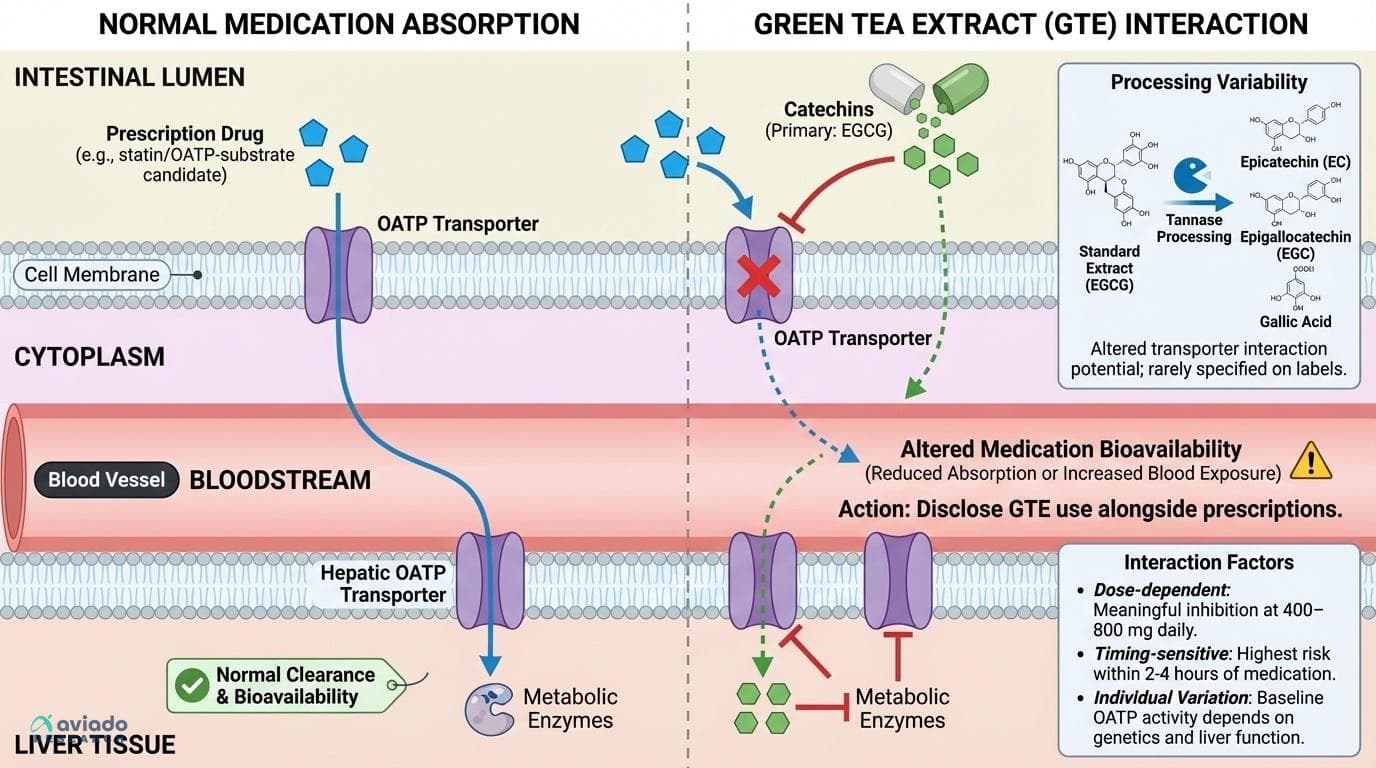
A key issue is transporters. Catechins can inhibit OATP (organic anion transporting polypeptide) transporters in the gut and liver [2]. These transporters help move some drugs from your intestines into your blood. If you block them, you can change how much drug gets in.
What changes in real life? Some clinical work reports meaningful shifts in exposure for certain OATP-substrate drugs, with increases reported in the tens of percent range in some settings [2]. The size of the change depends on the drug, the product, and timing.
Which Medications Are Affected
OATP transporters handle a surprisingly broad range of prescription medications. Any drug that relies on these transporters for absorption becomes a potential interaction candidate when combined with green tea extract [2].
The effect is dose-dependent and timing-sensitive. Studies suggest meaningful transporter inhibition begins around 400-800 mg of green tea extract daily — well within the range of typical supplement dosing [1]. The inhibition is most pronounced when green tea extract and medications are taken within 2-4 hours of each other, as catechin levels peak in the bloodstream during this window.
Individual variation adds another layer of complexity. Your baseline OATP transporter activity depends partly on genetics, meaning some people are naturally more susceptible to these interactions than others [2]. Age, liver function, and concurrent medications also influence the magnitude of the effect, making it impossible to predict interaction severity without individual monitoring.
The Processing Problem Most Labels Don't Mention
Not all green tea extracts are created equal, and the differences matter for drug interactions. Standard green tea extract is EGCG-dominant, but tannase-processed extracts have a completely different catechin profile [5][10].
Tannase processing converts EGCG into epicatechin (EC), epigallocatechin (EGC), and gallic acid. This enzymatic treatment fundamentally changes the biological activity of the extract [5]. While EGCG is the primary OATP inhibitor, the converted compounds have different transporter interactions and bioavailability profiles.
The problem: supplement labels rarely specify whether tannase processing was used. Two products with identical "green tea extract" labels could have completely different drug interaction potential depending on their catechin composition [5]. This processing variability makes it nearly impossible for consumers — or even healthcare providers — to assess interaction risk based on product labeling alone.
Timing and Dosing Strategies for Safe Use
If you use green tea extract and prescription drugs, timing is your main tool. You are trying to avoid peak catechin levels during the hours when your drug is absorbing.
Green tea catechins tend to peak in blood about 1–2 hours after you take them. Levels usually fall back toward baseline within about 4–6 hours [1]. That creates a practical rule: keep a 4+ hour gap between green tea extract and your medication.
Dose matters too. Reports often flag interactions in the 400–800 mg per day range, which matches common label directions [1][2]. Higher intakes (around 1,000 mg per day or more) may raise the chance and size of an interaction window. If you want a more conservative approach, many people choose 300–500 mg per day and still aim for consistent use [7].
What This Means for Your Supplement Strategy
This evidence does not mean green tea extract is “bad.” It means you should treat it like an active compound. If you take prescription drugs, build your supplement plan around timing and dose.
Start with spacing. Keep green tea extract at least 4 hours away from your medication doses. Pick a fixed time you can repeat daily.
Next, watch for changes when you start or stop. If side effects increase, or results feel weaker, timing or dose may be the reason [2]. Also, product type matters. EGCG-heavy extracts may pose more transporter risk than tannase-processed extracts, but labels often do not say which you have [5]. If you cannot confirm the catechin profile, use a lower dose and stricter spacing.
Green Tea Extract Can Change How Your Body Processes Common Medications — And Most People Have No Idea
Clinical research reveals green tea catechins inhibit drug transporters, meaningfully altering medication bioavailability
Diagram glossary
- EGCG:
- Epigallocatechin gallate is the primary active catechin found in green tea extract.
- GTE:
- A concentrated supplement derived from green tea that is rich in active catechins.
- inhibitor:
- A substance that blocks or reduces the activity of enzymes or transport proteins.
- statin/OATP-substrate:
- A drug, such as a statin, that requires OATP transporters for bodily absorption.
- Tannase:
- An enzyme that breaks down tannins and is often used in tea processing.
Conclusions
Green tea extract can act in unexpected ways. It may block OATP transporters that help move some drugs into your blood. That can shift drug exposure, sometimes by a meaningful amount, and timing is a big driver. If you use green tea extract, treat it like an active product: choose a clear dose, keep a 4+ hour gap from medications, and prefer products that list a catechin profile when possible.
The interaction data is not complete. Studies often test only one drug at a time, so results do not cover every prescription. Product differences are a major gap: catechin dose, EGCG percent, and processing (like tannase treatment) vary a lot, and labels may not disclose enough to compare risk. People also differ in baseline transporter activity, which may change susceptibility. Finally, long-term daily use and best spacing rules for specific drug types need more direct testing.
Track this in your stack
See how green tea extract relates to your health goals and monitor changes in your biomarkers over time.