Inside ProofMark: How Aviado Scores Every Supplement for Quality and Trust
Decoding the ProofMark Score—What It Tells You About The Supplements You Take
It's surprising how two identical supplement labels can hide completely different products inside.
One bottle might contain exactly what it promises, while another could be underdosed, contaminated, or filled with cheap alternatives. Most people assume all supplements are basically the same, but testing reveals massive quality gaps even between popular brands.
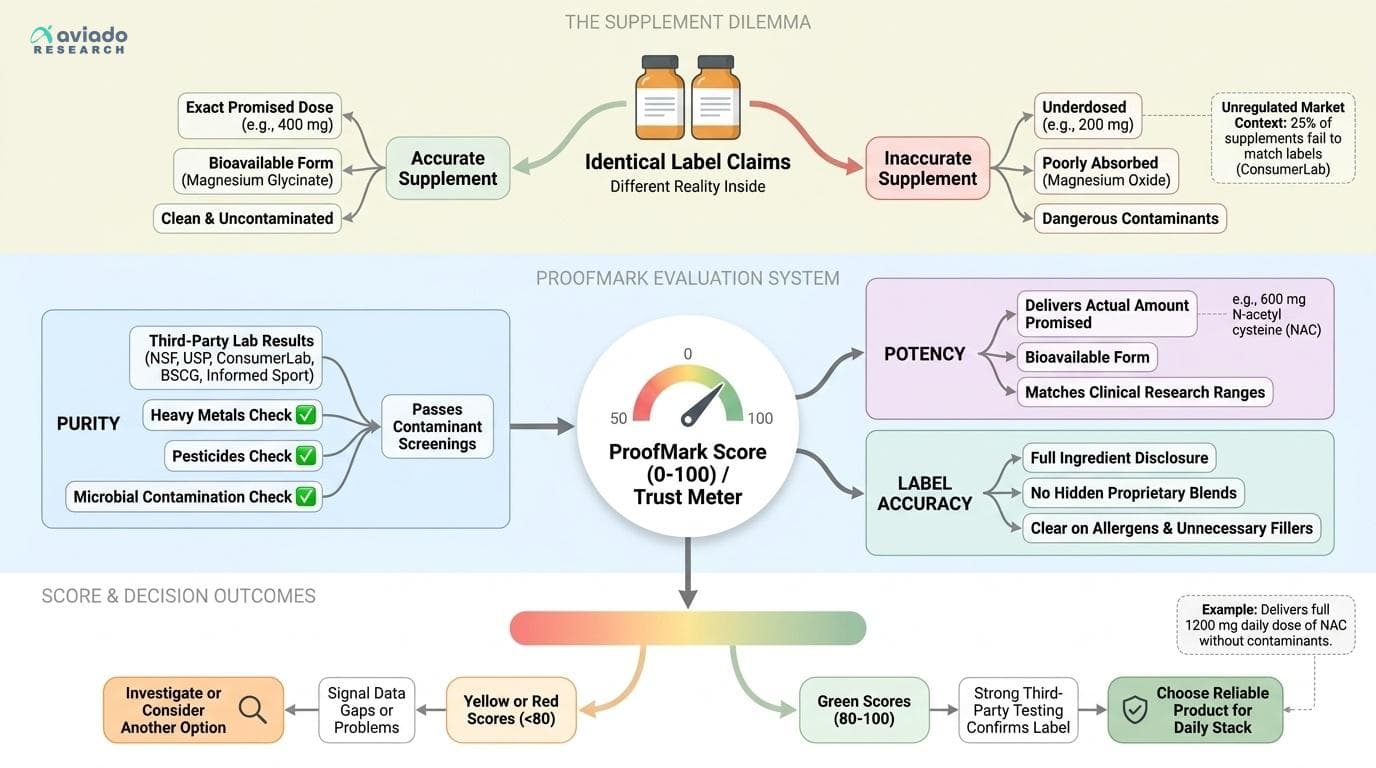
This matters because you're trusting these products with your health and money. ProofMark gives you a simple 0-100 score that cuts through marketing claims to show real evidence of purity, potency, and label accuracy. Green scores (80-100) mean strong third-party testing confirms what's on the label. Yellow or red scores signal gaps or problems you should investigate.
For your daily stack, aim for products scoring 80 or higher. If you're taking magnesium glycinate 400 mg daily, a high-scoring version ensures you're actually getting 400 mg of the bioavailable form, not cheap magnesium oxide. For NAC 600 mg twice daily, ProofMark helps you pick brands that deliver the full 1200 mg daily dose without contaminants. This scoring system lets you compare options in seconds and choose supplements backed by real data.
- Magnesium Glycinate
- A specific form of magnesium where the mineral is bonded to the amino acid glycine, making it easier for the body to absorb compared to cheaper forms. This bonded structure is called a chelate.
- Magnesium Oxide
- A common, low-cost form of magnesium found in many supplements, but one that the body absorbs poorly compared to other forms like magnesium glycinate.
- ProofMark
- Aviado's 0-100 score showing how much you can trust what's on a supplement label based on third-party testing and transparency data.
- Potency
- Whether the amount and form of each ingredient matches the label and delivers the promised dose in a bioavailable form.
- Purity
- How free a supplement is from contaminants like heavy metals, pesticides, or harmful microbes based on independent lab testing.
- Third-party testing
- Lab analysis done by independent organizations like NSF, USP, or ConsumerLab to verify a supplement's purity and potency claims.
- Bioavailable
- How easily your body can absorb and use a supplement ingredient. Different forms of the same nutrient can have vastly different bioavailability.
When you see two bottles of the same supplement on the shelf, you might assume they're basically identical. But testing reveals a different reality. One magnesium supplement might contain exactly 400 mg of bioavailable magnesium glycinate, while another delivers just 200 mg of poorly absorbed magnesium oxide—despite identical label claims.
Supplements aren't regulated like prescription drugs. Companies can make label claims without proving accuracy. Independent testing by ConsumerLab found that 25% of supplements failed to match their labels—some contained dangerous contaminants, others delivered half the promised dose. Even reputable-looking brands can have issues because there's no universal standard for quality control.
This leaves supplement users playing roulette with their health. Unless you have access to lab testing, you're relying on marketing claims and hope. That's why people taking NAC for liver support might see no benefits—their 600 mg capsules could contain just 300 mg of active ingredient, or the NAC could be degraded from poor storage.
ProofMark solves this transparency problem. It gives you instant access to real testing data, so you know which products deliver what they promise—and which fall short.
The ProofMark score is Aviado’s answer to the supplement quality puzzle. It’s a single score, from 0 to 100, that sums up how much evidence exists that a supplement’s label matches what’s inside the bottle. Think of it as a trust meter: the higher the score, the more reliable the product.
But it’s important to know what ProofMark is not. It’s not a recommendation to take a supplement, nor does a high score mean a product is right for your specific needs. Instead, ProofMark tells you whether a supplement is exactly what it claims to be, based on real-world testing and data. If you’re already taking a product or comparing options, ProofMark helps you judge which brands meet higher standards for purity, potency, and transparency.
For example, let’s say your starter stack includes NAC (N-acetyl cysteine). If one brand scores an 88 and another a 52, the higher score means there’s strong evidence the product contains the stated amount of NAC, is free from major contaminants, and the label fully discloses all ingredients. If a product gets a low score, it’s a sign to look closer or consider another option.
ProofMark brings together three essential pillars to rate supplement quality: Purity, Potency, and Label Accuracy.
Purity reflects how clean a supplement is. Aviado checks third-party lab results from organizations like NSF, USP, ConsumerLab, BSCG, and Informed Sport. The score considers whether the product passed contaminant screenings—looking for heavy metals, pesticides, or microbial contamination—and if it’s been independently verified.
Potency is about whether the supplement delivers the actual amount of active ingredient promised on the label, and whether it’s in a form your body can use. For example, magnesium glycinate is more bioavailable than magnesium oxide. ProofMark also checks if the dosage matches clinical research ranges. If a product uses a form or dose unlikely to help, or if tests show the real amount is off, the score drops.
Label Accuracy asks: does the label fully disclose all ingredients? Are there any proprietary blends that hide how much of each ingredient you're getting? Does the label make clear if there are allergens or unnecessary fillers? Full transparency is rewarded; hidden blends or missing details lower the score. Each of these pillars is grounded in data, so the score reflects real evidence—not just marketing claims.
Aviado doesn’t guess when assigning a ProofMark score. The database draws from a range of sources to keep the score as objective as possible. First, it pulls published third-party lab test results—if a supplement has been tested by groups like NSF or ConsumerLab, that data feeds directly into the score. It also checks official certification databases for stamps of approval.
FDA warning letters and product recalls are factored in too. If a supplement has been flagged for contamination or label violations, that’s a major signal. Aviado’s own team analyzes product labels using image extraction and advanced software, adding another layer of verification.
But this isn’t a closed system. Community contributions matter—users who scan products feed anonymized label data back into the platform, helping the database grow and adapt. Not every product has a ProofMark yet; when there’s not enough data, Aviado simply says so instead of guessing. Over time, as more users scan and more testing is published, the database becomes more comprehensive and the scores even more reliable.
ProofMark uses a clear, color-coded scale to help you quickly understand what the score means:
- 80-100 (Green): Strong third-party evidence of quality. These products have passed independent testing, show full label transparency, and match dosage claims. - 50-79 (Yellow): Partial data or minor concerns. There may be some missing info or minor discrepancies, but not enough to signal a major problem. - 0-49 (Red): Significant gaps or known issues. This could mean failed tests, missing ingredients, undisclosed blends, or contamination concerns. - — (Gray): Not yet scored—insufficient data available.
If a product you scan is in the green, you can feel confident about its label accuracy and purity. Yellow means you might want to check the breakdown for gaps. Red is a clear warning to investigate further before using the supplement. Gray means Aviado doesn’t have enough data yet, but you can help by scanning and contributing.
ProofMark isn’t just a number to glance at—it’s a practical tool for making better supplement decisions. If you’re in the store or shopping online, scan the bottle to pull up its ProofMark score. If it’s green, you’re looking at a product with strong evidence of quality. If it’s yellow or red, check the details—sometimes a low score simply means there isn’t enough public data, not that the product is unsafe.
When deciding between brands, ProofMark makes it easy to choose the version with more reliable evidence. This is especially useful for common supplements like NAC, magnesium, or vitamin D, where options can look similar but vary widely in quality. You can also help the community: if you scan a product Aviado hasn’t seen before, your contribution helps build a more accurate, transparent database for everyone.
Ultimately, ProofMark empowers you to cut through marketing and focus on real evidence. It’s not about chasing the highest score for its own sake—it’s about trusting that what you’re taking is what you think it is, every single time.
Inside ProofMark: How Aviado Scores Every Supplement for Quality and Trust
Decoding the ProofMark Score—What It Tells You About The Supplements You Take
Diagram glossary
- BSCG:
- A third-party certification organization that tests dietary supplements for banned substances and quality.
- cysteine:
- A sulfur-containing non-essential amino acid that acts as an antioxidant precursor.
- glycinate:
- A highly bioavailable form of a mineral bound to the amino acid glycine.
- NAC:
- N-acetyl cysteine is a supplement form of cysteine used to boost antioxidant levels.
- NSF:
- An independent organization that tests and certifies the quality and purity of dietary supplements.
- USP:
- A scientific nonprofit that sets public standards for the quality and purity of supplements.
Conclusions
Supplement quality varies dramatically behind identical-looking labels. ProofMark cuts through marketing claims with a simple 0-100 score based on real testing data for purity, potency, and transparency. By choosing products scoring 80 or higher, you ensure you're getting supplements that deliver their promised doses without harmful contaminants. As more users contribute data by scanning products, this transparency tool becomes even more powerful for making evidence-based supplement decisions.
ProofMark is only as strong as the data available. Not every supplement has been independently tested, and some products may have limited or outdated information. The score can’t guarantee a product’s effectiveness for your personal needs, nor does it cover every potential contaminant. Always check for updates and dig into the score breakdown when making important supplement choices.
Track this in your stack
See how proofmark relates to your health goals and monitor changes in your biomarkers over time.