
L-Citrulline Cuts Blood Pressure as Effectively as Exercise — But Only If Your Vascular System Responds
Meta-analyses show wildly different effect sizes across trials, suggesting your vascular biology determines whether you're a responder
Imagine lowering your blood pressure as effectively as a solid exercise routine—just by taking a supplement.
L-citrulline has shown the potential to deliver real cardiovascular benefits, but whether it works for you depends on your own biology. This episode explores how L-citrulline interacts with your blood vessels, how to know if you’re a responder, and what specific steps you can take to test and optimize your heart health.
- L-citrulline
- An amino acid supplement that can raise arginine and support nitric oxide in blood vessels.
- Nitric oxide (NO)
- A signal made by blood vessels that helps arteries relax and widen.
- Systolic Blood Pressure
- Peak arterial pressure during heart contraction, strongest predictor of cardiovascular events. elevated systolic BP damages blood vessels, heart, kidneys, and brain over time.
- Flow-mediated dilation (FMD)
- A test of how well an artery widens when blood flow increases, used to gauge endothelial health.
- Diastolic blood pressure (DBP)
- The bottom number on a blood pressure reading. It reflects pressure between heartbeats.
- Systolic blood pressure (SBP)
- The top number on a blood pressure reading. It rises with artery stiffness and predicts heart risk.
- Responder vs. non-responder
- A responder shows a clear blood pressure drop with citrulline; a non-responder does not.
- arginine
- An amino acid that helps produce nitric oxide to support blood vessel function.
- Citrulline
- An amino acid that supports nitric oxide signaling and can lower blood pressure.
- FMD
- A medical test measuring blood vessel dilation to assess overall endothelial function.
Picture this: you’re walking up the stairs or heading out for your morning commute. You check your blood pressure on your smartwatch or maybe at the pharmacy kiosk. The numbers aren’t terrible, but they’re not where you want them to be. Maybe your doctor has started hinting at medication, or you’re just feeling the weight of family history pressing in. What if there was a simple powder you could mix into your morning routine—something that, for some people, works almost as well as a few gym sessions a week? L-citrulline sounds almost too good to be true. You hear about it in fitness circles, supplement shops, and maybe that friend who’s always chasing the next edge. But then comes the doubt. Does it actually work, or is it just another powder in the pantry? The real story is more nuanced. L-citrulline is not a universal fix. For some people, it can lower blood pressure as much as regular exercise. For others, it barely moves the needle. The difference is not just about the dose or the brand—it’s about what’s happening inside your own blood vessels. Today, we’re diving into the science behind that difference, what it means for your daily life, and exactly how to find out if you’re one of the people who stands to benefit.
To understand why L-citrulline is a game-changer for some and a dud for others, you need to know how your blood vessels operate. Your arteries are lined with a thin layer of cells called the endothelium. These cells are not just wallpaper. They’re dynamic, responding to signals from your brain, hormones, and even what you eat. Their most important job is producing nitric oxide. Nitric oxide is a molecule that tells your blood vessels to relax and expand. When that system works, your blood flows smoothly and your pressure stays in check.
But here’s where things get interesting. Life, age, and chronic stress all take a toll on your endothelium. High blood sugar, inflammation, smoking, and even just getting older can all chip away at nitric oxide production. This is called endothelial dysfunction, and it’s one of the earliest warning signs that your heart and vascular system are under stress. If your endothelium is struggling, your arteries become stiff, your blood pressure drifts up, and you feel the effects—sometimes as fatigue, sometimes as headaches, sometimes as nothing at all.
Now, L-citrulline enters the scene. When you take L-citrulline, your body converts it into another amino acid, L-arginine. L-arginine is the main building block your endothelium uses to make nitric oxide. So in theory, more L-citrulline means more L-arginine, which means more nitric oxide, and ultimately, more relaxed arteries and lower blood pressure. But if your endothelium is already working well—if your nitric oxide production is strong—then adding extra raw material doesn’t change much. That’s why people with high blood pressure, older adults, or anyone with signs of endothelial dysfunction are most likely to see a benefit. If your blood vessels are healthy and flexible, L-citrulline might not do much. But if there’s a bottleneck in nitric oxide production, it can make a real difference.
So the big takeaway is this: L-citrulline is not magic. It’s a targeted tool. Its effectiveness depends on whether your blood vessels are struggling with nitric oxide production. That brings us to how you can figure out where you stand—and what numbers really matter.
Before you start any supplement, you want to know if you actually need it. With L-citrulline, the most important number is your blood pressure. That’s your daily window into how hard your heart is working and how flexible your arteries are. For adults, a healthy resting blood pressure sits below one hundred and twenty over eighty millimeters of mercury. Once you start creeping up toward one hundred and thirty systolic, you’re in the range where lifestyle changes and targeted interventions can really pay off. If your numbers are one hundred and thirty over eighty or higher for several days in a row, your risk for heart attack and stroke goes up. That’s the group that tends to see the biggest benefit from L-citrulline.
But blood pressure is just one piece of the puzzle. If you can, check your cholesterol—especially LDL cholesterol, which is the type most likely to cause plaque buildup. Aim for LDL below one hundred milligrams per deciliter. Triglycerides should be under one hundred and fifty. Another useful number is fasting glucose. If your fasting blood sugar is consistently over one hundred, your endothelium might already be under strain. In research, people with higher baseline blood pressure or metabolic risk factors—like high cholesterol or elevated glucose—are more likely to respond to L-citrulline.
There’s also a more advanced test called flow-mediated dilation, or FMD. This measures how well your arteries can expand when blood flow increases. Lower FMD scores signal endothelial dysfunction. Most people don’t have access to this test outside of research centers, but it’s worth knowing about if you’re already working with a cardiologist or interested in in-depth vascular health monitoring.
So, what does this mean for you? If your blood pressure is near or above one hundred and thirty, or if you have other risk factors like high cholesterol, high fasting glucose, or a family history of heart disease, you’re in the group that stands to gain the most from trying L-citrulline. But if your numbers are already optimal, the effect might be minimal. Next, let’s break down exactly how L-citrulline stacks up against exercise, and what the science says about real-world results.
Imagine getting the blood pressure benefits of a gym habit—just by mixing a supplement into your water. That’s what got researchers interested in L-citrulline. In a major review that pooled data from nine studies and over three hundred adults, researchers found that supplementing with L-citrulline lowered blood pressure by about as much as regular resistance training. Both interventions produced a noticeable drop in systolic pressure—often in the range of four to nine millimeters of mercury.
Here’s the mechanism: both exercise and L-citrulline boost nitric oxide production in your blood vessels. Exercise does it by creating repeated bouts of increased blood flow and mechanical stress, which teach your arteries to relax more effectively. L-citrulline does it by providing more of the raw material—arginine—that your endothelium needs to make nitric oxide. The endpoint is the same: your arteries become more elastic, your blood pressure goes down, and your risk for heart attack and stroke decreases.
But the similarities end with blood pressure. Exercise triggers a cascade of benefits throughout your body—improving insulin sensitivity, building muscle, strengthening bones, and supporting brain health. L-citrulline’s main effect is on blood vessel function. That means you should not see it as a replacement for movement. Instead, think of it as a lever you can pull if your blood vessels need extra support—and especially if you’re struggling to get blood pressure under control with lifestyle changes alone.
One more practical difference: time. Exercise routines often take several months to show the full effect on blood pressure, especially if you’re starting from scratch. L-citrulline, on the other hand, can show results within two to four weeks if you’re a responder. That fast feedback makes it easy to test whether the supplement is working for you. So how do you know if you’re likely to respond? That’s the responder paradox—and it’s the next question you’ll want answered.
If you dig into the research, you’ll notice something odd. Some studies show impressive drops in blood pressure with L-citrulline—up to about nine millimeters of mercury in certain groups. Others see only minor changes, maybe three or four points, and some report almost no effect at all.
A meta-analysis of fifteen clinical trials found an average drop of about seven and a half millimeters in systolic blood pressure for people taking L-citrulline. Another major review, which included both L-citrulline and watermelon (a natural citrulline source), found average reductions closer to four points. In a focused review of postmenopausal women with high blood pressure, the average drop was even higher—up to about nine millimeters.
So what’s behind these wild swings? It comes down to who is being studied. People who start with high blood pressure, especially those with underlying endothelial dysfunction, consistently see the biggest drops. Older adults, people with hypertension, and many postmenopausal women are more likely to have lower baseline nitric oxide production. That gives L-citrulline more room to work. If your vascular system is already healthy and your endothelium is firing on all cylinders, adding more L-citrulline is a bit like pouring extra water into a full glass—it just spills over, with little added effect.
Conversely, if your arteries are stiff, inflamed, or you have metabolic risk factors, there’s a bottleneck that L-citrulline can help bypass. The main mechanism is simple: it increases arginine in your blood, which your body uses to make nitric oxide. But if your endothelium is damaged beyond a certain point—say, by years of uncontrolled diabetes or advanced atherosclerosis—even extra arginine might not be enough. That’s why the effect size varies so much, and why tracking your own blood pressure numbers is critical.
The bottom line is this: the sicker your vascular system, the more likely you are to benefit. But you won’t know how much unless you test for yourself. That brings us to the nitty-gritty—how to actually use L-citrulline, what dose to take, and how to track your own response.
If you’ve decided to test L-citrulline, here’s how to do it in a way that mirrors the clinical trials. The most effective dose is six to eight grams per day, split into two servings—three to four grams in the morning and three to four grams in the evening. Lower doses, like two or three grams per day, often fail to move the needle. Higher doses don’t seem to add any extra benefit and may increase the chance of stomach upset.
You can take L-citrulline with or without food. Some people find it gentler on the stomach when taken with a meal, but the absorption is good either way. Consistency is key. Pick two times during the day that you can stick with—morning and evening work well for most people.
Before you start, measure your blood pressure every morning for seven days. Sit quietly for five minutes before each reading, and use the same arm and time of day. Record these numbers—you’ll want to see your baseline trend. Then start your citrulline protocol. Keep measuring your blood pressure daily for four to six weeks. Most people who respond show a noticeable drop within two to three weeks. If your systolic blood pressure drops by at least four or five points, you’re a responder. Seven to nine points is a strong response. If there’s no change after six weeks, you’re likely a non-responder, and it’s reasonable to stop.
One note about safety: L-citrulline is generally well-tolerated. Side effects are uncommon but can include mild stomach upset or loose stools, especially at higher doses. If you’re taking blood pressure medication, check with your doctor before adding L-citrulline. There’s a small risk your pressure could drop too low. The good news is that L-citrulline doesn’t appear to interact with most common medications, but it’s always wise to double-check.
A final point: If you have access to advanced vascular tests like flow-mediated dilation, they can help you predict your response. People with lower baseline FMD readings are more likely to see benefit from L-citrulline. But for most people, tracking blood pressure at home is the gold standard. Now, what about the rest of your lifestyle? Can you improve your vascular response and make L-citrulline work even better? Let’s look at the evidence.
No supplement can replace the foundation of healthy living, but certain habits can actually make your blood vessels more responsive to interventions like L-citrulline. First and foremost is physical activity. Regular exercise—especially aerobic training like brisk walking, cycling, or swimming—improves endothelial function by increasing nitric oxide production. Aim for at least one hundred and fifty minutes per week of moderate activity. Even small bouts throughout the day add up. Resistance training helps too, not just for muscle, but for vascular health.
Your diet is another major lever. Eating plenty of fruits and vegetables, especially leafy greens and beets, increases dietary nitrates, which your body converts to nitric oxide. Foods rich in antioxidants—think berries, citrus, nuts, and dark chocolate—help combat oxidative stress, which otherwise damages your endothelium. Limiting processed foods, added sugars, and excess salt also reduces the burden on your blood vessels. Try to keep sodium intake below two thousand three hundred milligrams per day, and focus on potassium-rich foods like bananas, sweet potatoes, and beans to help offset sodium’s effects.
Sleep matters, too. Poor sleep increases inflammation and disrupts the delicate balance of hormones that regulate blood vessel health. Aim for seven to nine hours of quality sleep per night. If you struggle with sleep apnea or frequent waking, talk to your doctor. Addressing sleep disorders can have a dramatic effect on blood pressure and endothelial health.
Finally, manage stress. Chronic stress increases levels of cortisol and adrenaline, which constrict blood vessels and raise blood pressure over time. Mindfulness practices, deep breathing, and even short daily walks can all help reset your stress response and allow your endothelium to recover.
The real beauty here is synergy. When you combine L-citrulline with these lifestyle interventions, you may create a bigger window for improvement. Think of it as stacking the deck in your favor. Now, let’s talk about what to watch for—early warning signs that your vascular system needs intervention.
Many people wait for a crisis before they pay attention to their heart health, but your body usually sends subtle signals first. The most obvious sign is a consistent rise in blood pressure. If you notice your home readings creeping above one hundred and thirty over eighty for several days in a row, that’s your cue to act. Occasional spikes during stress or exercise are normal, but persistent elevation means your arteries are working harder than they should.
Other warning signs include frequent headaches, especially in the morning, or a feeling of pulsation at your temples. These can be signs that your vascular system is under strain. Unexplained fatigue, dizziness when standing up, or trouble concentrating can also be linked to impaired blood flow. If you see swelling in your ankles or notice that cuts and bruises heal slowly, your circulation may be compromised.
For women, especially after menopause, watch for new-onset high blood pressure or changes in cholesterol. The hormonal shifts of menopause reduce estrogen, which normally protects your endothelium. This means your risk for vascular dysfunction increases in your forties and fifties, even if your numbers were perfect before. If you’re noticing changes, it’s a good time to check your blood pressure, cholesterol, and blood sugar.
If you have diabetes, a family history of heart disease, or you smoke, your risk is even higher. These factors accelerate endothelial dysfunction and make it more likely you’ll benefit from targeted interventions like L-citrulline.
Most importantly, don’t ignore early symptoms. The sooner you intervene—with lifestyle, with supplements, or with medical support—the easier it is to reverse course. So what’s the bottom line? How should you put all this into action?
L-citrulline is not a miracle cure. But for the right person—especially if you have elevated blood pressure or early signs of vascular dysfunction—it can be as effective as adding a gym routine for lowering blood pressure. The key is personalization. Check your baseline numbers, run your own mini-experiment, and combine supplement use with proven lifestyle changes.
If you respond, you’ll see results within a few weeks. If you don’t, you’ll know quickly, and you can turn your focus to other interventions. Either way, you’re taking charge of your heart health in a way that’s data-driven and actionable.
Keep tracking your blood pressure, keep moving, and keep stacking healthy habits. Your arteries are living tissue—they adapt to what you do every day. The choices you make now set your trajectory for the next decade. Give yourself the chance to see what’s possible, and don’t be afraid to experiment, measure, and adjust along the way. Your future self—and your heart—will thank you.
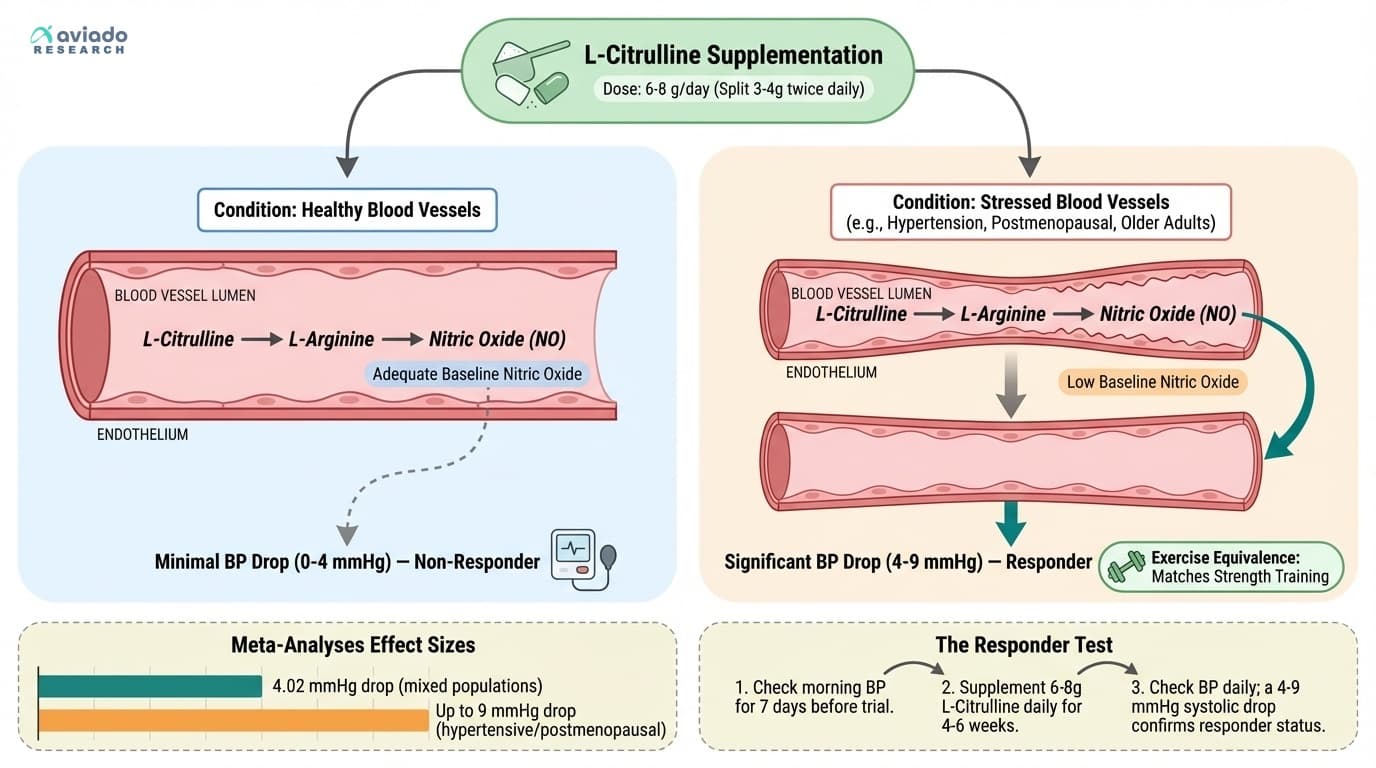
L-Citrulline Cuts Blood Pressure as Effectively as Exercise — But Only If Your Vascular System Responds
Meta-analyses show wildly different effect sizes across trials, suggesting your vascular biology determines whether you're a responder
Diagram glossary
- arginine:
- An amino acid that helps produce nitric oxide to support blood vessel function.
- Citrulline:
- An amino acid that supports nitric oxide signaling and can lower blood pressure.
- FMD:
- A medical test measuring blood vessel dilation to assess overall endothelial function.
- mmHg:
- A standard unit of pressure measurement commonly used to express blood pressure readings.
- SBP:
- Systolic blood pressure, which is the maximum pressure exerted in arteries during a heartbeat.
Conclusions
L-citrulline is not a guaranteed blood pressure fix. It works best when your blood vessels need nitric oxide support. If you have hypertension, are older, or are postmenopausal, your odds of benefit are higher. The practical approach is a 4–6 week self-trial at 6–8 grams per day with daily morning readings. If your systolic pressure falls by 4–9 mmHg, it is worth continuing. If it does not, stop and focus on proven basics like exercise, sleep, diet, and medical care.
Most trials run 4–12 weeks, so long-term outcomes are uncertain. Meta-analyses combine different populations, doses, and products (pure citrulline vs. watermelon), which can shrink or inflate average effects. The “responder” idea is supported by patterns across groups, but there is no simple test that predicts your response. Cholesterol and glucose findings come from small or short studies and may not hold in larger trials. If you take blood pressure drugs, have kidney disease, or have low baseline blood pressure, talk with a clinician before using citrulline.
Track this in your stack
See how l citrulline relates to your health goals and monitor changes in your biomarkers over time.