
L-Theanine Works Differently Alone vs. With Caffeine — And Most People Are Taking It Wrong
Understanding When L-Theanine Boosts Focus, When It Calms — and Why the Right Pairing Changes Everything
Most people think L-theanine works the same way every time, but surprising new research shows it has two completely different effects. Take it alone and you get mild relaxation. Take it with caffeine and you get sharp focus instead.
This means your L-theanine might be doing nothing if you're using it wrong. Sleep seekers taking it with morning coffee won't get better rest. Focus seekers taking it solo at night won't get cognitive benefits. You need to match your dose to your goal.
For better sleep, take 200-400 mg L-theanine alone 30-60 minutes before bed. For laser focus without caffeine jitters, take 100 mg L-theanine with 50-100 mg caffeine together in the morning. Don't mix these protocols. Pick one goal, stick to one method, and you'll get real results.
- L-theanine
- A unique amino acid found in tea leaves that produces different effects when taken alone (relaxation) versus with caffeine (focus enhancement).
- SMD (Standardized Mean Difference)
- A statistic used in meta-analyses to show the size of a treatment effect across studies; 0.2 is small, 0.5 is medium, 0.8 is large.
- Meta-Analysis
- A statistical technique combining results from multiple studies to find overall patterns.
- Context-sensitive supplement
- A supplement whose effects change dramatically based on what it's paired with or when it's taken.
- Reaction Time
- The speed at which someone can respond to a visual or auditory signal; faster times indicate better cognitive performance.
- Nootropic
- Substances that enhance cognitive function, particularly memory, creativity, or motivation.
- Actigraphy
- Objective sleep measurement using wearable devices that track movement patterns to determine sleep efficiency and quality.
- ADHD
- A neurodevelopmental disorder characterized by persistent patterns of inattention, hyperactivity, and impulsivity.
- Caffeine
- A central nervous system stimulant that increases alertness and prevents fatigue.
- Theanine
- An amino acid found in tea that promotes relaxation and enhances cognitive focus.
Why L-Theanine Isn’t Just a ‘Chill Pill’
L-theanine has earned a reputation as a natural relaxation aid, mostly because it’s the calming compound in green tea. But research over the past five years shows that this is only half the story. L-theanine acts as a context-sensitive supplement: its effects change dramatically depending on what you pair it with. Alone, it produces only mild relaxation and small improvements in sleep quality. In fact, a major meta-analysis found the benefit for sleep is real but modest — not the knockout many users expect [15].
But when L-theanine is taken alongside caffeine — and at the same time — its role shifts. Instead of just relaxing you, it sharpens focus, improves attention, and reduces the negative side effects of caffeine, like the jitters or post-coffee crash [5, 11, 12]. It’s this dual mode of action that separates L-theanine from most other relaxation supplements. The trick is knowing which 'version' you’re actually using.
The Evidence: Alone vs. Combined With Caffeine
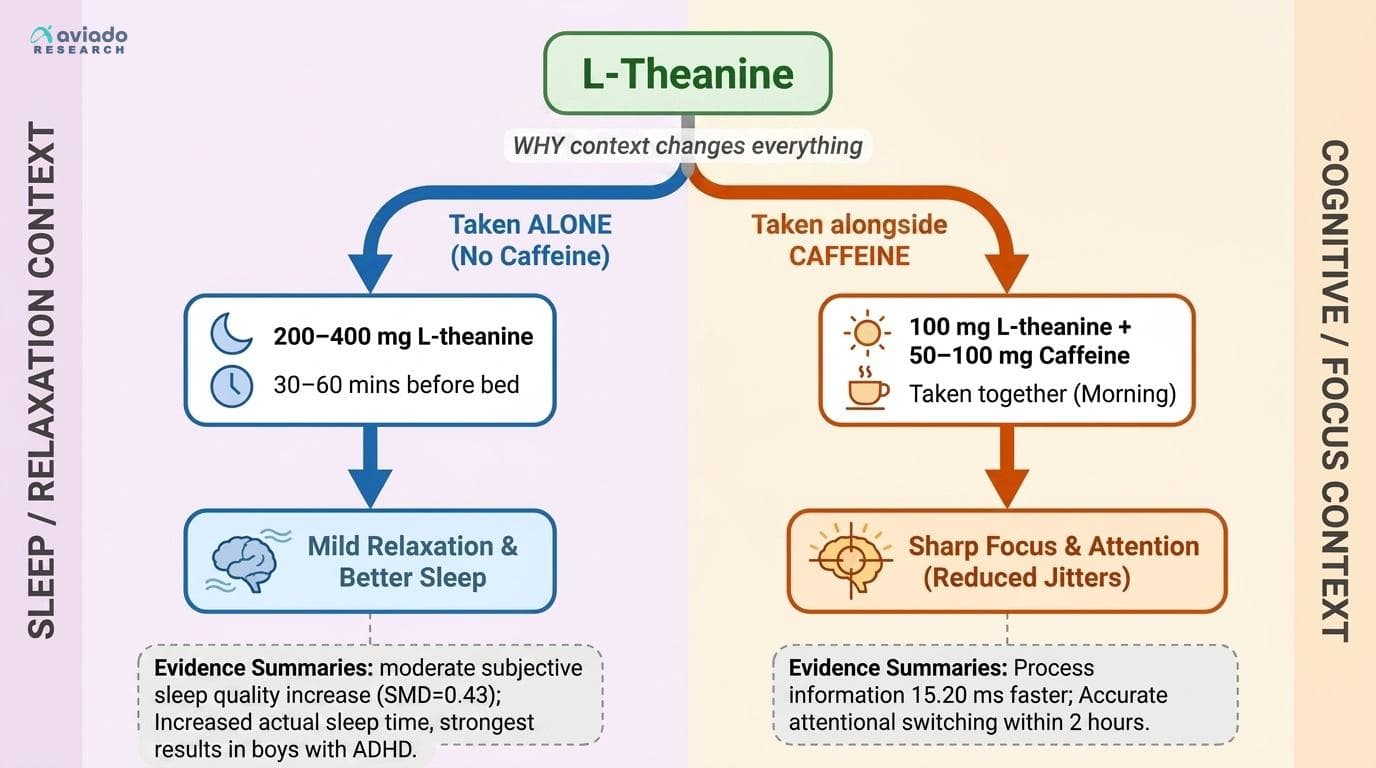
The evidence shows L-theanine alone produces modest sleep improvements. A 2025 meta-analysis of 12 studies with 897 participants found L-theanine increased subjective sleep quality scores by a moderate amount (SMD=0.43). The strongest results came in boys with ADHD, where 400 mg daily increased actual sleep time and efficiency measured by wearable devices.
But pair L-theanine with caffeine and everything changes. Multiple meta-analyses show the combo delivers measurable cognitive benefits that neither compound produces alone. Studies using 100 mg L-theanine with 50-100 mg caffeine found people processed information 15.20 milliseconds faster and switched between tasks more accurately within 2 hours of dosing. This isn't just feeling less jittery—it's actual performance enhancement that shows up on objective tests.
How to Match L-Theanine Protocols to Your Goals
The biggest mistake most users make is treating L-theanine like a one-size-fits-all supplement. But the research is clear: if you want better sleep, use L-theanine solo. If you want sharper focus and less caffeine-induced anxiety, use it with caffeine — at the same time, in the same dose.
For sleep or nighttime relaxation, research supports 200–400 mg of L-theanine, taken 30–60 minutes before bed [15]. For cognitive benefits, the sweet spot is 100 mg L-theanine with 50–100 mg caffeine, taken together in the morning or early afternoon [5, 11]. Avoid combining these protocols — taking L-theanine at night and with caffeine during the day is fine, but don’t expect one dose to deliver both effects. Matching your protocol to your goal can mean the difference between small, barely noticeable results and real, measurable benefits.
Why the Science (and Hype) Sometimes Clash
It’s easy to see why so many people feel confused about whether L-theanine 'works.' Media coverage and supplement marketing often ignore the context: are people taking it alone or with caffeine? Are they looking for relaxation or sharper focus? The latest research community consensus is that context matters — a lot [12]. That’s why sleep studies, cognitive trials, and consumer experiences sometimes seem to contradict each other.
The bottom line: L-theanine is not just a generic calming agent. Its effects depend on your goal and your protocol. If you want reliable results, treat L-theanine as a two-mode supplement — and audit your use accordingly.
L-Theanine Works Differently Alone vs. With Caffeine — And Most People Are Taking It Wrong
Understanding When L-Theanine Boosts Focus, When It Calms — and Why the Right Pairing Changes Everything
Diagram glossary
- ADHD:
- A neurodevelopmental disorder characterized by persistent patterns of inattention, hyperactivity, and impulsivity.
- Caffeine:
- A central nervous system stimulant that increases alertness and prevents fatigue.
- Theanine:
- An amino acid found in tea that promotes relaxation and enhances cognitive focus.
Conclusions
L-theanine’s benefits depend entirely on how and when you take it. Used alone, it offers a gentle boost to sleep quality and calm; paired with caffeine, it becomes a powerful cognitive enhancer that smooths out the downsides of stimulants. Most users get the best results by intentionally matching their L-theanine protocol to their personal goal — not treating it as a one-size-fits-all pill. For sleep, take 200–400 mg solo before bed. For focus, pair 100 mg L-theanine with 50–100 mg caffeine, taken together. This context-sensitive approach unlocks the real value of L-theanine — and makes sense of the conflicting research.
While research on L-theanine is growing, some gaps remain. The sleep benefits, though statistically significant, are only moderate and may not be noticeable for everyone. Most of the strongest cognitive data comes from acute, single-dose studies in healthy adults — long-term effects are less certain. Evidence in special populations (like ADHD or older adults) is promising but limited. Many commercial supplements bundle L-theanine with other compounds, making it difficult to know if benefits come from L-theanine itself. Finally, individual responses vary: not everyone feels the same boost, even at evidence-based doses.
Track this in your stack
See how l theanine relates to your health goals and monitor changes in your biomarkers over time.