
Lion's Mane Works Chronically, Not Acutely — But Most People Are Dosing It Wrong
Why timing and duration, not dose size, determine whether you'll see cognitive benefits
The surprising truth is Lion’s Mane rarely works in one day. Most people take it like coffee. They expect a fast brain boost.
What this means for you is simple. If you want results, think weeks. Use it daily, not “as needed.” You may notice clearer thinking and better memory over time.
Use 500–1,000 mg daily of a standardized extract. Keep going for at least 28 days in a row. You can try 250 mg twice daily if you prefer. Recheck your score at day 28 and day 56.
- Mane
- A branded lions mane extract name used to identify a specific standardized product in clinical trials. Products with different brand names can use different plant parts, extraction methods, or active-
- Standardized extract
- A plant extract made to contain a consistent amount of a target compound in every dose.
- PHQ-9
- A 9-item mood questionnaire used to track depressive symptoms over time.
- Erinacines
- Erinacines are bioactive compounds found primarily in the mycelium of Lion’s Mane mushroom that are studied for their potential to stimulate nerve growth-related pathways in the brain. They are though
- Mushroom powder (non-extract)
- Ground mushroom with variable potency; often less concentrated than extracts.
- Nerve Growth Factor (NGF)
- A protein that supports neuron growth and survival; changes tend to take time.
- Mini-Mental State Examination (MMSE)
- A 30-point cognitive test used in trials; higher scores reflect better cognition.
- caffeine
- A central nervous system stimulant that rapidly alters neurotransmitter activity to enhance alertness.
- NGF
- A protein that promotes the growth, maintenance, and survival of nerve cells.
- PMID
- A unique reference number assigned to biomedical articles in the PubMed database.
The Acute Dosing Myth: Why Single Doses Don't Work
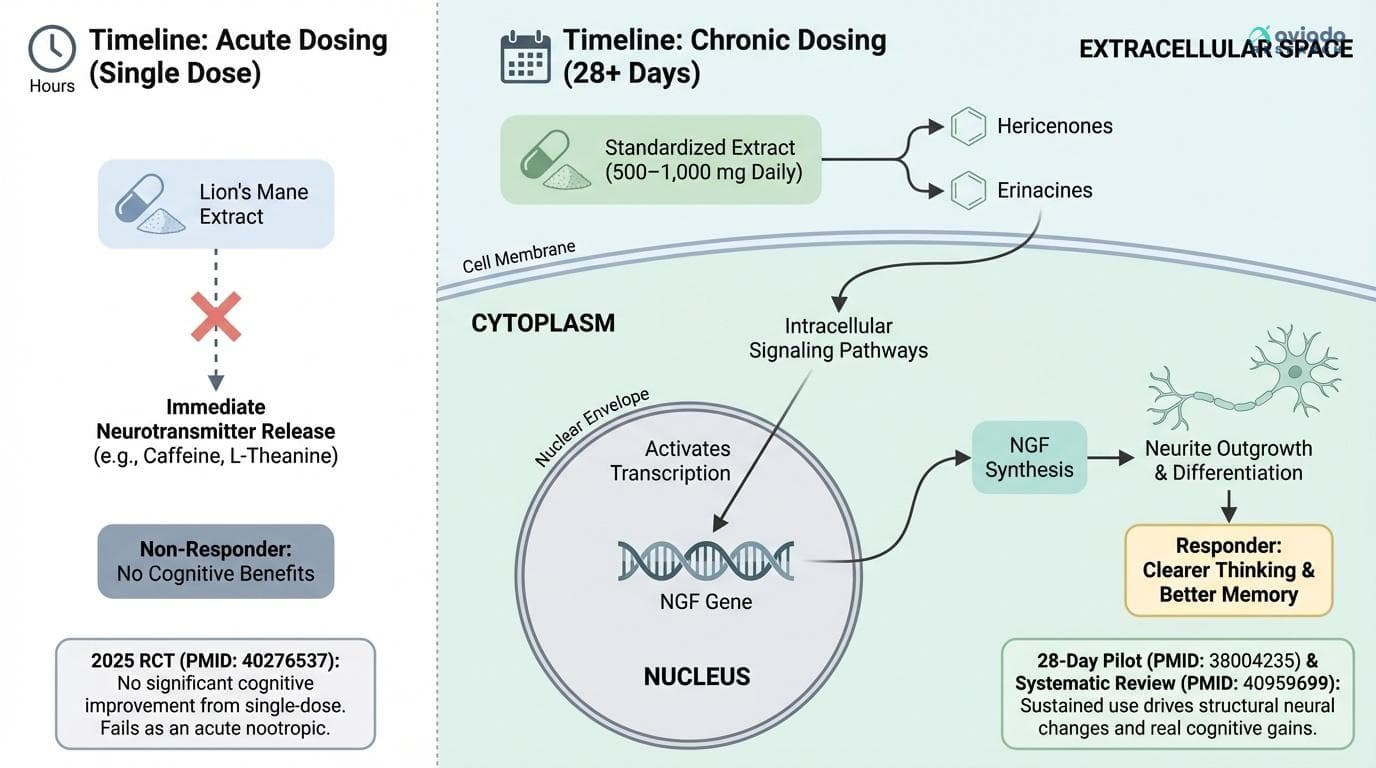
A 2025 randomized controlled trial directly tested how most people actually use Lion's Mane — as a single-dose cognitive enhancer — and found no significant effects on cognitive performance [1]. Participants received a standardized Lion's Mane extract and completed cognitive assessments, but showed no improvements compared to placebo. This wasn't due to insufficient dosing or poor study design; it reflects the fundamental mismatch between how Lion's Mane works biologically and how consumers expect it to work.
The problem lies in treating Lion's Mane like a traditional nootropic. Most cognitive enhancers — caffeine, L-theanine, even prescription stimulants — work by immediately altering neurotransmitter activity. You take them, they bind to receptors, and you feel different within hours. Lion's Mane operates through an entirely different mechanism that requires time to manifest.
This explains the widespread confusion in online reviews and forums, where users report everything from 'life-changing focus' to 'complete waste of money' for the same product. The difference isn't individual genetics or product quality — it's whether someone used it long enough for the underlying biological process to occur.
The NGF Pathway: Why Lion's Mane Needs Weeks, Not Hours
Lion’s Mane is not an “instant nootropic.” In a 2025 randomized controlled trial, a single dose of a standardized Lion’s Mane extract did not improve cognitive test performance versus placebo [1]. That result matches what many people feel: no obvious same-day change.
This is the key mismatch. Many brain boosters work fast because they change neurotransmitter signaling quickly. Lion’s Mane is studied more for longer-term nerve support pathways, which are slower.
So the split in reviews makes sense. People who take it sporadically often feel nothing. People who take it daily for weeks are more likely to notice changes they can track.
The 28-Day Evidence: What Chronic Use Actually Delivers
Lion’s Mane contains hericenones and erinacines, two compound families studied for neurotrophic effects [2]. In lab research, Lion’s Mane preparations can stimulate pathways linked to nerve growth factor (NGF) activity [2]. NGF is tied to neuron survival and new connections, which is a slow process.
That timeline matters for your expectations. Structural and growth-related changes do not show up in hours. They build across days and weeks.
Cell and neuron models also show neurite outgrowth and differentiation after sustained exposure, not one-off contact [2]. This lines up with human trials that only see benefits after longer use.
Dosing Protocols: How to Use Lion's Mane Correctly
When Lion’s Mane works in clinical research, it usually works with time. A 2025 systematic review of 5 RCTs and 3 pilot trials found improved cognitive function, with MMSE scores increasing by a weighted mean of 1.17 points [3]. These effects showed up in longer protocols, not single-dose designs.
A 2023 double-blind pilot study in young adults also tested timing. Single doses did not produce cognitive changes. Daily use for 28 days did show measurable improvements on cognitive testing, alongside reported gains in mental clarity and focus [4].
Overall, the pattern is consistent. Benefits show up more in memory and sustained attention tasks than in quick reaction-time tasks. That fits a slower, growth-and-connection model rather than a fast stimulant-like effect.
Lion's Mane Works Chronically, Not Acutely — But Most People Are Dosing It Wrong
Why timing and duration, not dose size, determine whether you'll see cognitive benefits
Diagram glossary
- caffeine:
- A central nervous system stimulant that rapidly alters neurotransmitter activity to enhance alertness.
- NGF:
- A protein that promotes the growth, maintenance, and survival of nerve cells.
- PMID:
- A unique reference number assigned to biomedical articles in the PubMed database.
- theanine:
- An amino acid often used as a cognitive enhancer to modulate neurotransmitter activity.
Conclusions
Lion’s Mane is better treated like a daily brain-support protocol, not a quick pick-me-up. The best evidence points to a simple rule: single doses do not move the needle, but consistent daily use over at least 28 days can improve cognitive test scores and perceived mental clarity. If you take it, prioritize a standardized extract, pick a dose you can sustain, and track results at day 28 and day 56.
Much of the clinical evidence is in older adults or people with mild cognitive impairment, so results may differ in healthy younger users. Trials vary in the exact extract used and how (or whether) hericenones and erinacines are quantified, which limits apples-to-apples comparisons across products. Longer-term questions remain, including the best duration beyond 28 days and how long benefits last after stopping.
Track this in your stack
See how lions mane relates to your health goals and monitor changes in your biomarkers over time.