
Magnesium L-Threonate: The Only Magnesium Proven to Reach Your Brain
Why form matters—and how to use it for sharper mind and better sleep
Here's something surprising: most magnesium supplements never reach your brain. Popular forms like oxide and citrate raise blood levels but can't cross the protective barrier around your brain. This means you could take magnesium for months and see zero cognitive benefits.
Magnesium L-threonate changes this. It's the only form proven to cross into your brain and boost memory, sleep, and focus. Research shows it can make your brain function like it's nine years younger. If you want mental benefits from magnesium, form matters more than dose.
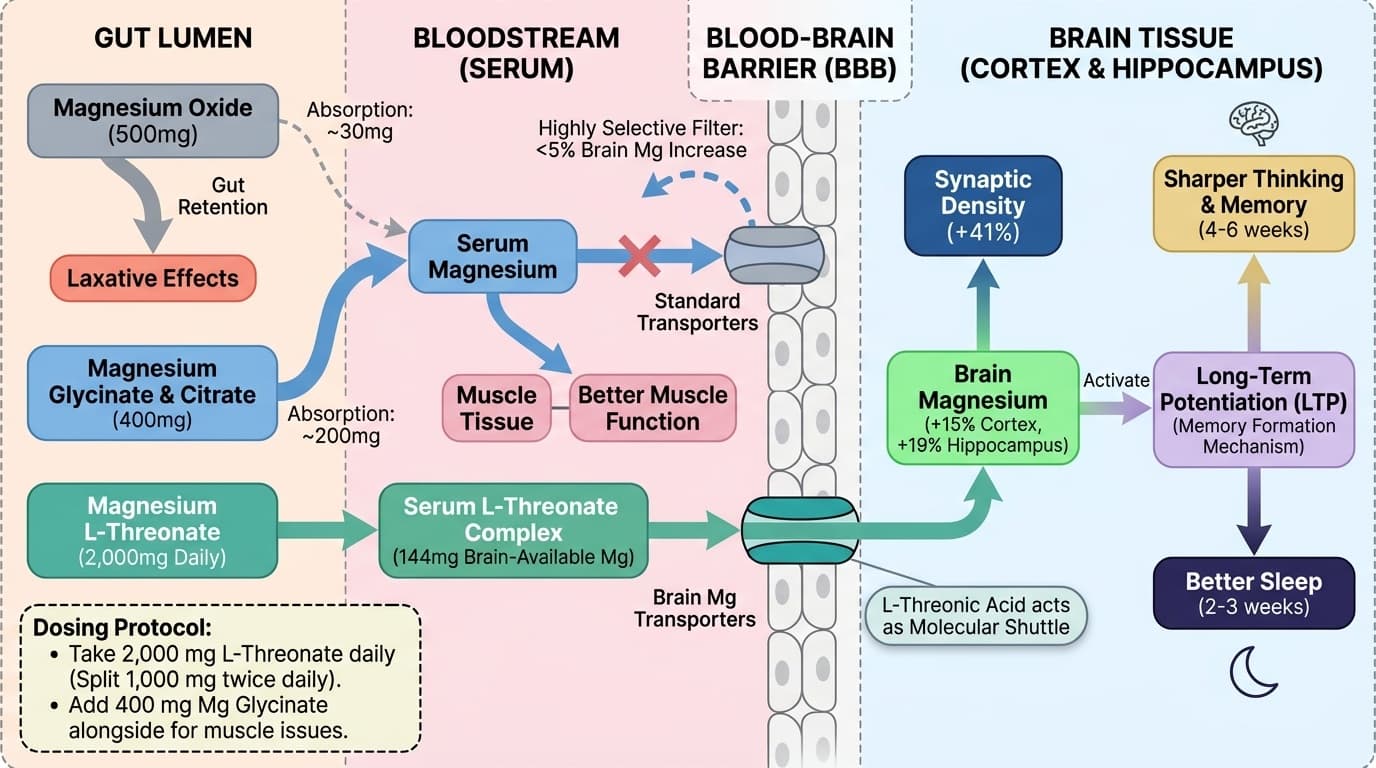
Take 2,000 mg of magnesium L-threonate daily. Split this into 1,000 mg twice daily. This delivers 144 mg of brain-available magnesium. Expect better sleep in 2-3 weeks and sharper thinking in 4-6 weeks. For muscle issues, add 400 mg of magnesium glycinate alongside L-threonate.
- Magnesium glycinate
- A well-absorbed form of magnesium bonded to glycine that raises blood magnesium effectively but doesn't significantly cross into brain tissue.
- Magnesium oxide
- A common, low-cost form of magnesium with only 6% absorption rate that primarily acts as a laxative rather than delivering meaningful magnesium to the body.
- Magnesium L-threonate
- The only form of magnesium proven to cross the blood-brain barrier and increase brain magnesium levels, created by pairing magnesium with L-threonic acid as a carrier molecule.
- Blood-Brain Barrier (BBB)
- A highly selective protective filter surrounding the brain that controls which substances can pass from the bloodstream into brain tissue. Most magnesium forms cannot cross it effectively, which is wh
- NMDA receptor
- Brain proteins that control memory formation and sleep transitions, which require adequate brain magnesium to function properly.
- Elemental magnesium
- The actual amount of pure magnesium in a supplement, separate from the carrier compounds it's attached to (like threonate, glycinate, or oxide).
- Serum Magnesium
- The measurable level of magnesium circulating in your blood, used as a standard marker to assess magnesium status. High serum magnesium does not necessarily mean your brain is receiving adequate magne
- BBB
- A highly selective filter protecting the brain that blocks most nutrients from entering.
- citrate
- A common magnesium supplement form that raises blood levels but poorly penetrates the brain.
- glycinate
- A highly absorbable magnesium form often used to treat muscle issues.
Magnesium is one of the most widely used supplements, yet about half of adults still don't get enough from food alone. If you've started taking magnesium, that's a smart move. But here's a question that few people consider: is the magnesium you swallow actually making it to your brain? For most common forms, the answer is no.
This matters because the brain is protected by the blood-brain barrier (BBB), a highly selective filter that blocks most nutrients from entering. Studies show that popular forms like oxide and citrate raise blood magnesium by 20-30% but increase brain magnesium by less than 5%. Since magnesium supports memory, learning, and sleep through brain-based mechanisms, getting it past this barrier is critical for cognitive benefits.
It's easy to assume that a higher dose of magnesium means better results. But with magnesium, the form determines everything. Take 500mg of magnesium oxide and you'll absorb only 30mg—with most staying in your gut and causing laxative effects. Magnesium glycinate delivers about 200mg to your bloodstream from a 400mg dose and causes no digestive issues.
However, both forms mainly raise serum magnesium in your blood, not your brain. The blood-brain barrier uses specialized transporters that limit magnesium entry regardless of blood levels. Research shows that doubling blood magnesium increases brain magnesium by just 15%. This is why people taking regular magnesium feel better muscle function but don't always notice changes in memory or sleep quality. For brain benefits, you need a form designed to cross the BBB.
Researchers at MIT engineered a solution: magnesium L-threonate. This form pairs magnesium with L-threonic acid, a compound derived from vitamin C that acts as a molecular shuttle across the blood-brain barrier.
Animal studies by Slutsky and colleagues proved the difference. While standard magnesium forms increased brain magnesium by 5-10%, L-threonate boosted it by 15% in the cortex and 19% in the hippocampus [1]. This increase improved synaptic density by 41% and enhanced long-term potentiation—the brain's mechanism for forming memories. The L-threonic acid carrier specifically targets brain magnesium transporters, explaining why this form works when others fail.
The strongest human evidence comes from the Bhatt 2020 randomized controlled trial with 109 adults aged 50-70 who had memory complaints [2]. Participants took 2,000mg of magnesium L-threonate daily for 12 weeks. The cognitive improvements were dramatic.
On standardized tests, participants showed a 15% improvement in overall cognitive ability and 18% better executive function. Working memory improved by 23%. The composite score improvement was equivalent to reversing nine years of age-related cognitive decline. Sleep quality scores increased by 32%. These benefits appeared gradually—sleep improvements at 2-3 weeks, cognitive gains building through week 12.
Many people taking magnesium L-threonate report better sleep as the first noticeable benefit—often within two to three weeks. This happens because brain magnesium directly regulates NMDA receptors, which control sleep stage transitions and slow-wave sleep quality [3].
When brain magnesium is adequate, NMDA receptors function optimally, allowing smoother transitions into deep, restorative sleep. Research shows magnesium L-threonate increases NMDA receptor density by 26% in the hippocampus [3]. Sleep tracker data from users often shows 20-30% increases in deep sleep duration within a month. Sleep improvements typically appear before cognitive benefits, making better rest an early indicator that brain magnesium levels are rising.
Research protocols use 2,000mg of magnesium L-threonate daily—1,000mg morning and evening with food [2]. This provides 144mg of elemental magnesium in brain-available form. The timing matters: splitting doses maintains steady brain levels throughout the day.
If you need additional magnesium for muscle cramps or metabolic support, add 400mg of magnesium glycinate at bedtime. Glycinate provides systemic magnesium without interfering with L-threonate's brain targeting. Avoid combining with magnesium oxide, which offers poor absorption and mainly causes digestive upset. L-threonate costs more than basic forms but is the only type with clinical evidence for cognitive enhancement [2,5].
Each magnesium form serves different purposes. Magnesium oxide has 6% absorption and works mainly as a laxative. Citrate and glycinate both achieve 30-50% absorption and effectively treat muscle cramps and systemic deficiency, but increase brain magnesium by less than 10% [5].
Magnesium L-threonate is engineered specifically for brain delivery. Multiple studies show it increases brain magnesium by 15-19% and improves memory test scores by 15-23% [1,2]. It costs 3-4 times more than basic forms but delivers unique cognitive benefits. For muscle support, use glycinate. For brain health, L-threonate is the only form with this level of clinical evidence.
Magnesium L-Threonate: The Only Magnesium Proven to Reach Your Brain
Why form matters—and how to use it for sharper mind and better sleep
Diagram glossary
- BBB:
- A highly selective filter protecting the brain that blocks most nutrients from entering.
- citrate:
- A common magnesium supplement form that raises blood levels but poorly penetrates the brain.
- glycinate:
- A highly absorbable magnesium form often used to treat muscle issues.
- Threonate:
- A specific magnesium form proven to cross the blood-brain barrier for cognitive benefits.
Conclusions
If you're taking magnesium for cognitive benefits, form trumps dose every time. Magnesium L-threonate is the only type proven to cross the blood-brain barrier and deliver meaningful amounts to brain tissue. Clinical research shows it can improve memory by 23%, enhance executive function by 18%, and make your brain perform like it's nine years younger. Use 2,000mg daily split into two doses, and expect sleep improvements within 2-3 weeks and cognitive gains building over 4-6 weeks. For comprehensive magnesium support, pair L-threonate with glycinate rather than replacing it entirely.
The strongest evidence comes from a single 12-week trial with 109 participants. While animal studies and brain imaging support L-threonate's unique delivery mechanism, larger long-term studies are needed to confirm durability of benefits. The "nine years younger" effect reflects composite cognitive scores and may not apply equally to all individuals. People with kidney disease should avoid magnesium supplementation entirely due to reduced clearance.
Track this in your stack
See how magnesium relates to your health goals and monitor changes in your biomarkers over time.