
Resveratrol Works — But Only If You Have the Right Metabolic Profile
Why metabolic dysfunction—not dose—predicts who benefits from this popular supplement
Resveratrol marketing promises universal anti-aging benefits, but the surprising truth is far more targeted.
This popular supplement only works if you already have metabolic problems like high blood sugar or inflammation. For healthy adults, resveratrol does absolutely nothing—regardless of dose or brand.
Here's what this means for you: Check your fasting glucose, blood pressure, and CRP levels first. If these markers are elevated, resveratrol can cut your fasting glucose by 19 mg/dL and drop blood pressure by 8 points. If your numbers are already healthy, you're wasting your money on resveratrol.
The effective dose is 1000 mg daily with food for people with metabolic dysfunction. Take it for 12 weeks, then retest your markers. If you see no improvement after 3 months of proper dosing, stop taking it. The key is matching your metabolic profile to the supplement—not hoping for magic results when your body doesn't need the fix.
- SIRT1
- A protein known as Sirtuin 1, involved in cellular aging and metabolic regulation. Resveratrol activates SIRT1, which is thought to drive many of its anti-aging and insulin-sensitizing effects.
- Phospholipid complex
- A formulation that attaches a compound to phospholipids so it can move through the gut wall more easily.
- Glucose
- Blood sugar level, the primary energy source for cells. Fasting glucose is normal, prediabetes, ≥126 suggests diabetes.
- Metabolic profile
- A combination of blood markers (such as glucose, cholesterol, and CRP) that shows whether your body has metabolic dysfunction, like insulin resistance or chronic inflammation.
- C-Reactive Protein (cardiac)
- High-sensitivity C-reactive protein, a liver-produced acute-phase reactant. Independent predictor of heart attack and stroke.
- Dose-response relationship
- A concept describing how the effect of a supplement changes with different doses. For resveratrol, higher doses help—but only if you have metabolic dysfunction.
- Hemoglobin A1c
- Average blood sugar over the past 2-3 months by assessing glycated hemoglobin. each 1% increase raises cardiovascular risk by 18%.
- CRP
- A liver protein that serves as a key blood biomarker for systemic inflammation.
- mmHg
- A standard unit of pressure measurement commonly used to quantify blood pressure.
- SBP
- The maximum arterial pressure exerted during the contraction of the heart muscle.
Resveratrol’s Benefits: Not Universal, But Powerful for the Right People
Resveratrol has been hyped as a catch-all supplement for inflammation, aging, and heart health, but the latest research reveals a striking pattern. Massive reviews of clinical trials show that resveratrol's benefits are real and substantial—but only in people with metabolic dysfunction. Adults with obesity, type 2 diabetes, or elevated inflammation markers see dramatic improvements: fasting glucose drops by 19 mg/dL, systolic blood pressure falls by 8 mmHg, and inflammatory markers plummet by clinically significant amounts when taking 1000+ mg daily [41760304, 38374352].
The flip side is equally clear-cut. In healthy adults—especially postmenopausal women without metabolic problems—multiple large-scale reviews found zero measurable effects on glucose, blood pressure, cholesterol, or inflammation markers [40771919, 34666902]. These weren't small studies with inconclusive results. Umbrella meta-analyses covering dozens of trials consistently show the same pattern: resveratrol works powerfully for people with metabolic problems and does nothing for those with normal blood markers.
Why Your Metabolic State Makes You a Resveratrol Responder or Non-Responder
The dramatic difference between responders and non-responders isn't about dosage, brand quality, or delivery method. It's pure biology. Resveratrol's primary mechanism involves activating SIRT1, a protein that regulates insulin sensitivity, inflammation, and cellular aging [40158656]. In people with metabolic dysfunction, SIRT1 activity is suppressed—giving resveratrol a clear target to improve. But in healthy adults, SIRT1 is already running at optimal levels, so additional resveratrol supplementation hits a biological ceiling.
This explains why dose-response studies show a clear pattern: even at very high doses (up to 5000 mg daily), healthy individuals see no improvements in aging markers, blood sugar, or inflammation. Meanwhile, people with elevated baseline markers consistently benefit from doses as low as 500 mg daily, with maximum effects typically seen at 1000-1500 mg [41760304]. This biological gating mechanism makes resveratrol fundamentally different from broadly-acting supplements like magnesium or vitamin D.
How to Tell If Resveratrol Will Work for You: Action Steps
So how do you know if you’re a likely responder? The answer is in your bloodwork. Check your fasting glucose, high-sensitivity CRP, and blood pressure. If any of these are elevated—or if you have a diagnosis of type 2 diabetes, metabolic syndrome, or obesity-related inflammation—then you are in the group that sees strong, reliable benefits from resveratrol. In this population, studies support daily dosing of 1000 mg or more, ideally taken with food or in a phospholipid complex form to improve absorption [41760304, 38374352].
If your metabolic markers are all in the healthy range, current evidence suggests you won’t see meaningful changes from resveratrol, regardless of dose or delivery method. This means that personalizing your supplement strategy—by testing before, during, and after a resveratrol trial—is key. Don’t waste time or money if you’re not in the responder group; but if you are, resveratrol offers one of the most evidence-backed, non-drug options for improving metabolic health.
Mechanism: SIRT1 Activation and the Limits of Supplementation
Resveratrol’s most celebrated effect is its activation of SIRT1, a protein that plays a major role in aging and metabolic regulation. In people with metabolic stress, SIRT1 activity is often low—so resveratrol supplementation can restore balance, leading to lower blood sugar and inflammation. In healthy adults, SIRT1 is already running close to maximum, so extra resveratrol can’t push it further. Recent meta-analyses have quantified this dose-response relationship, showing that only those with room for improvement see benefits [40158656]. This is why resveratrol’s effects are ‘gated’ by your baseline metabolic state, not just how much you take.
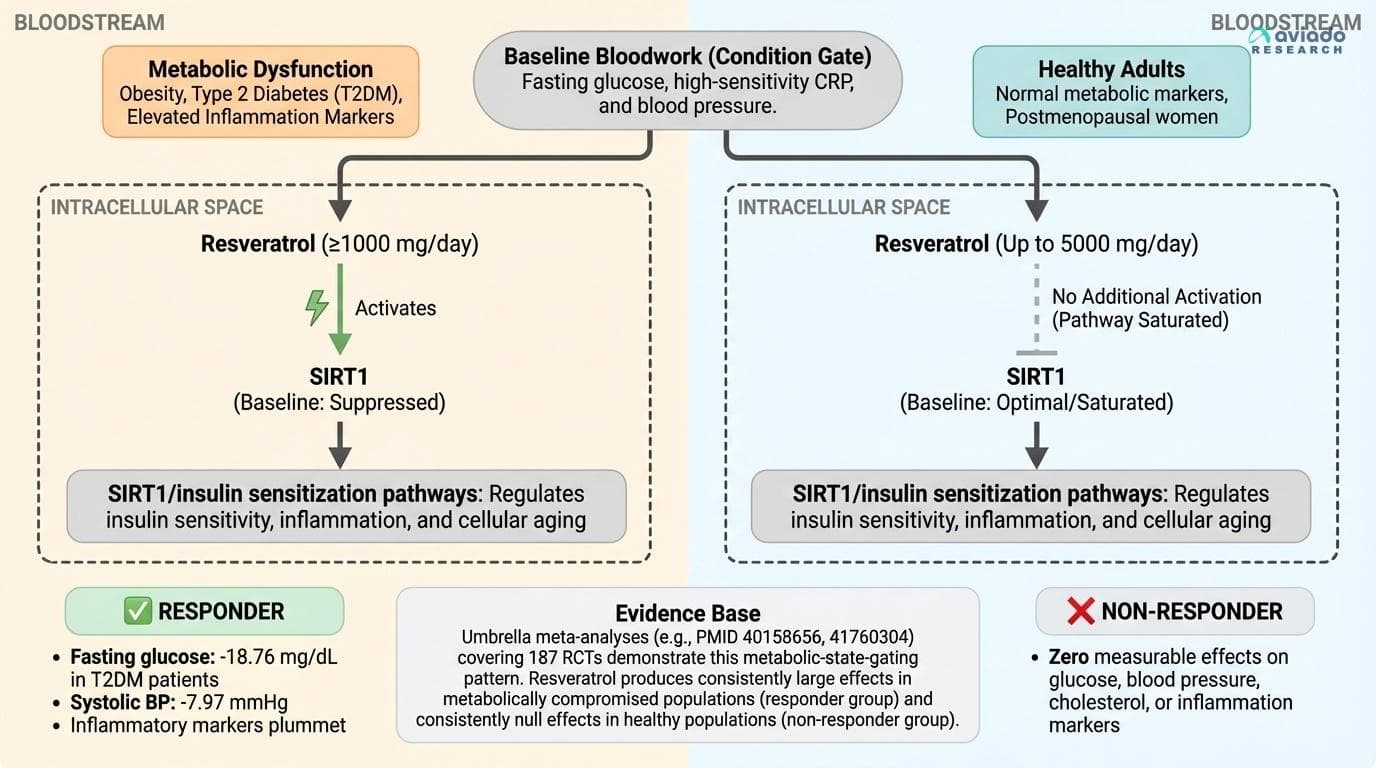
Resveratrol Works — But Only If You Have the Right Metabolic Profile
Why metabolic dysfunction—not dose—predicts who benefits from this popular supplement
Diagram glossary
- CRP:
- A liver protein that serves as a key blood biomarker for systemic inflammation.
- glucose:
- A simple sugar that serves as the primary energy source for the body's cells.
- mmHg:
- A standard unit of pressure measurement commonly used to quantify blood pressure.
- SBP:
- The maximum arterial pressure exerted during the contraction of the heart muscle.
- SIRT1/insulin:
- A cellular signaling pathway that regulates metabolic processes, glucose homeostasis, and aging.
- T2DM:
- A chronic metabolic disorder characterized by insulin resistance and elevated blood sugar levels.
Conclusions
The evidence is unambiguous: resveratrol is a precision tool, not a universal supplement. If you have metabolic dysfunction—elevated glucose, blood pressure, or inflammation—resveratrol at 1000+ mg daily delivers measurable, clinically significant improvements. If your metabolic markers are healthy, resveratrol will do nothing regardless of dose or formulation. The key to success is simple: test your biomarkers before starting, use resveratrol only if you're in the responder group, and retest after 12 weeks to confirm it's working. This targeted approach maximizes both results and cost-effectiveness.
Most meta-analyses to date focus on short- to medium-term outcomes (typically 8–24 weeks), so the long-term effects of resveratrol supplementation remain uncertain. There is also variability in supplement formulations and bioavailability, which may affect individual results. While large effects are seen in metabolically compromised groups, data in younger, healthy adults and non-obese populations consistently show no effect, but sample sizes in some subgroups remain limited. Finally, most studies have not directly compared different delivery methods (such as phospholipid complex or nanoparticle forms), so the optimal formulation for maximum absorption is still an open question.
Track this in your stack
See how resveratrol relates to your health goals and monitor changes in your biomarkers over time.
Sources (5)
This article informs how supplementation moves 2 markers.
Each biomarker page clusters supplements, ranges, and the evidence behind every score. Useful when you're starting from a number, not a goal.
High-sensitivity C-reactive protein. > 3 mg/L associated with chronic systemic inflammation affecting the brain and vasculature.
3-month average blood glucose. Levels >= 5.7% associated with cognitive decline independent of diabetes diagnosis.