
Skin, Hair, and Collagen Health for Men 18-39: The Science of Looking as Good as You Feel
A Comprehensive Guide to Early Action for Lifelong Health and Confidence
Most men think skin aging and hair loss are problems for their 40s and 50s.
This is a surprising misconception. Your collagen production peaks in your mid-20s and drops 1-1.5% every year after that. Hair follicles start shrinking from DHT damage as early as your late teens. By age 35, you've already lost 10-15% of your peak collagen and half of all men show visible hair thinning.
This means the damage you see in your 30s actually started years earlier. Your skin and hair reflect what's happening inside your body. Dull skin and thinning hair signal that your antioxidant defenses, hormone balance, or nutrition are off track. These visible changes are early warning signs that your body is aging faster than it should.
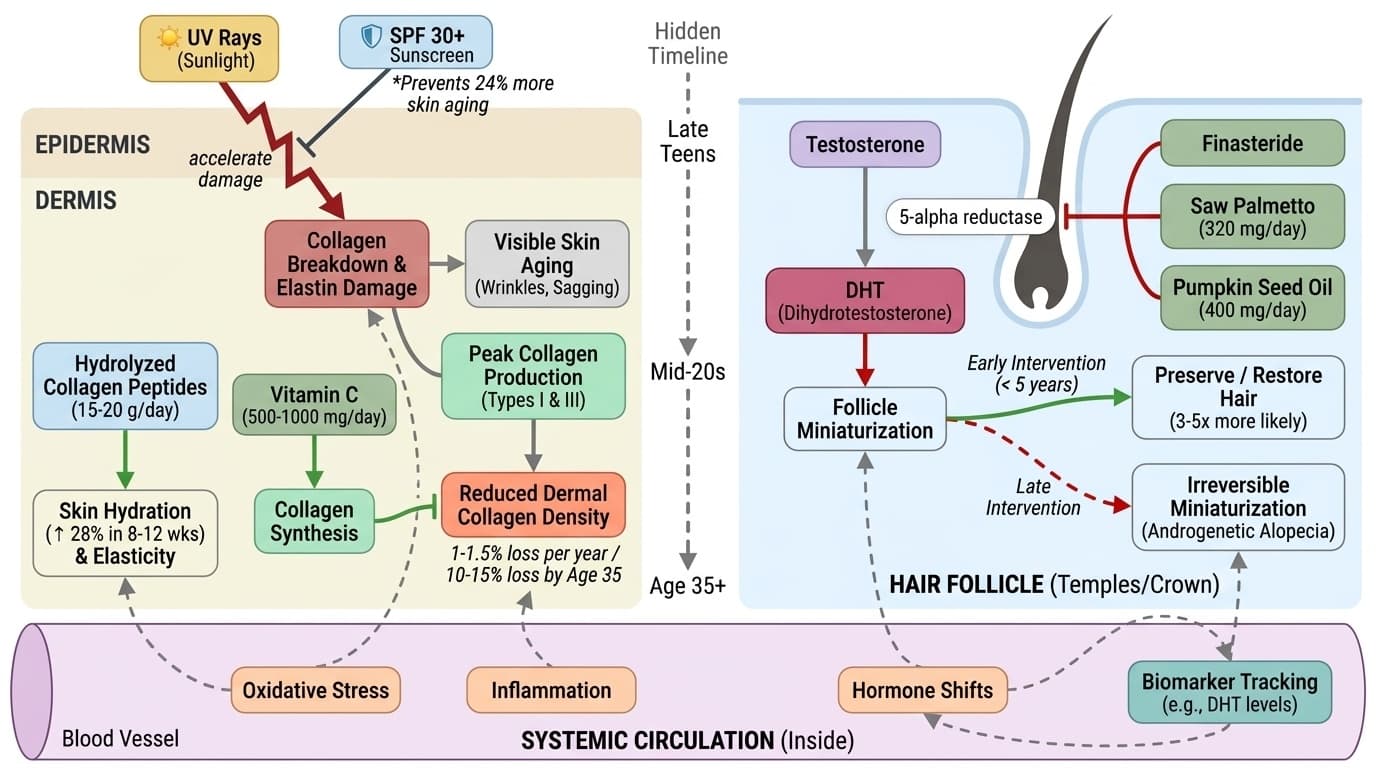
You can take specific steps now to slow this process. Research shows hydrolyzed collagen peptides at 15-20 grams daily improve skin hydration by 28% in 8-12 weeks. Vitamin C at 500-1000 mg daily supports collagen synthesis. Daily SPF 30+ sunscreen prevents 24% more skin aging than sporadic use. For hair, saw palmetto at 320 mg daily or pumpkin seed oil at 400 mg daily can slow DHT-related loss if you start at the first sign of thinning. The earlier you act, the better your results.
- Hydrolyzed Collagen Peptides
- Collagen protein broken down into smaller pieces for better absorption. More effective than regular collagen powder for skin benefits.
- Zinc Oxide
- A mineral compound commonly used as the active ingredient in physical (mineral) sunscreens that works by sitting on top of the skin and reflecting or scattering UV rays, rather than absorbing them
- C-Reactive Protein (cardiac)
- High-sensitivity C-reactive protein, a liver-produced acute-phase reactant. Independent predictor of heart attack and stroke.
- Androgenetic Alopecia
- The medical term for male pattern hair loss, caused by a combination of genetic factors and the hormone DHT shrinking hair follicles over time. It typically starts with thinning at the temples or crown
- Collagen
- A protein that gives your skin firmness and strength.
- 5-alpha reductase inhibitor
- A substance that lowers DHT by blocking an enzyme in your body.
- SPF (Sun Protection Factor)
- A number that shows how well a sunscreen protects you from UV rays.
- DHT
- Dihydrotestosterone is an androgen hormone linked to male pattern hair loss and follicle shrinkage.
- elastin
- A highly elastic protein in connective tissue that allows skin to resume its shape.
- finasteride
- A medication used to treat male pattern hair loss by inhibiting DHT production.
- peptide
- A short chain of amino acids that serves as a building block for proteins.
- SPF
- Sun protection factor is a measure of how well sunscreen blocks ultraviolet radiation.
You might think skin aging and hair loss are concerns for later in life. In reality, these processes begin in your late teens and accelerate through your 20s and 30s. Collagen, the protein that keeps your skin firm and youthful, reaches its peak production in your mid-20s. After that, your body makes about 1-1.5% less each year. By age 35, most men have lost 10-15% of their peak collagen production. This slow decline is invisible at first, but the effects add up quickly.
The story is similar for hair. Androgenetic alopecia—male pattern hair loss—starts with subtle thinning at the temples or crown, sometimes as early as your late teens. The Norwood-Hamilton studies show that progression is fastest between ages 20 and 35. By age 25, about 1 in 4 men already see hair thinning. By 35, it is half of all men [7]. Waiting until you see obvious changes means you are already years behind. The damage to your hair follicles and skin structure is often happening long before you can see it in the mirror.
Why does this matter? Because skin and hair are not just about looks. They provide a visible readout of your internal health—signs of inflammation, oxidative stress, and hormone shifts. These issues show up first on the outside, but they are changing your overall health from the inside out. Recognizing and acting on early signs gives you the power to slow down the clock. In the next section, you'll learn how sun exposure, hormones, and nutrition drive these changes—and what you can do to gain the upper hand.
You might not notice when your collagen levels drop, but the effects are happening under your skin every day. Collagen types I and III are the main proteins that keep your skin strong and elastic. As mentioned, production peaks around your mid-20s, then drops by about 1-1.5% per year. This loss is slow but relentless. By age 35, you have already lost a significant portion of your youthful foundation.
The biggest accelerant of visible aging is sunlight—specifically, ultraviolet (UV) rays. A 2019 study in the Journal of Dermatological Science found that men aged 30-35 who had years of chronic sun exposure without protection had the same dermal collagen density as men 15 years older [1]. This means the sun can speed up your skin's aging process dramatically. The changes you see in your 30s—wrinkles, sagging, uneven pigment—are the result of damage that started years earlier. This process, called photoaging or dermatoheliosis, involves not only collagen breakdown but also elastin damage and increased inflammation.
The timeline matters. Once collagen is lost, it is very slow to rebuild. Most interventions, including supplements and topical treatments, take months to show measurable improvement. For example, studies suggest that collagen peptide supplementation improves skin hydration and elasticity over 8-12 weeks [3]. UV protection, on the other hand, prevents further loss immediately. The earlier you start, the more of your youthful appearance you keep. Next, we’ll explore why hair loss follows its own timeline—and why waiting to address it almost always means worse results.
Hair loss in men is driven primarily by a hormone called DHT (dihydrotestosterone). DHT is made from testosterone by an enzyme called 5-alpha reductase. In hair follicles, especially those at the temples and crown, DHT causes the follicles to shrink and produce thinner hair over time—a process called miniaturization. This starts in your late teens or early 20s for many men, and the progression is most rapid through your 20s and early 30s [7].
The key insight is that early intervention is much more effective than waiting. A 2015 study in the Journal of the American Academy of Dermatology found that starting treatment within the first five years of noticeable thinning is three to five times more likely to preserve or restore hair than starting after significant loss has occurred [2]. Once a follicle has been miniaturized for a long time, it often cannot be revived. This is why men who maintain fuller hair into their 40s and 50s are usually those who acted at the first signs of thinning.
DHT levels can be measured directly, giving you a baseline for tracking the effect of treatments—either medications like finasteride or natural DHT blockers like saw palmetto and pumpkin seed oil. It is also important to monitor other key biomarkers, as hormonal shifts do not act in isolation. Tracking and adjusting early gives you the best shot at keeping your hair and your confidence high. Up next, we’ll discuss the essential biomarkers every man in this age group should know for skin and hair health.
To optimize your skin, hair, and collagen health, you need to track the biomarkers that reveal the real story inside your body. Here are the most important ones for men aged 18-39:
1. Vitamin D (25-OH): Sun exposure creates vitamin D, but also damages collagen. Men who use sunscreen or avoid sun can become deficient. Vitamin D is critical for healthy hair follicle cycles and immune defense in the skin. The standard range is 30-100 ng/mL, but the optimal range for both skin and hair is 40-60 ng/mL. Supplementation or regular testing is recommended if you avoid midday sun.
2. Ferritin: Often overlooked in men, ferritin reflects your stored iron. Levels below 40 ng/mL are linked to increased hair shedding (telogen effluvium). For optimal hair health, aim for 70-100 ng/mL. Ferritin can be raised with iron-rich foods or supplements, but excess iron can be harmful—so retest after 3-6 months.
3. Zinc: Essential for keratin (hair protein) formation, wound healing, and oil gland function. Deficiency leads to thinning hair, slow healing, and more acne. Serum zinc should be 80-120 mcg/dL for optimal results, with RBC (red blood cell) zinc tests being more accurate. Zinc interacts with copper and iron; balance is key.
4. Thyroid Panel (TSH, free T3, free T4): Both low and high thyroid hormone can cause hair loss and skin changes. Standard TSH range is up to 4.5 mIU/L, but optimal is 1.0-2.5 mIU/L. Adjusting thyroid function can take 4-8 weeks to show changes in skin and hair.
5. DHT: High DHT is linked to faster hair loss. Measuring before and during intervention helps track progress, especially if using DHT blockers.
6. hs-CRP: This marker of inflammation should be below 0.5 mg/L. Elevated levels accelerate skin aging and slow wound repair. Lowering hs-CRP with lifestyle, nutrition, and supplements can improve both inner and outer health.
Tracking these markers helps you spot problems early and fine-tune your interventions. Next, we’ll dig into the supplements and strategies backed by the strongest evidence for this age group.
To optimize your skin, hair, and collagen health, you need to track the biomarkers that reveal what's happening inside your body. Here are the most important ones for men aged 18-39:
Vitamin D (25-OH): Sun exposure creates vitamin D but damages collagen. Men who use sunscreen or avoid sun often become deficient. Vitamin D drives healthy hair follicle cycles and immune defense in skin. Standard range is 30-100 ng/mL, but optimal for skin and hair is 40-60 ng/mL. Test every 6 months if you avoid midday sun.
Ferritin: Your stored iron levels. Ferritin below 40 ng/mL causes increased hair shedding. For optimal hair health, target 70-100 ng/mL. You can raise ferritin with iron-rich foods or supplements, but excess iron harms organs. Retest after 3-6 months of supplementation.
Zinc: Essential for keratin formation, wound healing, and oil gland function. Deficiency causes thinning hair, slow healing, and more acne. Target serum zinc of 80-120 mcg/dL. RBC zinc tests are more accurate than serum. Zinc competes with copper and iron for absorption.
Thyroid Panel (TSH, free T3, free T4): Both low and high thyroid hormones cause hair loss and skin changes. Standard TSH range goes up to 4.5 mIU/L, but optimal is 1.0-2.5 mIU/L. Thyroid changes take 4-8 weeks to show effects on skin and hair.
DHT: High DHT accelerates hair loss. Measuring before and during treatment tracks your progress with DHT blockers like saw palmetto or pumpkin seed oil.
hs-CRP: This inflammation marker should stay below 0.5 mg/L. Elevated levels speed skin aging and slow wound repair. Lowering hs-CRP through nutrition and supplements improves both appearance and health.
Tracking these markers helps you catch problems early and adjust your protocol. Next, we'll explore the supplements backed by the strongest evidence for this age group.
Research shows specific supplements can support your skin and hair from the inside out—especially when you start early. Here's what works best for men 18-39, with exact mechanisms and dosages:
Hydrolyzed Collagen Peptides (15-20g daily, Types I and III): Hydrolyzed means broken down for better absorption. Double-blind studies show this dose taken for 8-12 weeks increases skin hydration by 28%, elasticity by 15%, and reduces wrinkle depth. Collagen works best with 50 mg vitamin C, which your body needs to build new collagen. Verisol and PEPTAN brands have the most research data.
Vitamin C (500-1000 mg daily): Required for the enzyme that cross-links collagen fibers. Also fights UV-induced free radicals. Deficiency blocks collagen production completely. Both oral supplements and topical L-ascorbic acid (10-20%) are proven effective. Skin improvements appear in 4-8 weeks with consistent use.
Saw Palmetto (320 mg daily, liposterolic extract) + Pumpkin Seed Oil (400 mg daily): Both block 5-alpha reductase naturally, lowering DHT with fewer side effects than pharmaceuticals. A 24-week study found pumpkin seed oil improved hair density by 60%. Meta-analyses show saw palmetto has significant anti-androgenic effects. Start at first signs of thinning for best results.
Astaxanthin (4-12 mg daily): This carotenoid antioxidant is 6000 times stronger than vitamin C for fighting singlet oxygen. Human trials show improvements in skin elasticity, wrinkle depth, and UV resistance after 6-8 weeks. It provides internal photoprotection, acting like sunscreen from inside your body.
Daily Sunscreen (SPF 30+, broad spectrum): The single most effective anti-aging intervention. A landmark 4.5-year study found daily users had 24% less skin aging than occasional users. Choose mineral formulas (zinc oxide/titanium dioxide) or modern clear versions for daily wear, regardless of weather.
Stacking Strategy: Collagen peptides and vitamin C work together. Saw palmetto and pumpkin seed oil can be combined safely. Astaxanthin adds antioxidant support to any protocol. Sunscreen prevents new damage while supplements rebuild from within. Next, you'll learn realistic timelines for seeing results.
Knowing what to look for can make the difference between effective prevention and playing catch-up. For men in their 20s and 30s, the earliest signs of problems are often subtle:
1. Diffuse hair thinning at the temples or crown: This is the classic start of androgenetic alopecia. Act as soon as you notice it—don’t wait for large bald spots. Early intervention with topical minoxidil, natural DHT blockers, or finasteride gives you the best chance of preserving your hair [2].
2. Sudden increase in hair shedding (more than 100 hairs per day): This suggests acute telogen effluvium, often triggered by stress, illness, weight loss, or a drop in key nutrients like ferritin, zinc, or vitamin D. This type of shedding is usually reversible if you address the root cause, so check your labs and correct deficiencies quickly.
3. Persistent adult acne or skin inflammation: Acne that appears or worsens in your late 20s or 30s often points to deeper issues—hormonal imbalance, insulin resistance, gut dysbiosis, or food sensitivities. Topical treatments help, but long-term improvement comes from addressing the underlying problem.
See a dermatologist if you are unsure about changes in your skin or hair, or if you notice rapid progression. Combining expert input with biomarker tracking and targeted intervention gives you the best odds of success. Next, we’ll tie together how optimizing your skin and hair connects to your broader systemic health.
It is easy to dismiss skin and hair concerns as purely cosmetic, but research shows otherwise. Dermatologists routinely diagnose systemic health problems—like insulin resistance (seen as acanthosis nigricans), liver dysfunction (jaundice or spider angiomas), thyroid disorders (dry skin, hair loss), and autoimmune diseases—just by looking at your skin [1].
The same molecular forces that age your skin—chronic inflammation, oxidative stress, hormone imbalances—are also at work in your organs, blood vessels, and brain. That is why interventions like antioxidant support, DHT management, and sun protection do more than improve your appearance: they also lower your risk for other age-related diseases [6].
Professional and social research shows that men who maintain healthy skin and hair are perceived as more vital, confident, and competent. This has real, measurable effects on career advancement and relationships [8]. Optimizing your visible health is a visible sign of overall wellness, not just luck or genetics. In conclusion, let’s review the most actionable steps you can take right now to future-proof your skin, hair, and confidence.
Start early, track the right biomarkers, and use evidence-based interventions. Here is your science-backed starter protocol:
- Collagen peptides: 15-20 grams daily, hydrolyzed type I and III, paired with 50 mg of vitamin C. Expect improvements in 8-12 weeks [3]. - Vitamin C: 500-1000 mg daily, oral or topical (L-ascorbic acid 10-20%) for enhanced collagen support and antioxidant defense. - Saw palmetto (320 mg) and pumpkin seed oil (400 mg): Begin at the first sign of thinning for natural DHT reduction and hair preservation [4][5]. - Astaxanthin: 4-12 mg daily as a potent antioxidant and internal photoprotector [6]. - Daily sunscreen: SPF 30+ broad-spectrum, mineral or modern clear formulas, used every morning regardless of sun plans [8]. - Track vitamin D (aim for 40-60 ng/mL), ferritin (70-100 ng/mL for hair health), zinc (80-120 mcg/dL), thyroid function (TSH 1.0-2.5 mIU/L), DHT, and hs-CRP (<0.5 mg/L).
The man who looks 35 at 50 did not get lucky—he started this routine at 25. Every year you wait, the odds of full restoration drop. Take action now for visible, lasting results that go far beyond the mirror.
Skin, Hair, and Collagen Health for Men 18-39: The Science of Looking as Good as You Feel
A Comprehensive Guide to Early Action for Lifelong Health and Confidence
Diagram glossary
- Collagen:
- A structural protein that provides firmness and elasticity to skin and connective tissues.
- DHT:
- Dihydrotestosterone is an androgen hormone linked to male pattern hair loss and follicle shrinkage.
- elastin:
- A highly elastic protein in connective tissue that allows skin to resume its shape.
- finasteride:
- A medication used to treat male pattern hair loss by inhibiting DHT production.
- peptide:
- A short chain of amino acids that serves as a building block for proteins.
- SPF:
- Sun protection factor is a measure of how well sunscreen blocks ultraviolet radiation.
Conclusions
Your skin and hair are visible signals of your internal health. Early action—starting in your 20s and 30s—offers the best chance to slow aging, preserve youthful appearance, and boost overall well-being. The most effective steps are evidence-based and straightforward: daily collagen and vitamin C, consistent sunscreen, and early intervention for hair loss with natural DHT blockers. Tracking key biomarkers lets you personalize your protocol and catch problems before they become visible. Investing in your skin and hair now pays off in confidence, health, and longevity.
Most of the cited research focuses on short-to-medium term outcomes (up to six months) and may not capture long-term side effects or benefits. Some studies have small sample sizes or focus on specific brands or extracts, which may not generalize to all products. Individual response varies by genetics, lifestyle, and adherence. More research is needed to clarify the best combinations, dosing for diverse populations, and the long-term impact on systemic health. Always consult a healthcare provider before starting new supplements or medications.
Track this in your stack
See how collagen relates to your health goals and monitor changes in your biomarkers over time.