
Skin, Hair & Collagen After 40: A Comprehensive Guide to Your Body’s Structural Health
Why visible changes in your skin signal deeper shifts—and how to take control in midlife
Here's what's surprising: the wrinkles and hair loss you see in the mirror aren't just cosmetic issues.
They're warning signs that your joints, blood vessels, and bones are weakening too. By age 50, you've lost up to one-third of your body's collagen. By 65, you could be down to half.
This means your skin changes predict your internal health. Men with more visible facial aging have worse cardiovascular health than their peers. When wounds heal slowly or hair thins suddenly, your body is signaling deeper problems with tissue repair and structural strength.
You can fight back with specific doses: 10-15 grams of hydrolyzed collagen peptides daily, 500-1000mg of vitamin C internally plus 15-20% topical vitamin C, 8-12mg of astaxanthin, and daily SPF 30+ sunscreen. Add a retinoid at night starting with 0.25-0.5%. These steps don't just improve your appearance—they strengthen your joints, blood vessels, and bones from the inside out.
- MMP-1
- A branded skin hair collagen product family name used to identify a specific extract or formulation in research and supplement labels.
- MMP-9
- A branded skin hair collagen product family name used to identify a specific extract or formulation in research and supplement labels.
- 25-OH Vitamin D
- The form of vitamin D measured in blood tests to determine if you have adequate levels for health.
- Astaxanthin
- A powerful antioxidant found in algae and seafood that helps protect your skin and body from damage.
- Hydrolyzed collagen peptides
- Broken-down collagen proteins that are easily absorbed and provide building blocks for your body to make new collagen.
- PICP (Procollagen I C-terminal Propeptide)
- A blood marker that shows how much new type I collagen your body is making. Higher levels indicate better collagen production.
- Retinoids
- Vitamin A-based compounds (like retinol and tretinoin) that increase collagen production and reverse sun damage in skin.
- androgen
- A male sex hormone, such as testosterone, that regulates masculine characteristics.
- Collagen
- The primary structural protein providing strength and flexibility to skin, bones, and connective tissues.
- DHT
- A potent androgen hormone linked to male pattern hair loss and prostate growth.
- Ferritin
- A blood cell protein that stores iron and releases it in a controlled fashion.
- insulin
- A pancreatic hormone that regulates blood glucose levels by facilitating cellular sugar uptake.
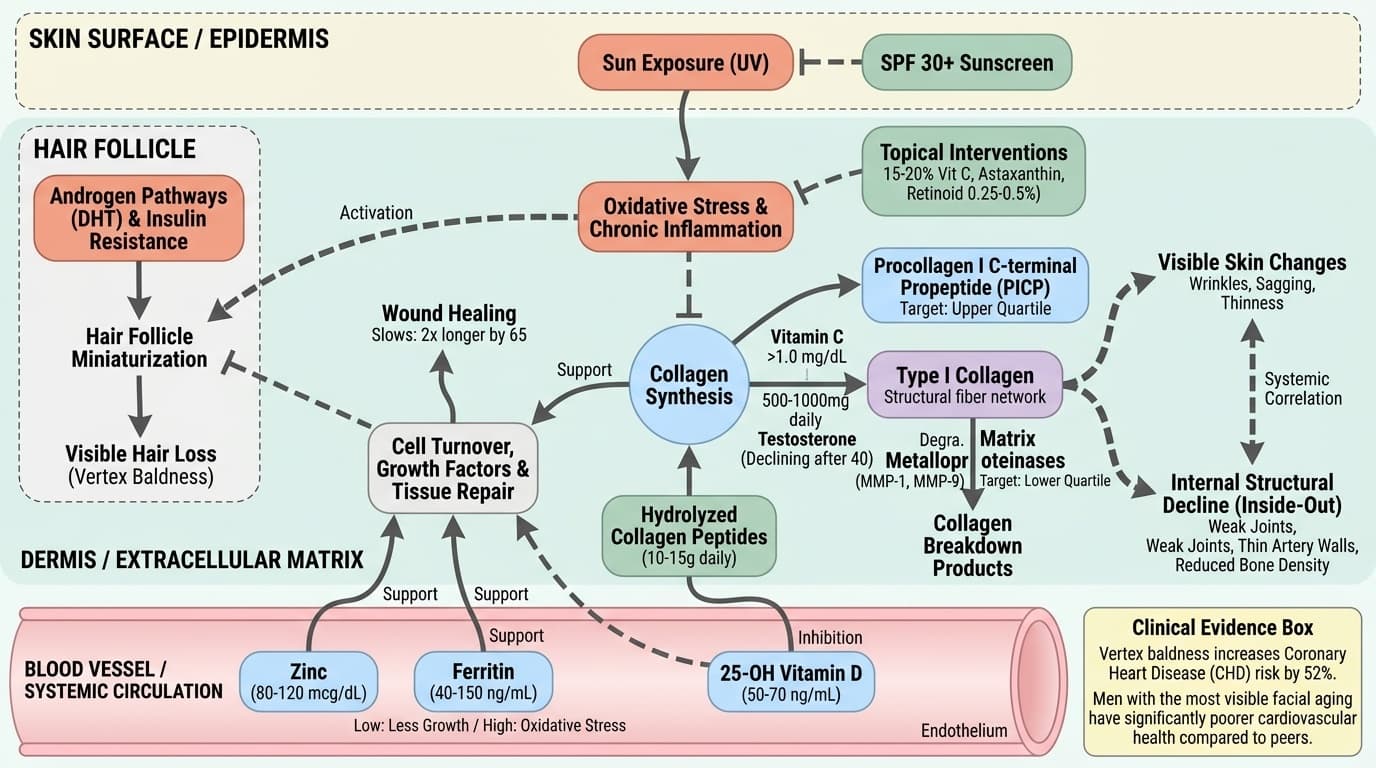
Collagen is the main structural protein in your body, making up about 30% of your total protein content. It's what gives your skin its firmness, keeps your joints flexible, and holds your blood vessels and bones together. But starting as early as your mid-twenties, collagen production drops by 1-1.5% each year. By age 50, you've lost 25-35% of your original collagen. By 65, you may have just half the collagen you had in your prime.
This decline shows up first in your skin—wrinkles, sagging, and thinness. But the same process quietly weakens your tendons, thins your artery walls, and reduces bone density. A 2023 study found that men with the most visible facial aging had significantly poorer cardiovascular health compared to peers with less visible aging [1]. What shows up on your face is happening in your arteries and joints too.
The cause isn't just age. Your body's collagen-breaking enzymes (matrix metalloproteinases or MMPs) work faster as you age, especially with chronic inflammation or sun exposure. Testosterone, which supports collagen synthesis, declines after 40, making the problem worse. For men, visible skin changes are warning signals for system-wide structural problems.
Hair loss in men is often dismissed as genetic inevitability, but research shows it reveals your body's deeper health. While male pattern baldness is driven by genetics and DHT hormone, the severity and speed can be accelerated by chronic inflammation, insulin resistance, and nutrient deficiencies like zinc and iron. A meta-analysis of over 36,000 men found that vertex baldness (crown loss) increases coronary heart disease risk by 52% [1]. The reason: the same androgen pathways affecting hair follicles also influence blood vessel health.
Wound healing is another clear signal. Healing time nearly doubles between ages 25 and 65, mainly because of slower collagen production, reduced growth factors, and weaker blood vessels. If a simple cut takes two or three weeks to heal instead of one, your body is signaling drops in tissue repair and immune function—not just a skin problem.
When these changes appear—sudden diffuse hair thinning, slower healing, or new baldness patterns—they often reflect zinc deficiency, low ferritin, or even prediabetes. Watching for these early signs gives you a head start on reversing or slowing deeper structural decline.
Tracking the right biomarkers can help you understand what’s happening below the surface. For men 40-65, these markers tell you if your interventions are working—or if early warning signs are being missed.
Procollagen I C-terminal Propeptide (PICP) is a blood marker that indicates how much new type I collagen your body is making. The standard range varies by age, but your aim should be the upper quartile for your demographic. When you supplement with collagen, rising PICP levels confirm you’re building more collagen. On the flip side, matrix metalloproteinases (MMP-1 and MMP-9) are enzymes that break down collagen. Keeping these in the lower quartile for age means less structural breakdown. MMPs go up with more sun exposure, inflammation, and oxidative stress.
Vitamin C is crucial: you need at least 1.0 mg/dL in your blood to keep collagen synthesis running smoothly. Without enough, collagen production stalls no matter how much protein you eat. Zinc, with a standard range of 80-120 mcg/dL, supports rapid cell turnover in skin and hair. Low zinc delays healing and causes hair loss. Ferritin, which should be between 40-150 ng/mL, is another overlooked factor: both low and high levels can harm skin and hair. Low ferritin means less hair growth; high ferritin signals iron overload and more oxidative stress, speeding up aging. Finally, 25-OH Vitamin D, best kept at 50-70 ng/mL, helps your skin repair, protects against UV damage, and supports immune health.
These biomarkers interact: vitamin C helps crosslink collagen, while zinc and iron support growth and healing. Watching these numbers gives you control over visible and invisible aging. Next, we’ll unpack how real-life interventions move these markers—and how quickly you can expect results.
Hydrolyzed collagen peptides—especially type I/III—are a cornerstone intervention for men looking to support skin, joint, and bone health after 40. These peptides are broken down for easy absorption and supply the exact amino acids your body needs to rebuild its structural proteins. The most effective forms contain di- and tripeptides like Pro-Hyp and Hyp-Gly, which research shows are especially active in stimulating new collagen synthesis.
A strong body of evidence supports taking 10-15 grams daily. Multiple randomized controlled trials have found improvements in skin elasticity, hydration, and wrinkle depth in men and women, with results typically visible after 8-12 weeks. But the impact goes beyond looks: these same peptides have been shown to support joint cartilage, tendon integrity, and even bone density in older adults. The mechanism is direct: collagen peptides provide the building blocks, while also signaling your cells to ramp up their own collagen production.
Stacking matters. For best effect, always take collagen with vitamin C—this vitamin is required for the enzymes that crosslink and stabilize new collagen fibers. Without it, your body can’t fully use the peptides you’re taking. When started at the recommended dose, you may notice improvements in skin and joint comfort within a few months, but bone density changes take 9-12 months to show up in biomarker tests.
Collagen’s effects are amplified when combined with lowering MMPs through lifestyle changes and antioxidant support. Next, we’ll look at why sun protection isn’t just cosmetic, but one of the most powerful interventions for preserving your body’s structural proteins.
Most men underestimate the long-term impact of sun exposure. But decades of UV damage don’t just cause wrinkles—they trigger enzymes (MMPs) that break down collagen everywhere, including your joints and blood vessels. Sun-induced DNA changes can also create pre-cancerous skin patches that become more visible in your 40s and 50s.
The evidence for daily broad-spectrum sunscreen is overwhelming. A landmark randomized controlled trial published in the Annals of Internal Medicine found that men who used SPF 30+ sunscreen daily had 24% less visible skin aging over 4.5 years compared to those who used it occasionally [1]. These benefits were not just skin-deep: reducing sun-induced aging also lowers the risk of skin cancers, which increase sharply for men over 50. Men have twice the melanoma mortality rate as women, in part because they wait longer to seek care and because male skin allows deeper tumor penetration.
For best results, apply sunscreen every morning—even on cloudy days—and reapply if you sweat or swim. The benefits compound: preserving your skin’s collagen also means stronger blood vessels and connective tissue throughout your body. When paired with antioxidants and collagen peptides, sunscreen forms the foundation of true anti-aging for men. Up next, we’ll discuss vitamin C—how it powers both internal and external repair.
Vitamin C is absolutely essential for collagen synthesis. It acts as a co-factor for the enzyme prolyl hydroxylase, which crosslinks and stabilizes new collagen fibers. Without enough vitamin C, your body simply can’t build or repair collagen, no matter how much protein or peptides you consume.
For men 40-65, the optimal plasma range is above 1.0 mg/dL. Supplementing with 500-1000 mg of vitamin C daily supports internal collagen production and boosts immune function at the same time. But the benefits don’t stop there—topical vitamin C (as 15-20% L-ascorbic acid serum) provides direct antioxidant protection to your skin, reduces hyperpigmentation, and further ramps up local collagen production. This dual approach means you’re supporting both systemic repair and visible improvements in skin tone and texture.
The dose-response relationship is clear: internal vitamin C is needed daily to keep your body’s collagen-building machinery running. Topical forms work best at concentrations above 10%, with 15-20% being the sweet spot for noticeable results. Results can be seen in skin health within 8-12 weeks, but deeper tissue changes are slower. For even greater effect, always stack vitamin C with collagen peptides and antioxidants—these combinations have synergistic effects, amplifying each other’s benefits. In the next section, we’ll explore how advanced antioxidants like astaxanthin further protect your structural proteins.
Retinoids, including topical retinol (0.5-1%) and prescription tretinoin, are proven to reverse visible and structural effects of sun damage. They work by increasing collagen synthesis by up to 80%, speeding up skin cell turnover, thickening the epidermis by 25%, and reducing pigmentation irregularities. This isn't just about smoother skin—retinoids actually reverse the age-related thinning that comes with declining testosterone.
Start with 0.25-0.5% retinol, applied two to three nights per week, and build tolerance over 4-8 weeks. Higher concentrations and regular use yield stronger effects, but starting low prevents irritation. Results in skin thickness and elasticity appear within 12 weeks, with deeper collagen changes building over 6-12 months.
Retinoids work best when combined with daily sunscreen and antioxidants, since they increase UV sensitivity. They also amplify the effects of collagen peptides and vitamin C, creating multi-layered repair. For men, retinoids can counteract the combined effects of testosterone decline, UV damage, and chronic inflammation.
Retinoids, including topical retinol (0.5-1%) and prescription tretinoin, are the gold standard for reversing the visible and structural effects of sun damage. They work by increasing collagen synthesis, speeding up skin cell turnover, thickening the epidermis, and reducing pigmentation irregularities. This isn’t just about smoother skin—retinoids actually reverse the thinning of skin that comes with age and low testosterone.
Start with 0.25-0.5% retinol, applied two to three nights per week, and build up tolerance over 4-8 weeks. The dose-response is clear: higher concentrations and regular use yield stronger effects, but starting low avoids irritation. Consistency is key; results in skin thickness and elasticity can be seen within 12 weeks, with deeper collagen changes building over 6-12 months.
Retinoids work best when stacked with daily sunscreen and antioxidants, since they make your skin more sensitive to UV. They also synergize with collagen peptides and vitamin C, creating a multi-layered repair process. For men, the addition of retinoids can counteract the compounded effects of testosterone decline, UV damage, and chronic inflammation. In the next section, we’ll discuss how to watch for early warning signs and tailor your protocol to your unique risks.
For men in midlife, being proactive about skin and collagen health means knowing what to watch for. New or changing moles—especially after age 50—demand attention. The classic ABCDE criteria (Asymmetry, Border, Color, Diameter, Evolving) still apply, but men should be extra vigilant about moles on the back, scalp, or ears. These are the highest-risk spots for melanoma and often go unnoticed until advanced.
If you notice wounds that take significantly longer to heal compared to five years ago, this isn’t just aging—it’s a sign of declining collagen synthesis, lower growth factor production, or impaired microvascular function. It’s also a prompt to check your vitamin C, zinc, and protein intake, as well as your blood sugar, since high glucose dramatically slows healing. Sudden diffuse hair thinning (not just receding hairline) points to issues like thyroid dysfunction, iron or zinc deficiency, or severe stress—these are reversible when the root cause is addressed.
Remember, these visible changes are rarely isolated—they’re often the first sign of deeper shifts in your structural and metabolic health. By tracking your biomarkers and responding early, you can slow, halt, or even reverse some of the decline that most men assume is inevitable. The next and final section will bring together your action plan for visible and internal results.
Taking control of your skin, hair, and collagen health after 40 means integrating multiple interventions for the strongest effect. Start with hydrolyzed collagen peptides (10-15g daily) and pair with 500-1000mg of vitamin C internally, plus 15-20% topical vitamin C on your skin. Use daily SPF 30+ sunscreen to block ongoing collagen breakdown, and add 8-12mg astaxanthin to further reduce oxidative stress and inflammation. Incorporate a retinoid regimen, starting low and building up.
Track key biomarkers: PICP to confirm new collagen synthesis, MMP-1 and MMP-9 to monitor breakdown, and maintain optimal levels of vitamin C, zinc, ferritin, and 25-OH vitamin D. Remember to watch for demographic-specific warning signs—slow wound healing, new moles, and sudden hair changes mean it’s time to act.
Every one of these interventions is backed by research and works together to rebuild your body’s foundation from the inside out. The visible improvements in your skin and hair are just the start—they’re confirmation that your blood vessels, tendons, and bones are also getting stronger. By stacking these habits, you’re not just fighting aging—you’re investing in your body’s long-term resilience.
Skin, Hair & Collagen After 40: A Comprehensive Guide to Your Body’s Structural Health
Why visible changes in your skin signal deeper shifts—and how to take control in midlife
Diagram glossary
- androgen:
- A male sex hormone, such as testosterone, that regulates masculine characteristics.
- Collagen:
- The primary structural protein providing strength and flexibility to skin, bones, and connective tissues.
- DHT:
- A potent androgen hormone linked to male pattern hair loss and prostate growth.
- Ferritin:
- A blood cell protein that stores iron and releases it in a controlled fashion.
- insulin:
- A pancreatic hormone that regulates blood glucose levels by facilitating cellular sugar uptake.
- mcg/dL:
- Micrograms per deciliter is a standard unit of measurement for blood test concentrations.
- MMP-1:
- Matrix metalloproteinase-1 is an enzyme that breaks down interstitial collagens in tissues.
- MMP-9:
- Matrix metalloproteinase-9 is an enzyme involved in the degradation of the extracellular matrix.
- ng/mL:
- Nanograms per milliliter is a standard unit of measurement for biomarker concentrations in blood.
- PICP:
- A procollagen peptide used as a clinical biomarker to measure bone and collagen formation.
- Procollagen:
- A precursor molecule synthesized by cells that is processed to form mature collagen.
- SPF:
- Sun protection factor measures a sunscreen's ability to protect skin from UVB radiation.
Conclusions
Skin, hair, and collagen health are much more than surface concerns for men in midlife. The visible changes you see are a reflection of deeper shifts in your body’s connective tissues. The good news is that targeted interventions—collagen peptides, daily sun protection, vitamin C, astaxanthin, and retinoids—can slow, halt, or even partially reverse these changes. Tracking key biomarkers and responding early to warning signs means you’re taking charge not just of your appearance, but of your entire structural health. The steps you take for your skin are investments in every tissue that holds your body together.
While the interventions described are supported by strong clinical evidence for skin and structural health, individual responses can vary. Most studies focus on short- to medium-term outcomes (3-12 months), so long-term impacts are less well established. The majority of clinical trials are not specific to men aged 40-65, and there may be important differences in outcomes based on ethnicity, comorbidities, or baseline nutritional status. Some biomarkers, like PICP and MMPs, are not widely available in standard lab panels. Finally, while supplements and topical agents can support collagen health, they cannot fully reverse decades of damage or replace medical management when disease is present.
Track this in your stack
See how collagen relates to your health goals and monitor changes in your biomarkers over time.