
Sleep Is Your Superpower: The Essential Guide to Recovery for Men Under 40
How Deep, Consistent Sleep Fuels Testosterone, Metabolism, and Peak Performance
A surprising University of Chicago study revealed that young men sleeping just five hours nightly saw their testosterone crash as if they had aged 10 years in one week. For men under 40, skipping sleep isn't dedication—it's sabotaging your hormones, recovery, and results.
Your body performs nearly all real repair during sleep. Testosterone and growth hormone peak at night. Your brain clears toxins. Your metabolism resets. If you feel foggy, recover slowly from workouts, or carry stubborn belly fat despite good diet and training, poor sleep quality may be the missing piece.
You can upgrade immediately. Take magnesium glycinate 300-400 mg one hour before bed. Add apigenin 50 mg and L-theanine 200-400 mg for faster sleep onset. Set a non-negotiable bedtime. Cut caffeine after 10 AM. These changes can boost testosterone, improve mood, and maximize every training session.
- Magnesium Glycinate
- A specific form of magnesium where the mineral is bonded to the amino acid glycine, which improves absorption and has a calming effect; it is often preferred over other magnesium forms for sleep support
- Magnesium RBC
- A test measuring magnesium in your red blood cells, linked to sleep quality; optimal range is 5.0-6.5 mg/dL
- GABA
- The brain's primary inhibitory neurotransmitter, promoting calm and relaxation. Low levels linked to anxiety and sleep problems.
- Apigenin
- A natural plant compound (flavonoid) found in chamomile and other plants that binds to receptors in the brain to promote relaxation and sleepiness. It is commonly taken as a supplement to help with sl
- REM Sleep
- Rapid Eye Movement sleep, a deep stage crucial for memory consolidation and testosterone release; 60-70% of daily testosterone is produced during REM cycles
- Hypothalamic-Pituitary-Gonadal Axis
- A hormonal communication chain linking the brain (hypothalamus and pituitary gland) to the testes, which together regulate testosterone production; when sleep is disrupted, signals along this chain are suppressed
- Slow-Wave Sleep
- The deepest stage of non-REM sleep, also called deep sleep, during which the brain produces slow electrical waves and the body releases the majority of its daily human growth hormone for muscle repair
- beta-amyloid
- A protein fragment that forms brain plaques associated with Alzheimer's disease.
- caffeine
- A central nervous system stimulant that promotes alertness and prevents sleep.
- CRP
- C-reactive protein is a blood marker that indicates inflammation levels in the body.
- glycinate
- A salt of the amino acid glycine, often used to improve mineral absorption.
- HGH
- Human growth hormone is a peptide that stimulates growth, cell reproduction, and regeneration.
If you’re a man between 18 and 39, you’re in the group most likely to cut corners on sleep. Social pressure, late-night screens, irregular schedules, and the drive to push harder make it easy to treat rest as optional. But research consistently shows your body can’t outsmart biology. The problem is urgent: sleeping less than six hours a night, even for a week, can drop your testosterone by 10–15%, mirroring a decade of hormonal aging [1].
This dramatic shift isn’t just about energy—it impacts everything from your muscle growth to your mental focus. A 2022 review found that young men who skimp on sleep see higher insulin resistance, more belly fat, and increased stress hormones, even if their diet and exercise are on point [2]. The irony is sharp: the very men striving for peak performance are undermining themselves at the most basic level. If you’ve ever hit a plateau in the gym or struggled to stay sharp at work, your sleep patterns might be the silent culprit.
As you move further into this guide, you’ll see the specific ways that sleep interacts with every major marker of health—setting the stage for deep dives into hormones, metabolism, and brain function.
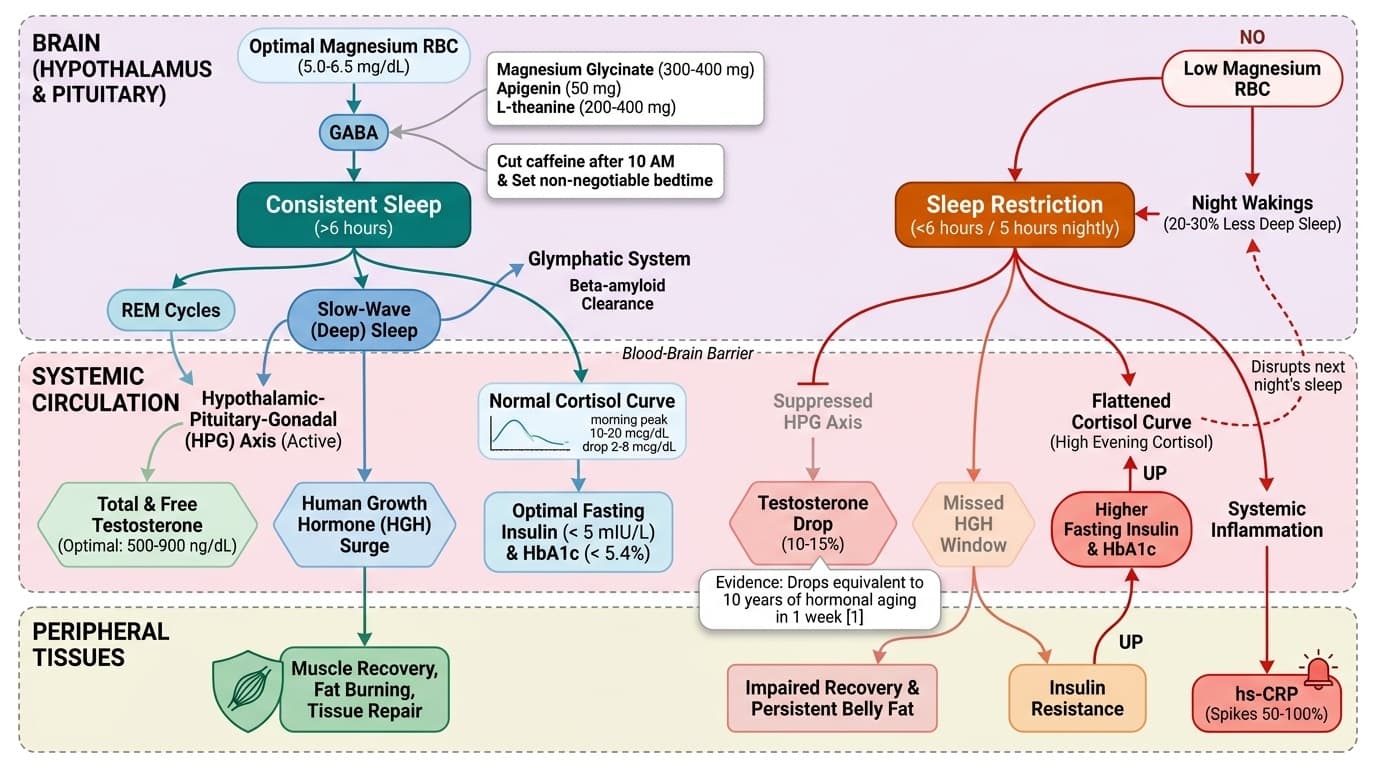
During the night, your body orchestrates a hormonal symphony that’s essential for men under 40. About 60–70% of your daily testosterone is released while you sleep, especially during REM cycles [1]. When sleep is short or fragmented, your hypothalamic-pituitary-gonadal axis—the system that signals testosterone production—gets suppressed. There is no supplement or hack that can replace this natural process.
Deep sleep is equally crucial for releasing human growth hormone (HGH). Most of your HGH is secreted during the first cycle of slow-wave, or deep, sleep. Miss this window, and your muscle recovery, fat burning, and tissue repair all suffer [2]. This matters especially if you’re training hard or aiming for lean muscle gains. Sleep also powers your brain’s “cleaning crew”: the glymphatic system. This system only switches on during deep sleep and washes out waste like beta-amyloid, which is linked to early Alzheimer’s risk [3].
The takeaway here is simple but profound: if you want to protect your testosterone, boost muscle recovery, and keep your brain sharp, deep and consistent sleep is non-negotiable. In the next section, we’ll break down exactly which biomarkers to track to see these effects in real time.
To understand how sleep shapes your health, you need to track the right biomarkers. For young men, start with total and free testosterone. If your sleep is chronically poor, you can expect your testosterone to be 15-30% below your true potential. The standard range for total testosterone in men aged 18-39 is 300-1000 ng/dL, but the optimal range for peak performance is 500-900 ng/dL [1].
Cortisol, your main stress hormone, should peak in the morning at 10-20 mcg/dL, then drop by evening to 2-8 mcg/dL. Poor or irregular sleep flattens this curve, leading to high evening cortisol—which disrupts your next night's sleep and leaves you groggy in the morning [2].
Insulin resistance rises fast when sleep slips. HbA1c and fasting insulin levels worsen within just four days of restricted rest [2,4]. Optimal fasting insulin should be below 5 mIU/L, and HbA1c should stay under 5.4%. If your blood sugar markers are off, fixing sleep may do more than any supplement. Inflammation spikes quickly too: one bad night can raise your hs-CRP by 50-100%, a marker of inflammation linked to long-term disease risk [2].
Finally, check your magnesium RBC. This mineral is essential for quality sleep because it supports GABA, a neurotransmitter that calms your brain. Optimal magnesium RBC is 5.0-6.5 mg/dL. Low levels mean more night wakings and 20-30% less deep sleep [5].
Tracking these markers gives you real feedback as you improve your sleep—fueling your momentum as you move toward targeted interventions.
Every biomarker reacts quickly to how you sleep, handle stress, and manage your routine. For testosterone, even a single week of sleep restriction can drop levels by as much as 15%. It takes about a week of high-quality sleep to restore testosterone to your personal best—assuming other factors like training and nutrition are dialed in [1].
Cortisol responds even faster. A few nights of late bedtimes or disrupted sleep can flatten your normal rhythm, raising evening cortisol and making it harder to wind down. Sleep fixes—like a set wake time and blue light reduction—can start to normalize cortisol within days [2].
Insulin resistance and inflammation markers, like HbA1c and hs-CRP, are also tightly tied to sleep. A 2019 study showed that even “catch-up” sleep on weekends couldn’t fully reverse the insulin resistance built up during a week of poor sleep [4]. Inflammation (hs-CRP) can spike after just one bad night and will remain elevated with chronic sleep debt [2].
Magnesium levels fall fastest under stress. If you’re training hard or feeling anxious, your body burns through magnesium, which can worsen sleep. Supplementing brings levels back up within 2–4 weeks, supporting deep sleep and better biomarker profiles [5].
Understanding these fast, direct interactions helps you see why quick fixes rarely work—and why a new sleep routine can deliver results you can track almost immediately.
Supplements can help you bridge the gap when lifestyle alone isn't enough. For men under 40, start with magnesium glycinate or L-threonate, taken at 300-400 mg of elemental magnesium one hour before bed. These forms are absorbed 30-40% better than oxide and directly activate GABA receptors for deep relaxation. A meta-analysis found magnesium improved sleep quality scores by 15-20% in adults with low magnesium [5].
Apigenin, a compound from chamomile, can be taken at 50 mg about 30 minutes before bed. It acts as a mild GABA-A agonist, reducing sleep onset time by an average of 12-15 minutes without the dependency or hangover of stronger sleep aids. Early data and widespread use by top neuroscientists suggest consistent benefits for sleep initiation.
L-theanine, found in green tea, is another safe daily option. At 200-400 mg, 30 minutes before bed, it promotes alpha brain waves—reducing mental chatter and anxiety without making you drowsy. A randomized controlled trial showed L-theanine improved sleep quality scores by 18% in young adults while reducing next-day fatigue [6].
Stacking these supplements creates synergy: magnesium and apigenin both support GABA, while L-theanine calms racing thoughts. Choose forms with proven absorption—glycinate or threonate for magnesium, standardized extracts for apigenin and L-theanine. Start with one supplement, track sleep changes for two weeks, then add another if needed. Always combine with lifestyle changes for best results.
Your body's internal clock, or circadian rhythm, is easily disrupted by modern life. For men under 40, the most powerful anchor is a consistent wake time—seven days a week. Even a one-hour difference between weekdays and weekends, known as "social jet lag," can increase insulin resistance by 15-20% and disrupt hormone production [2].
Light cues drive this system. Blue light from screens (in the 450-490 nm range) suppresses melatonin production by up to 70% when viewed within two hours of bedtime. Using blue-blocking glasses or avoiding screens for 90 minutes before bed can restore melatonin levels by 40-50%. In contrast, getting 10-15 minutes of natural sunlight within an hour of waking helps reset your circadian clock, improving nighttime melatonin production by 30-50% and making it easier to fall asleep.
Your sleep environment amplifies these effects. Keep your bedroom between 65-68°F, use blackout curtains to eliminate light pollution, and remove electronics that emit standby lights. Room temperature above 70°F can reduce deep sleep by 15-20%. Combine these environmental controls with targeted supplements and you create a powerful, self-reinforcing system for better sleep.
Many sleep problems go undetected—especially in young, active men. If you snore or your partner notices you stop breathing at night, you might have obstructive sleep apnea. This affects up to 9% of young men but is rarely diagnosed. Sleep apnea destroys your sleep architecture, so even eight hours in bed may leave you tired and foggy. If you wake unrefreshed, consider a sleep study [2].
Alcohol is another hidden disruptor. Many young men use it to wind down, but even two drinks within three hours of bedtime can reduce REM sleep by up to 40% and blunt growth hormone release. This means slower muscle recovery and more fatigue, even if you’re sleeping through the night [2].
Caffeine is deceptively persistent. A coffee at 2 p.m. leaves a quarter of the caffeine in your system at midnight, making it harder to fall asleep. If you struggle with sleep onset, set your caffeine cutoff at 10 a.m. for two weeks and see if your sleep improves.
Watching for these signs—and acting early—protects your recovery and keeps your biomarkers on track. Next, you’ll learn how to build a sleep protocol that works for your lifestyle.
Optimizing sleep isn’t about one big change—it’s the sum of small, consistent habits. Start with a non-negotiable sleep-wake schedule. Wake up at the same time every day, including weekends. This trains your circadian rhythm and boosts hormone release [2].
Next, set your environment: block blue light after sunset, use blackout curtains, and keep your room cool. In the morning, get outside for sunlight exposure—just 10–15 minutes is enough to set your body clock. If stress or anxiety make it hard to wind down, add magnesium glycinate (300–400 mg), apigenin (50 mg), or L-theanine (200–400 mg) to your evening routine [5,6].
Track your progress by measuring testosterone, cortisol, HbA1c, hs-CRP, and magnesium RBC every few months. Notice how your sleep improvements shift these numbers. If you hit a plateau, check for hidden disruptors like late caffeine or mild sleep apnea.
By making these steps part of your daily routine, you stack the deck in your favor—unlocking better recovery, sharper focus, and higher performance in every area of life.
Sleep Is Your Superpower: The Essential Guide to Recovery for Men Under 40
How Deep, Consistent Sleep Fuels Testosterone, Metabolism, and Peak Performance
Diagram glossary
- beta-amyloid:
- A protein fragment that forms brain plaques associated with Alzheimer's disease.
- caffeine:
- A central nervous system stimulant that promotes alertness and prevents sleep.
- CRP:
- C-reactive protein is a blood marker that indicates inflammation levels in the body.
- GABA:
- An inhibitory neurotransmitter in the brain that promotes relaxation and reduces neuronal excitability.
- glycinate:
- A salt of the amino acid glycine, often used to improve mineral absorption.
- HGH:
- Human growth hormone is a peptide that stimulates growth, cell reproduction, and regeneration.
- Insulin:
- A hormone produced by the pancreas that regulates blood glucose levels and fat storage.
- mcg/dL:
- Micrograms per deciliter is a standard unit of measurement for blood test concentrations.
- mIU/L:
- Milli-international units per liter is a standard unit used to measure hormone concentrations.
- ng/dL:
- Nanograms per deciliter is a common unit of measurement for hormone levels like testosterone.
- RBC:
- Red blood cells are responsible for transporting oxygen from the lungs to body tissues.
- REM:
- Rapid eye movement is a sleep stage associated with dreaming and memory consolidation.
- theanine:
- An amino acid found in tea leaves that promotes relaxation and improves sleep quality.
Conclusions
For men aged 18–39, sleep is not just rest—it’s your body’s main engine for hormone production, muscle recovery, and mental clarity. Prioritizing deep, consistent sleep outperforms any supplement stack or training tweak. By tracking key biomarkers and using targeted interventions, you can see measurable improvements within weeks. Treat sleep as your foundation, not an afterthought, and watch every aspect of your health and performance rise.
While strong evidence links sleep quality with hormonal, metabolic, and cognitive outcomes, most cited studies are short-term or observational in young men. Individual responses to supplements like magnesium, apigenin, and L-theanine may vary, and long-term safety data in this demographic is limited. Sleep apnea remains underdiagnosed in younger men, so some issues may go unnoticed without clinical evaluation. The guide does not cover all possible sleep disorders or causes of poor recovery.
Track this in your stack
See how magnesium relates to your health goals and monitor changes in your biomarkers over time.