
Why Two People Taking the Same Vitamin D Dose Can End Up With Completely Different Blood Levels
How absorption, metabolism, and genetics make your vitamin D response unique—and why one-size-fits-all dosing misses the mark
If you and a friend both take 2,000 IU of vitamin D, here's something surprising: your blood levels might change completely differently.
One person could see a big jump. The other might barely budge. This isn't about supplement quality. Your gut, genes, and vitamin D-binding proteins control how much actually gets into your system.
This matters because most people assume the label dose works for everyone. But studies show vitamin D absorption varies by 3-5 times between people. Even with identical diets and sun exposure, your body weight, genetics, and how your liver processes vitamin D create wildly different results. This explains why some people feel great on supplements while others see no change.
Start with a baseline 25(OH)D blood test. Take 2,000-4,000 IU daily with a fatty meal for best absorption. Retest after 8-12 weeks. If you're not hitting 30-50 ng/mL, increase by 1,000 IU increments. Some people need just 1,000 IU daily. Others need 5,000 IU or more. Your blood levels are your only true guide.
- Liposomal
- A delivery form that wraps a compound in tiny fat-like spheres to improve absorption or stability.
- Fat-soluble
- Describes vitamins like D that dissolve best in fat, meaning they're better absorbed when taken with food containing fat.
- Diastolic Blood Pressure
- Minimum arterial pressure between heartbeats, reflecting vascular resistance. elevated diastolic BP indicates increased arterial stiffness and peripheral resistance.
- Weight
- Body weight in kilograms, most basic anthropometric measure.
- 25(OH)D (25-hydroxyvitamin D)
- A blood biomarker used to measure vitamin D status; this is what most labs test to assess if you're deficient or sufficient.
- Vitamin D-binding protein (DBP)
- A protein in your blood that carries most of your vitamin D; genetic differences in DBP can change how much usable vitamin D you have even if your blood test looks 'normal.'
- Vitamin D, 25-OH
- 25-hydroxyvitamin D, the storage form reflecting vitamin D status. Deficiency (<20 ng/mL) extremely common, especially in northern climates.
- DBP
- Vitamin D-binding protein, which transports vitamin D and its metabolites through the bloodstream.
- ng/mL
- Nanograms per milliliter, a unit of measurement used to express substance concentration in blood.
The Myth of 'One Dose Fits All'
Most people believe that taking 2,000 IU of vitamin D daily will predictably raise their blood levels by the same amount. Research reveals this assumption is completely wrong. Two people taking identical doses can see 25(OH)D blood levels rise by 5 ng/mL in one person and 25 ng/mL in another. Body weight alone explains much of this difference—heavier people need higher doses to achieve the same blood levels. Age matters too: older adults absorb vitamin D 40% less efficiently than younger people. Even timing affects results—taking vitamin D with a high-fat meal increases absorption by 32% compared to taking it on an empty stomach [4,10].
Why Absorption and Metabolism Vary So Much
Three major factors create this massive variability in vitamin D response. Absorption varies dramatically based on gut health and meal composition. People with Crohn's disease or celiac disease absorb 50-70% less vitamin D than healthy individuals. Taking vitamin D with at least 15 grams of fat increases bioavailability by 30-50%. Metabolism differences are equally important—genetic variations in liver enzymes can speed up or slow down vitamin D processing by 2-3 times. Some people have gene variants that make them rapid metabolizers, requiring 50% higher doses to maintain the same blood levels as slow metabolizers [4,10].
The Hidden Role of Vitamin D-Binding Protein (DBP)
Here's where vitamin D testing gets tricky: most labs only measure total 25(OH)D, but 85-90% of that is bound to vitamin D-binding protein (DBP) and unavailable to your cells. Your genes determine which type of DBP you produce, and this dramatically affects how much vitamin D is actually usable. People with certain DBP variants can have 'normal' total 25(OH)D levels of 30 ng/mL but functionally low free vitamin D equivalent to someone with 15 ng/mL total levels. This explains why some people feel deficient despite 'adequate' lab results. Future testing may focus on free 25(OH)D or DBP genotyping for more accurate dosing [1,4].
Personalized Supplement Strategies: From Testing to Titration
Smart vitamin D supplementation requires a test-and-adjust approach. Start with baseline 25(OH)D testing to know your starting point. Begin with 2,000-4,000 IU daily (higher end for people over 150 pounds), taken with a meal containing at least 15 grams of fat. Liposomal formulations may improve absorption by 20-30% for people with digestive issues. After 8-12 weeks, retest your 25(OH)D. Target 30-50 ng/mL for most health benefits. If you're below target, increase by 1,000 IU increments and retest in another 8-12 weeks. People with malabsorption conditions may need 5,000-10,000 IU daily to reach optimal levels [4,10].
Why Population Studies on Vitamin D Are So Conflicting
This individual variability explains why vitamin D research produces conflicting headlines. When studies give everyone 1,000 IU daily, blood levels might rise by 2 ng/mL in some participants and 15 ng/mL in others. Researchers then see mixed results because many participants never reach therapeutic levels while others may exceed them. Studies that measure final 25(OH)D levels and group participants by achieved blood levels (rather than dose given) show much clearer benefits. This is why your personal blood test results matter more than population study averages [4].
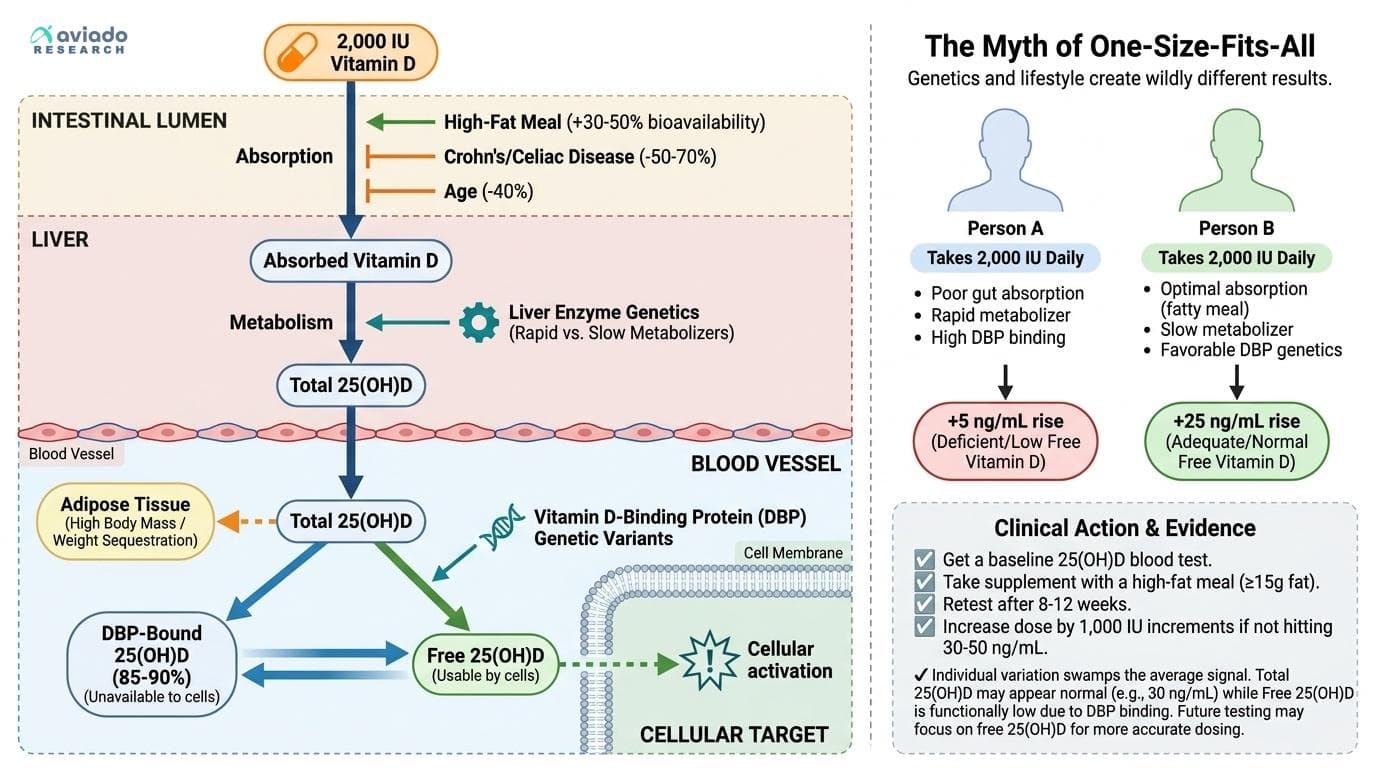
Why Two People Taking the Same Vitamin D Dose Can End Up With Completely Different Blood Levels
How absorption, metabolism, and genetics make your vitamin D response unique—and why one-size-fits-all dosing misses the mark
Diagram glossary
- DBP:
- Vitamin D-binding protein, which transports vitamin D and its metabolites through the bloodstream.
- ng/mL:
- Nanograms per milliliter, a unit of measurement used to express substance concentration in blood.
Conclusions
Vitamin D supplementation success depends entirely on personalization, not standard dosing. The same 2,000 IU dose can produce 3-5 times different blood level changes due to variations in absorption, metabolism, body weight, and vitamin D-binding protein genetics. Start with baseline 25(OH)D testing, supplement with 2,000-4,000 IU daily with fat for optimal absorption, and retest after 8-12 weeks. Adjust doses based on your achieved blood levels, targeting 30-50 ng/mL. Some people need just 1,000 IU daily while others require 5,000+ IU to reach the same target. Future advances in free vitamin D testing and genetic screening will make dosing even more precise.
Most current studies focus on total 25(OH)D levels and do not routinely measure free vitamin D or DBP genotype, which may be more accurate indicators of vitamin D status. Research on personalized vitamin D dosing is still emerging, and optimal target ranges can vary depending on individual health needs. Some evidence comes from specific populations (like those with digestive disorders), so results may not apply to everyone. Inter-individual differences make it challenging to create universal guidelines.
Track this in your stack
See how vitamin d relates to your health goals and monitor changes in your biomarkers over time.