
Why Your Curcumin Isn't Working: The Formulation Gap That Explains Conflicting Research
Meta-analyses reveal the hidden variable behind inconsistent curcumin studies
The surprising reason curcumin “fails” is not your dose. It is your form. Most curcumin never reaches your blood.
This means you should check your label first. If it is plain curcumin powder, you may feel nothing. If it is a better form, you can see real changes.
Use 500–1,000 mg a day of nanocurcumin. Or take 500 mg curcumin with 5–10 mg piperine daily. For phospholipid curcumin, use 500–1,000 mg daily with food.
- Curcumin
- A key compound in turmeric studied for inflammation and metabolic markers.
- BCM-95
- A branded curcumin extract formulated with turmeric essential oils to improve absorption. It is one of several enhanced curcumin products used to overcome standard curcumin's low bioavailability.
- IL-6
- A branded curcumin product family name used to identify a specific extract or formulation in research and supplement labels.
- Phospholipid complexes
- A formulation where curcumin is chemically bound to phospholipids (fat-like molecules) to improve its ability to dissolve in fats and pass through cell membranes. This enhances absorption into the blo
- Nanocurcumin
- Curcumin made into very small particles to improve absorption.
- Longvida
- A branded lipid-based curcumin formulation designed to improve stability and absorption. It is often used when researchers want higher tissue exposure than standard curcumin provides.
- Malondialdehyde (MDA)
- A biomarker of oxidative stress formed when free radicals damage fats in cell membranes. Higher MDA levels suggest greater oxidative damage in the body.
- CRP
- C-reactive protein is a blood marker indicating inflammation in the body.
- glucose
- A simple sugar that serves as the primary energy source for living organisms.
- LDL
- Low-density lipoprotein is a cholesterol carrier often associated with cardiovascular disease risk.
The Bioavailability Problem That Explains Everything
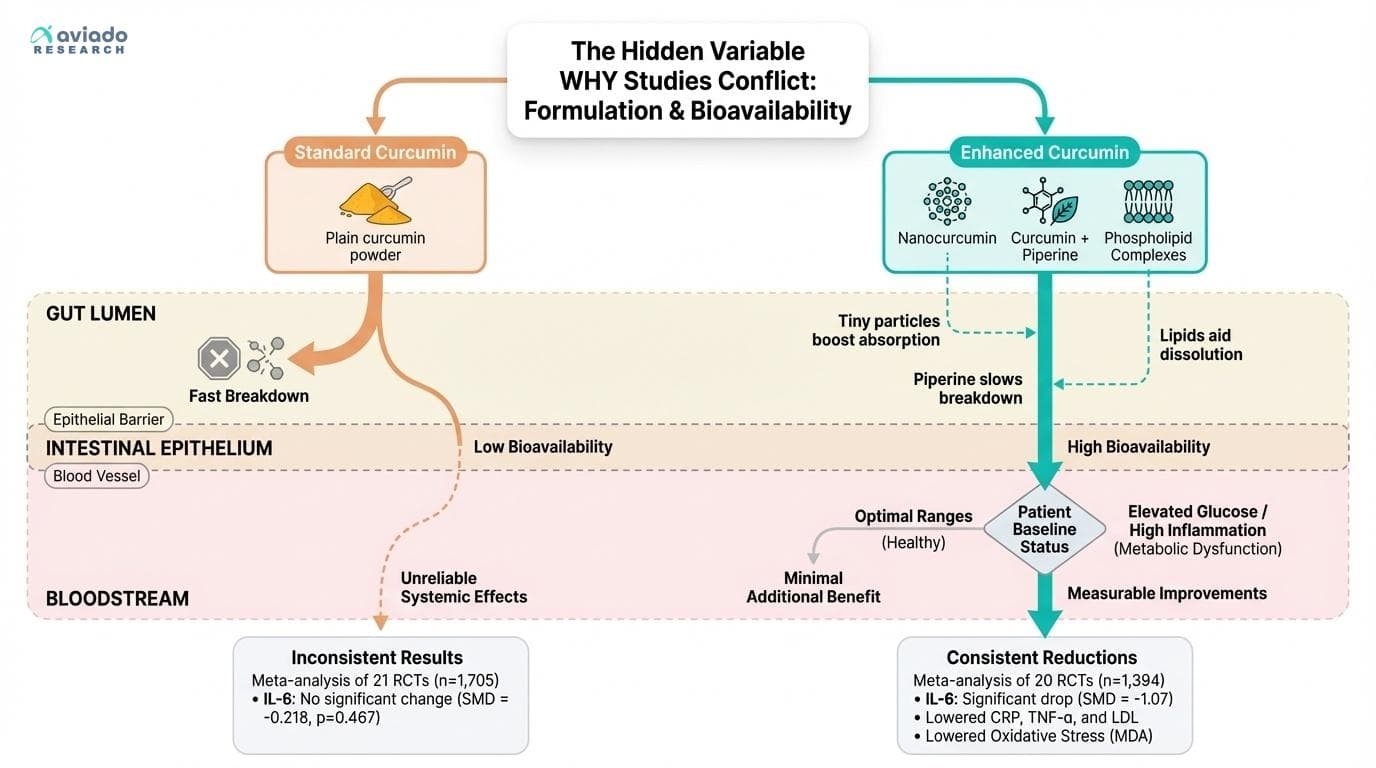
Standard curcumin has very low bioavailability. Much of it gets broken down fast. That can limit real effects.
This is why new delivery forms exist. Nanocurcumin uses tiny particles to boost absorption. Curcumin with piperine uses black pepper extract. It slows curcumin breakdown. Phospholipid complexes bind curcumin to fat-like molecules. This helps it dissolve and absorb.
In a 2024 meta-analysis of 20 RCTs (n=1,394), nanocurcumin lowered IL-6 (SMD: -1.07 ng/L). It also lowered oxidative stress markers like MDA. In a separate 2024 meta-analysis of 21 RCTs (n=1,705), curcumin did not significantly lower IL-6 (SMD = -0.218, p=0.467). The simplest explanation is formulation.
The Meta-Analysis Contradiction That Reveals the Truth
Curcumin studies look mixed until you track formulation. IL-6 shows this clearly.
One meta-analysis of 32 RCTs (n=2,038) found curcumin lowered IL-6 by 1.69 pg/mL. But a different meta-analysis of 21 RCTs (n=1,705) found no significant IL-6 change (SMD = -0.218, p=0.467).
When trials use higher-absorption forms, results cluster. Nanocurcumin trials, for example, show larger and more consistent IL-6 drops across studies. Plain curcumin trials vary more. That spread can cancel out in meta-analyses and look like “no effect.”
Who Responds Best: The Inflammation Connection
Curcumin isn't a general wellness supplement—it's a targeted intervention that works best in people with existing metabolic dysfunction or inflammation. Meta-analyses consistently show stronger effects in participants with conditions like metabolic syndrome, prediabetes, diabetes, and rheumatoid arthritis compared to healthy individuals.
A systematic review focusing on diabetes and prediabetes found that curcumin supplementation significantly reduced malondialdehyde levels (a marker of oxidative stress) with an effect size of -1.31 [4]. Another meta-analysis of 13 studies with 785 participants found curcumin improved multiple markers associated with metabolic syndrome [5]. The common thread: these studies focused on people with measurable metabolic dysfunction, not healthy individuals.
If your baseline inflammatory markers like C-reactive protein and IL-6 are already in optimal ranges, curcumin may provide minimal additional benefit. But if you have elevated glucose, inflammatory markers, or metabolic syndrome features, the research suggests curcumin can provide measurable improvements—provided you're taking a bioavailable form.
Dosing and Timing: What the Research Shows
Your effective dose depends on the form you use.
Nanocurcumin trials often use 500–1,000 mg per day. Curcumin with piperine often uses 500 mg curcumin plus 5–10 mg piperine per day. Phospholipid-complexed curcumin studies often use 500–1,000 mg per day.
Take curcumin with food that contains fat. This can raise absorption. Some studies split the dose. For example, 500 mg twice daily. This may help keep blood levels steadier.
Why Your Curcumin Isn't Working: The Formulation Gap That Explains Conflicting Research
Meta-analyses reveal the hidden variable behind inconsistent curcumin studies
Diagram glossary
- CRP:
- C-reactive protein is a blood marker indicating inflammation in the body.
- glucose:
- A simple sugar that serves as the primary energy source for living organisms.
- IL-6:
- Interleukin-6 is a pro-inflammatory cytokine involved in immune responses and metabolic dysfunction.
- LDL:
- Low-density lipoprotein is a cholesterol carrier often associated with cardiovascular disease risk.
- MDA:
- Malondialdehyde is a widely used biomarker for measuring oxidative stress and lipid peroxidation.
- piperine:
- An active compound in black pepper that enhances the bioavailability of other substances.
- TNF-α:
- Tumor necrosis factor-alpha is an inflammatory cytokine involved in systemic inflammation and immune regulation.
Conclusions
Curcumin research looks “confusing” for one main reason: formulation. Plain curcumin powder often absorbs poorly. That can make results look weak or inconsistent. Higher-absorption forms—like nanocurcumin, curcumin plus piperine, and phospholipid complexes—show more reliable changes in inflammation and oxidative stress markers in meta-analyses. If your curcumin is not working, the fastest fix is to switch the delivery form and track a few key labs over 8–12 weeks.
Most trials last about 8–12 weeks. That limits what we can say about long-term use. Nanocurcumin has promising results, but it has fewer total trials than standard curcumin. Studies also vary in the exact curcumin product, dose, and participant health status. This makes head-to-head comparisons harder. People with low baseline inflammation may also see smaller changes than people starting with higher markers.
Track this in your stack
See how curcumin relates to your health goals and monitor changes in your biomarkers over time.
Sources (5)
This article informs how supplementation moves 1 marker.
Each biomarker page clusters supplements, ranges, and the evidence behind every score. Useful when you're starting from a number, not a goal.