
Your Genetics Determine Whether Sulforaphane Works at All — Here's How to Find Out
Here's something surprising: sulforaphane might do almost nothing for you while giving your friend three times the benefits from the same dose.
This all comes down to one gene called GSTM1. Half of people lack this gene entirely, making them "super responders" who get much higher sulforaphane levels in their blood. The other half clear it out fast and see minimal effects.
This explains why sulforaphane reviews are so mixed. Some people rave about better energy and health markers. Others feel nothing. It's not about the brand or timing - it's your DNA. Most studies mix both groups together, hiding the real story. When researchers separate people by genetics, the benefits become clear and measurable.
If you're a genetic responder (GSTM1-null), take 30-60 mg sulforaphane daily with myrosinase for best absorption. That's about 20-40 grams of fresh broccoli sprouts. Studies show this can lower triglycerides by 41 mg/dL and LDL cholesterol by 8 mg/dL in responders. Get a genetic test first - it costs under $100 and tells you if sulforaphane will work for you.
- GSTM1
- A gene that encodes the enzyme glutathione S-transferase M1, which helps process sulforaphane. Some people lack this gene, making them 'GSTM1-null'.
- Nrf2 activation
- A proposed mechanism by which sulforaphane boosts the body's antioxidant and detoxification pathways; shown to be inconsistent in human trials.
- GSTM1-null
- A genetic variation where the GSTM1 gene is missing, resulting in slower clearance and higher blood levels of sulforaphane.
- ALT (SGPT)
- Alanine aminotransferase enzyme, highly specific to liver cells. elevated in hepatocellular injury from viral hepatitis, fatty liver, or medications.
- Sulforaphane
- A compound found in broccoli sprouts and other cruciferous vegetables, studied for its effects on metabolism and detoxification.
- Triglycerides
- Triglycerides, the primary fat storage molecule in blood. elevated levels indicate metabolic dysfunction and increase cardiovascular risk.
- Glucose
- Blood sugar level, the primary energy source for cells. Fasting glucose is normal, prediabetes, ≥126 suggests diabetes.
- ALT
- An enzyme found mostly in the liver, used as a biomarker for liver health.
- DNA
- The molecule that carries genetic instructions for the development and functioning of living organisms.
- LDL
- Low-density lipoprotein is a type of cholesterol that can build up in blood vessels.
Why Your Genes Decide If Sulforaphane Works
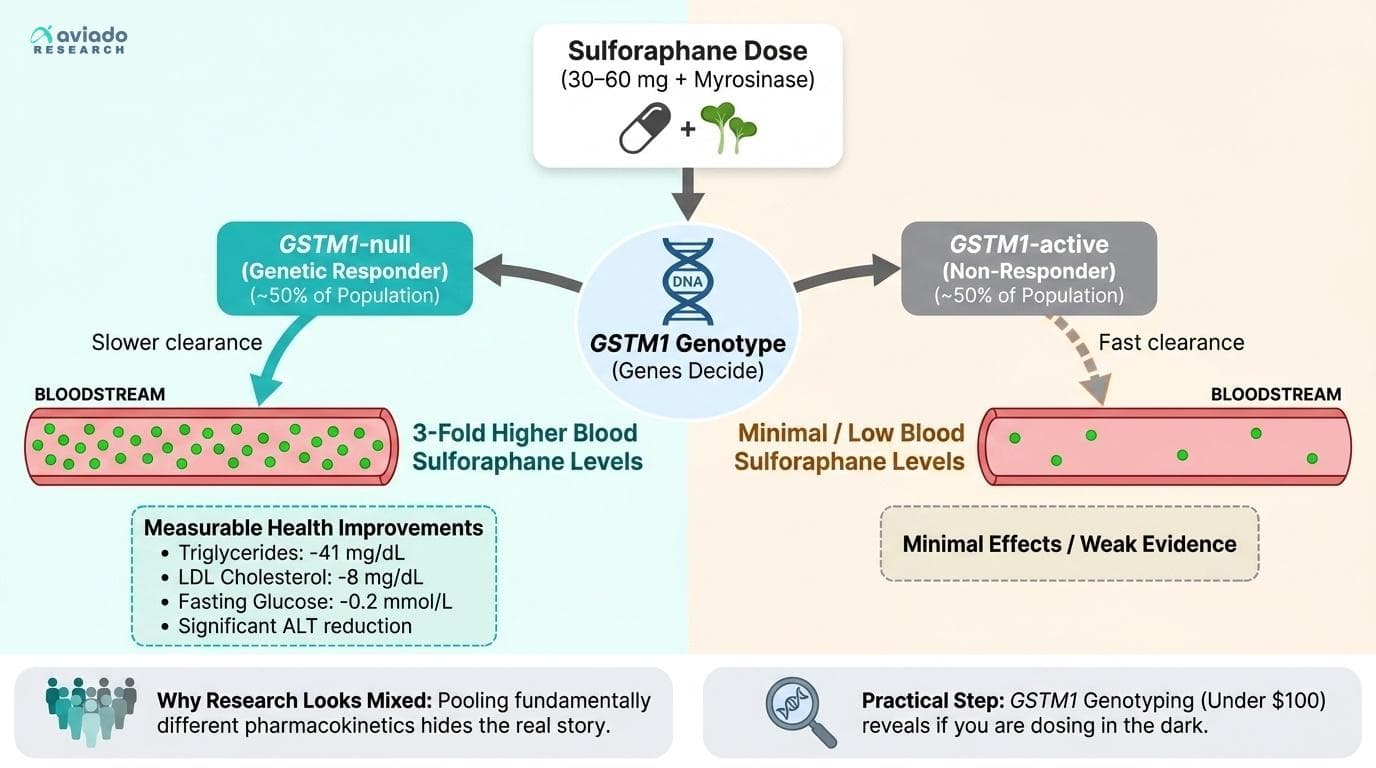
Sulforaphane is often marketed as a universal supplement for detox, brain health, and metabolic support. But what nearly all marketing ignores is the dramatic genetic split in how people process sulforaphane, determined by the GSTM1 gene. If you have the GSTM1-null variant (which about half of people do), your body can’t clear out sulforaphane as quickly, leading to three times higher blood levels after taking the same dose compared to someone with an active GSTM1 gene. This means you’re far more likely to experience the touted benefits — while others may notice almost nothing, even at the same dose. This hidden genetic variable is why sulforaphane studies in humans have produced mixed results, while animal and cell studies (which don’t have this genetic split) look much more consistent.
The GSTM1 Effect: Evidence from Human Studies
Multiple randomized trials and meta-analyses now confirm that GSTM1-null individuals achieve blood sulforaphane levels three times higher than people with active GSTM1 genes. This translates into measurable health improvements. A meta-analysis of 10 trials found sulforaphane lowered triglycerides by 41 mg/dL in mixed populations - but when studies separated by genetics, GSTM1-null responders saw the biggest drops. Another meta-analysis showed LDL cholesterol reductions of 8 mg/dL, again strongest in genetic responders. Liver health improved too: a 24-week trial found significant ALT reductions, and a 12-week study showed fasting glucose dropped by 0.2 mmol/L in people taking broccoli sprout extract. The key finding: human trials that ignore GSTM1 status mix strong responders with non-responders, making results look weak and inconsistent.
Practical Steps: Testing and Dosing for Maximum Benefit
To know if you’re likely to benefit, you need to know your GSTM1 status. Direct-to-consumer genetic testing services can provide this information, often for under $100. If you are GSTM1-null, you are a high responder: studies support daily doses of 30–60 mg sulforaphane (commonly from broccoli sprout extract or fresh sprouts, equivalent to about 20–40 grams fresh sprouts). For GSTM1-positive individuals, the same dose may not deliver much benefit, and higher doses or alternative strategies might be needed — but the evidence for benefit is far weaker in this group. Regardless of genotype, always ensure your sulforaphane supplement includes active myrosinase or take it with a raw cruciferous vegetable to boost conversion from glucoraphanin.
Why This Changes Everything for Sulforaphane Research and Use
The discovery of the GSTM1 effect reframes sulforaphane from a supplement with average, population-level benefits to a highly personalized tool. It also explains why some people feel noticeable improvements in energy, detox, or metabolic markers — and others report no change. For supplement users, this means you can stop guessing: a simple genetic test tells you if sulforaphane is likely to work for you. For researchers, it highlights the need to stratify trials by GSTM1 status, or risk missing true effects buried in mixed populations.
Your Genetics Determine Whether Sulforaphane Works at All — Here's How to Find Out
A single gene variant (GSTM1) causes a 3-fold difference in how much sulforaphane your body actually absorbs and uses — meaning roughly half the population gets dramatically less benefit from the same dose. Without knowing your GSTM1 status, you're dosing in the dark. This angle passes every test: it's specific to sulforaphane (no other common supplement has this well-documented genetic responder/non-responder split with quantified effect size from an RCT), it's not obvious, it's actionable (GSTM1 genotyping is available), and it reframes the entire supplement decision around personal biology rather than population averages. The 3-fold difference is a concrete, startling number. It also explains why sulforaphane research looks 'mixed' — studies are pooling people with fundamentally different pharmacokinetics. This is the hidden variable that resolves the confusion.
Diagram glossary
- ALT:
- An enzyme found mostly in the liver, used as a biomarker for liver health.
- DNA:
- The molecule that carries genetic instructions for the development and functioning of living organisms.
- glucose:
- A simple sugar that serves as the primary energy source for the body's cells.
- GSTM1:
- A gene that determines how quickly the body processes and clears compounds like sulforaphane.
- LDL:
- Low-density lipoprotein is a type of cholesterol that can build up in blood vessels.
- mmol:
- A millimole is a unit of measurement representing one thousandth of a mole.
- myrosinase:
- An enzyme essential for converting plant compounds into active sulforaphane for bodily absorption.
Conclusions
Sulforaphane works dramatically better for some people than others, and it all comes down to the GSTM1 gene. If you're GSTM1-null (about half the population), you'll get three times higher blood levels and measurable improvements in triglycerides, cholesterol, and liver markers. If you have active GSTM1, the same dose may do very little. A simple genetic test tells you which group you're in, making this a solved problem. For confirmed responders, 30-60 mg daily with myrosinase gives you the best chance of seeing real benefits.
While the GSTM1 genetic split is well-documented, most studies to date have not stratified participants by genotype, making it difficult to give personalized recommendations for GSTM1-positive individuals. The strongest evidence for benefit is in GSTM1-null responders, and the main proposed mechanism (Nrf2 activation) has not been reliably demonstrated in humans. Dose-response relationships and long-term outcomes still need further study, especially for broader uses like neuroprotection. Direct-to-consumer genetic tests are not always 100% accurate, and real-world absorption may vary depending on supplement formulation.
Track this in your stack
See how sulforaphane relates to your health goals and monitor changes in your biomarkers over time.