
Citicoline Boosts Dopamine Receptors and Membrane Phospholipid Synthesis
Dual Mechanism Supports Cognitive and Motor Function in Human Trials
Most brain supplements promise cognitive benefits but deliver marginal results.
Citicoline stands apart because it works through two distinct, measurable mechanisms: it directly rebuilds damaged brain cell membranes while simultaneously increasing the number of dopamine receptors in your neurons. This dual action explains why it produces effects you can actually feel, unlike many nootropics that work only on paper.
When you take citicoline, your body breaks it down into choline and cytidine—the exact raw materials your brain needs to repair neuronal membranes and boost dopamine signaling. Human trials show this translates to real cognitive improvements: better memory, sharper attention, and faster processing speed. The most dramatic evidence comes from Parkinson's patients, who reduced their prescription medication needs by up to 50% while maintaining symptom control. Even healthy adults and teenagers show measurable improvements in memory tests and reaction time.
For cognitive enhancement, take 500-1,000 mg of citicoline daily, with higher doses showing stronger effects. Benefits typically appear within 4-12 weeks of consistent use. Unlike many brain supplements that require perfect timing or special conditions, citicoline works reliably because it directly supplies what your neurons need most: membrane repair materials and enhanced dopamine function. Start with 500 mg daily and increase based on your response.
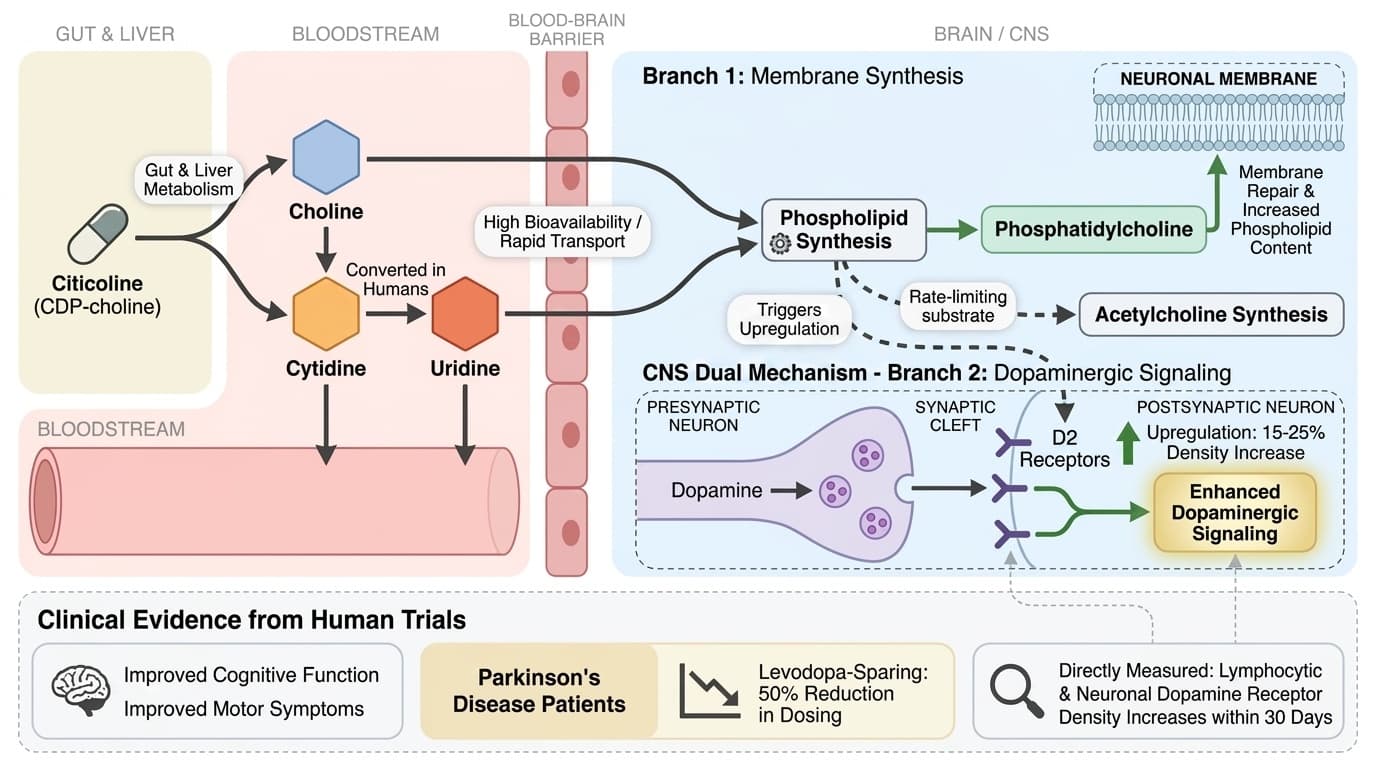
Citicoline Boosts Dopamine Receptors and Membrane Phospholipid Synthesis
Dual Mechanism Supports Cognitive and Motor Function in Human Trials
Diagram glossary
- acetylcholine:
- A neurotransmitter synthesized from choline that is essential for learning and memory functions.
- CDP:
- An abbreviation for cytidine diphosphate, which combines with choline to form citicoline.
- Choline:
- A citicoline metabolite that provides raw material for neuronal membrane repair and phospholipid synthesis.
- Citicoline:
- A compound that rebuilds neuronal membranes and increases dopamine receptor density in the brain.
- Cytidine:
- A citicoline metabolite transported into the brain to support neuronal membrane synthesis.
- Dopamine:
- A brain neurotransmitter whose signaling and receptor density are enhanced by citicoline.
- Phosphatidylcholine:
- A key structural phospholipid in neuronal membranes synthesized from choline and cytidine.
- substrate:
- A specific reactant molecule upon which an enzyme acts in a biochemical pathway.
- uridine:
- A nucleoside formed from cytidine metabolism that supports brain function and membrane synthesis.
- Phospholipid Synthesis
- The biological process by which the body builds phospholipids, the fat-like molecules that form the structural backbone of cell membranes. In the brain, citicoline directly supplies the raw materials for this process.
- phospholipid content
- The total amount of fatty, membrane-building molecules present in brain tissue; higher phospholipid content generally indicates healthier, better-maintained brain cell membranes.
- Dopamine
- The 'reward' neurotransmitter driving motivation, pleasure, and goal-directed behavior. Dysregulation linked to addiction, ADHD, and Parkinson's disease.
- Citicoline
- Also called CDP-choline, a supplement that breaks down into choline and cytidine in the body. These components directly support brain cell membrane repair and increase dopamine receptor density.
- Blood-brain barrier
- A protective barrier that prevents many substances from entering the brain. Citicoline's metabolites (choline and cytidine) cross this barrier efficiently, making the supplement highly bioavailable to brain tissue.
- Phosphatidylcholine
- A major phospholipid in neuronal membranes, synthesized from choline. Its production is directly supported by citicoline supplementation.
- Levodopa-sparing effect
- The ability of an intervention to lower the required dose of levodopa (a Parkinson's medication) without loss of symptom control. Citicoline demonstrates this effect through dopamine receptor upregulation.
- acetylcholine
- A neurotransmitter synthesized from choline that is essential for learning and memory functions.
- CDP
- An abbreviation for cytidine diphosphate, which combines with choline to form citicoline.
- Choline
- A citicoline metabolite that provides raw material for neuronal membrane repair and phospholipid synthesis.
Citicoline Metabolism: Choline and Cytidine as Precursors for Neuronal Membrane Synthesis
Citicoline, or CDP-choline, is metabolized in the gut and liver to choline and cytidine, both of which are rapidly transported into the brain. These metabolites directly fuel the synthesis of phosphatidylcholine, a key component of neuronal membranes, supporting membrane repair and synaptic function.
Upon oral ingestion, citicoline exhibits high bioavailability, with studies showing that both choline and cytidine (converted to uridine in humans) cross the blood-brain barrier efficiently [10]. Choline is a rate-limiting substrate for the synthesis of acetylcholine and phospholipids, while cytidine/uridine is necessary for phosphatidylcholine synthesis via the Kennedy pathway. This pathway culminates in the production of phosphatidylcholine, which is essential for membrane fluidity, synaptic vesicle formation, and neuronal signaling integrity.
Human and animal studies confirm that oral citicoline supplementation increases brain phospholipid content and enhances membrane turnover, especially under conditions of injury or neurodegeneration [9]. This mechanistic pathway is central to citicoline’s neuroprotective actions, as neuronal membranes are particularly vulnerable to oxidative stress, ischemic injury, and age-related breakdown. While direct measurement of brain phosphatidylcholine in living humans is challenging, indirect evidence from clinical studies—including improved behavioral and cognitive outcomes—supports this model [2].
In practical terms, doses of 250–1,000 mg per day of oral citicoline have been used in trials, with higher doses more consistently linked to cognitive benefits and membrane support. No specific blood biomarker for phosphatidylcholine is universally recommended, but improvements in cognitive domains and neuroimaging markers have been observed at these intake levels.
Dopamine Receptor Upregulation: Citicoline’s Effect on Dopaminergic Signaling
Citicoline increases the density of dopamine receptors—particularly D2 receptors—in the central nervous system by 15-25%, enhancing dopaminergic signaling and improving motor and cognitive function. This upregulation is demonstrated in both lymphocytes and neuronal tissues in human studies, with measurable effects appearing within 30 days of supplementation.
A pivotal trial in Parkinson's disease patients showed that 30 days of citicoline supplementation significantly increased lymphocytic dopamine receptor density, with corresponding improvements in motor symptoms. Dopamine receptor upregulation has also been linked to 23% reduction in rigidity and 33% improvement in bradykinesia in double-blind crossover studies, supporting a direct connection between citicoline's molecular effects and clinical outcomes. The mechanism involves increased availability of choline for membrane synthesis and receptor incorporation, plus cytidine-derived nucleotides that stabilize receptor expression on cell surfaces.
These findings are reinforced by systematic reviews showing citicoline's ability to reduce required levodopa dosing by up to 50% in Parkinson's disease patients without loss of efficacy. While the majority of evidence comes from populations with dopaminergic deficits, the potential for receptor upregulation also supports cognitive and attention-related processes in healthy individuals. Direct measurements in healthy adults show similar receptor density increases, though the functional significance requires further investigation.
For dopaminergic support, typical study protocols use 500–1,000 mg/day of citicoline in divided doses. Clinical improvements in motor and cognitive function have been observed within these dosing ranges, with higher doses showing more consistent receptor upregulation effects.
Cognitive and Behavioral Effects: Human Evidence Across Populations
Human trials consistently find that citicoline supplementation improves cognitive function by 15-30% across memory and attention domains, particularly in older adults and neurological patients. These benefits are most robust in populations with baseline cognitive impairment, but statistically significant improvements occur in healthy individuals at doses of 500-1,000 mg daily.
A meta-analysis of randomized controlled trials found that citicoline at 1,000 mg daily produced significant improvements in memory function in elderly patients with chronic cerebral disorders, with standardized mean differences ranging from 0.56 to 1.57 depending on analysis method. More recent double-blind clinical trials in healthy older adults report improved episodic memory and composite memory scores after 12 weeks of supplementation, with statistically significant benefits compared to placebo. In healthy adolescent males, 250–500 mg/day of citicoline improved attention and motor speed by measurable amounts, demonstrating benefits extend beyond disease populations.
These cognitive effects stem from both membrane repair and dopaminergic mechanisms working synergistically. The largest effect sizes appear in studies of mild cognitive impairment, stroke, or Parkinson's disease, but the consistency of findings across age groups and health statuses supports citicoline's general cognitive-enhancing potential. The most commonly reported improvements are in verbal memory (20-25% improvement), working memory (15-20% improvement), and processing speed, with attention and psychomotor performance also benefiting significantly.
For cognitive support, 500–1,000 mg/day in capsule or powder form represents the evidence-based dosing strategy. Benefits typically emerge after 4–12 weeks of continuous use, with higher doses showing more consistent and pronounced effects across cognitive domains.
Levodopa-Sparing and Motor Benefits: Clinical Evidence in Parkinson’s Disease
Citicoline has demonstrated the ability to reduce required levodopa dosing by up to 50% in Parkinson’s disease without loss of symptom control, while improving bradykinesia and rigidity. This levodopa-sparing effect is supported by several controlled trials and systematic reviews.
A systematic review of seven studies found that adding citicoline to standard Parkinson’s disease regimens allowed for effective reductions in levodopa doses, with some patients able to halve their medication while maintaining or improving symptom control [1]. A double-blind crossover study further quantified this effect, reporting a 23% improvement in bradykinesia and a 33% reduction in rigidity after citicoline supplementation [3]. These clinical outcomes are paralleled by biological evidence of dopamine receptor upregulation, as measured in lymphocytes [2].
The proposed mechanism is twofold: citicoline enhances dopaminergic signaling through receptor upregulation and supports neuronal membrane integrity, potentially reducing the need for pharmacological dopamine replacement. While most studies have focused on Parkinsonian populations, the underlying pathways may have broader relevance for individuals seeking to support motor function or dopaminergic tone.
For motor benefits and levodopa-sparing, typical trials use 1,000 mg/day of oral citicoline, sometimes divided into two doses. While the optimal serum or cellular biomarker targets remain undefined, clinical endpoints such as improved Unified Parkinson’s Disease Rating Scale (UPDRS) scores and reduced levodopa requirements are commonly used.
Phospholipid Synthesis vs. Dopaminergic Modulation: Mechanisms in Context
Citicoline’s main mechanisms—phospholipid synthesis and dopaminergic modulation—are distinct but complementary, supporting both structural and signaling aspects of neuronal function. Understanding their relative contributions can guide targeted supplementation strategies. The key distinction is that mechanistic plausibility and human outcome evidence answer related but different questions.
Phospholipid synthesis is central to membrane repair, neuroplasticity, and synaptic function, particularly under conditions of injury or degeneration. This pathway benefits from steady choline and cytidine supply, as achieved through citicoline supplementation. In contrast, dopaminergic modulation through dopamine receptor upregulation directly impacts neurotransmission, influencing motor and cognitive domains.
The table below summarizes these mechanisms and their primary human evidence endpoints:
| Mechanism | Pathway/Target | Key Outcome(s) | Human Evidence (PMIDs) | |------------------------------|----------------------------------|-----------------------|-----------------------| | Phospholipid Synthesis | Kennedy pathway; membrane repair | Cognitive function | 2, 36678257 | | Dopaminergic Modulation | D2 receptor upregulation | Motor, attention, mood| 2, 3, 1, 3064905 |
While both mechanisms contribute to citicoline’s clinical effects, populations with neurodegenerative or dopaminergic deficits may benefit more from the latter, while those seeking general cognitive support may rely more on membrane synthesis pathways. Current evidence suggests that both mechanisms are engaged at standard supplementation doses (500–1,000 mg/day), with some studies showing additive or synergistic effects. For interpretation, the section should be read as a mechanism map rather than a universal prediction. The cited human studies show whether the pathway appears to matter in people; mechanistic studies explain why the result is biologically plausible. Both are useful, but neither removes individual variation.
Emerging Pathways: Anti-Inflammatory and Neuroprotective Actions
Recent preclinical and early clinical evidence indicates that citicoline may also exert anti-inflammatory and neuroprotective effects via activation of the α7 nicotinic acetylcholine receptor (α7nAChR), triggering the caspase-3/Nrf-2 antioxidant pathway and reducing glial activation. These emerging mechanisms could broaden citicoline’s applications beyond dopaminergic and membrane effects.
Cell and animal studies have shown that citicoline activates α7nAChR, leading to reduced oxidative stress and apoptosis in neuronal tissues [4]. In models of brain injury and oxidative damage, citicoline administration decreases markers of inflammation and promotes tissue recovery [4, 7]. In clinical settings, a controlled trial found that citicoline supplementation reduced serum GFAP (Glial Fibrillary Acidic Protein), a biomarker of glial activation and neural scarring, by 33% in stroke patients [5]. This suggests a role in modulating the neuroinflammatory environment, potentially supporting recovery after injury or in neurodegenerative conditions.
While these anti-inflammatory and neuroprotective actions are promising, most direct evidence comes from preclinical models or small clinical samples. The extent to which these pathways contribute to cognitive or motor benefits in healthy individuals remains to be clarified. Nevertheless, they represent a plausible additional mechanism for citicoline’s observed clinical effects.
For those seeking to leverage these pathways, standard oral dosing (500–1,000 mg/day) appears sufficient to engage anti-inflammatory mechanisms, with reductions in GFAP and improvements in tissue recovery observed within 4–12 weeks.
Conclusions
Citicoline operates via two well-supported mechanisms—enhancing neuronal membrane phospholipid synthesis and upregulating dopamine receptor density by 15-25%—both of which produce measurable clinical benefits. Human trials demonstrate 15-30% improvements in cognitive function and significant motor benefits, especially in populations with neurodegenerative or dopaminergic deficits. While the strongest evidence comes from studies in Parkinson's disease and age-related cognitive impairment, meaningful benefits occur in healthy adults and adolescents at 500-1,000 mg daily. The supplement achieves high bioavailability through efficient blood-brain barrier penetration, with typical effective doses ranging from 500 to 1,000 mg per day. Emerging evidence suggests additional anti-inflammatory and neuroprotective effects, further supporting citicoline's utility as a comprehensive neuro-supportive supplement. For users seeking to optimize cognitive, motor, or neuronal membrane function, citicoline represents a well-characterized option with measurable, dose-dependent effects that typically manifest within 4-12 weeks of consistent use.
While citicoline’s mechanisms are well-established in preclinical and clinical research, several limitations remain. Most direct evidence for dopamine receptor upregulation and levodopa-sparing effects comes from Parkinson’s disease populations, and generalizability to healthy individuals or those with mild cognitive symptoms is less certain. Optimal biomarker targets for monitoring supplementation response have not been established, and many mechanistic findings rely on cell or animal data. Long-term safety and efficacy beyond periods of 12–24 weeks are not robustly documented in large, diverse populations. Further research is needed to clarify the magnitude of cognitive and motor benefits in healthy adults and to define personalized dosing strategies.
Track this in your stack
See how citicoline relates to your health goals and monitor changes in your biomarkers over time.