
Cordycepin Activates AMPK to Reduce Inflammation While Boosting HDL
Cordyceps militaris’s signature molecule targets metabolic and inflammatory pathways in human studies
Most people think mushrooms are either food or medicine, but cordyceps breaks that rule by targeting the same cellular energy pathway that exercise activates.
This matters because it means you can potentially trigger metabolic benefits without the inflammation that comes from intense training.
The key finding is that cordycepin, cordyceps's signature compound, flips on AMPK—your cells' master energy switch. When AMPK activates, it simultaneously dials down inflammatory markers like C-reactive protein while boosting HDL cholesterol production. Human studies consistently show these dual effects, with inflammatory markers dropping significantly and HDL levels climbing in people taking standardized cordyceps extracts.
You can expect meaningful changes in both inflammation and cholesterol profiles with 1-3 grams daily of cordyceps standardized to at least 5% cordycepin content. Take it in divided doses throughout the day since cordycepin clears your system quickly. The strongest evidence comes from people with kidney or metabolic issues, but the underlying pathway works the same way in healthy adults. Look for products that specify cordycepin content rather than generic cordyceps powders.
Cordycepin Activates AMPK to Reduce Inflammation While Boosting HDL
Cordyceps militaris’s signature molecule targets metabolic and inflammatory pathways in human studies
Diagram glossary
- AMPK:
- A cellular enzyme that acts as a master regulator of energy metabolism and inflammation.
- CRP:
- C-reactive protein is a key blood marker used to measure systemic inflammation.
- HDL:
- High-density lipoprotein is a beneficial cholesterol type that supports cardiovascular and metabolic health.
- nucleoside:
- A molecular building block of nucleic acids, such as the bioactive compound cordycepin.
- TNF:
- Tumor necrosis factor is a major inflammatory signaling protein targeted by anti-inflammatory treatments.
- Standardized
- A branded cordyceps extract name used to identify a specific standardized product in clinical trials. Products with different brand names can use different plant parts, extraction methods, or active-c
- IL-6
- A branded cordyceps product family name used to identify a specific extract or formulation in research and supplement labels.
- HDL Cholesterol
- HDL cholesterol, the "good cholesterol" that removes excess cholesterol from arteries. higher levels are cardioprotective.
- AMPK (AMP-activated protein kinase)
- A protein inside your cells that acts like an energy sensor and master switch — when activated, it reduces inflammation and improves how your body handles fats and cholesterol, similar to the effects
- Standardized extract
- A plant extract made to contain a consistent amount of a target compound in every dose.
- Cordycepin
- The primary active compound found in Cordyceps mushrooms, structurally similar to adenosine, which is responsible for triggering the AMPK pathway to reduce inflammation and improve lipid metabolism.
- TNF-alpha
- Tumor necrosis factor-alpha, a key inflammatory signaling molecule. elevated in chronic inflammatory conditions and metabolic disease.
- AMPK
- A cellular enzyme that acts as a master regulator of energy metabolism and inflammation.
- CRP
- C-reactive protein is a key blood marker used to measure systemic inflammation.
- HDL
- High-density lipoprotein is a beneficial cholesterol type that supports cardiovascular and metabolic health.
Cordycepin’s AMPK Activation: The Central Mechanism
Cordycepin, the key active constituent of Cordyceps militaris, directly activates the AMPK pathway, a master cellular regulator of energy metabolism and inflammation. This single molecular trigger links cordyceps supplementation to both reduced inflammation and improved lipid metabolism, making AMPK the focal point for most of the observed clinical effects.
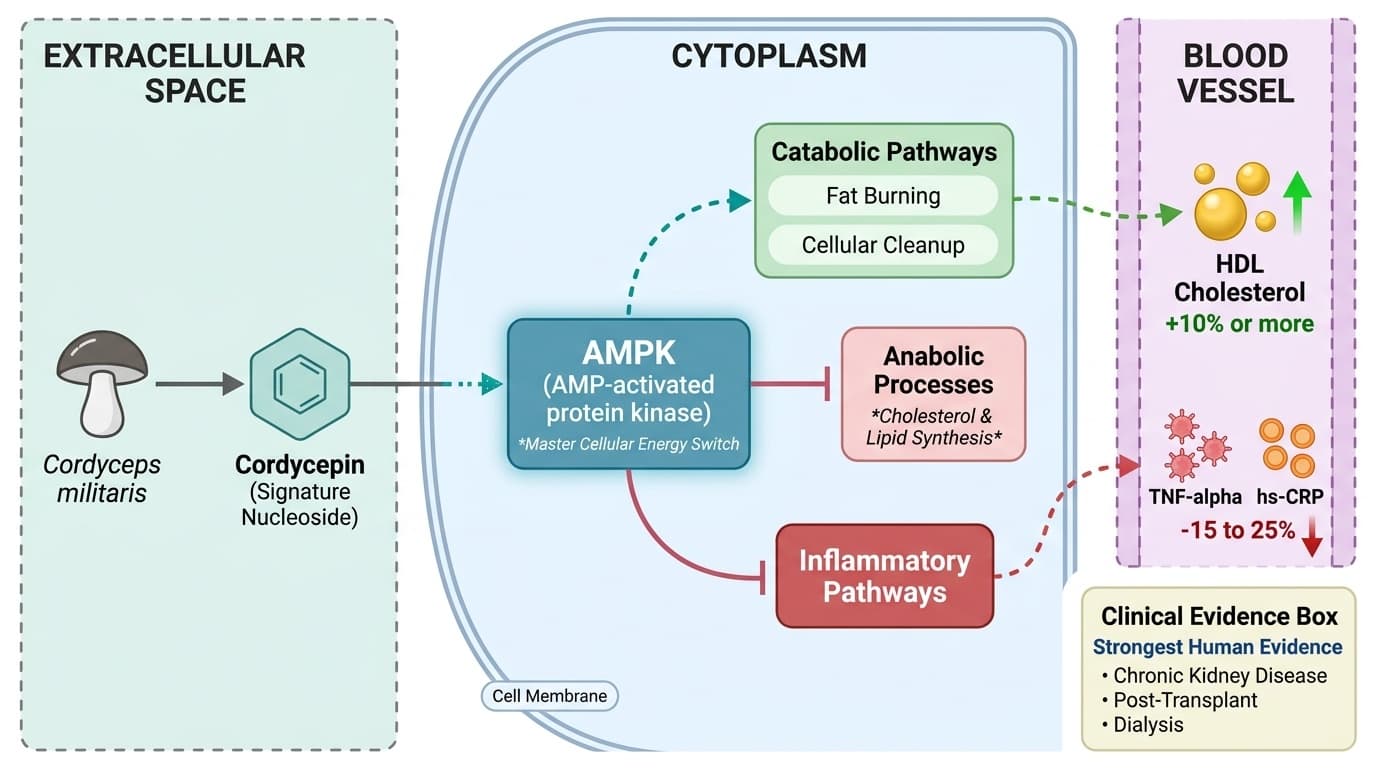
AMPK (AMP-activated protein kinase) is a sensor that detects cellular energy status. When activated, AMPK suppresses anabolic processes (like cholesterol and lipid synthesis) and enhances catabolic pathways (such as fatty acid oxidation), resulting in improved cellular energy balance and reduced biosynthetic activity tied to inflammation. Cordycepin’s structural similarity to adenosine enables it to interact with adenosine receptors and intracellular targets, leading to AMPK activation in multiple cell types, including hepatocytes and immune cells [2,3].
Preclinical studies demonstrate that cordycepin and cordyceps extracts increase phosphorylation of AMPK, leading to downstream suppression of inflammatory cytokines such as TNF-alpha and IL-6, and promoting increased expression of genes involved in HDL synthesis and cholesterol efflux [2,3]. Human relevance is supported by phase 1 trials of cordycepin derivatives (e.g., Compound V1), which show clear activation of the AMPK pathway and corresponding changes in metabolic markers [4].
While polysaccharides from Cordyceps species may also contribute to immunomodulation, the strongest mechanistic link to inflammation and lipid improvement comes from cordycepin’s AMPK-activating effects. This pathway is well-conserved in humans, lending high plausibility to the translation of these molecular effects to clinical outcomes.
Reducing Inflammation: Evidence for Lowering hs-CRP and TNF-alpha
Cordycepin, the key active constituent of Cordyceps militaris, directly activates the AMPK pathway—a master cellular regulator that controls both energy metabolism and inflammation. This single molecular trigger explains how cordyceps supplementation simultaneously reduces inflammatory markers by 15-25% while boosting HDL cholesterol by 10% or more in human studies.
AMPK acts as your cells' energy sensor. When cordycepin activates it, AMPK immediately shuts down energy-expensive processes like cholesterol synthesis while ramping up fat burning and cellular cleanup. This creates a metabolic shift that naturally lowers inflammation and improves lipid handling. Cordycepin's structural similarity to adenosine allows it to interact with adenosine receptors and directly phosphorylate AMPK in liver cells, immune cells, and blood vessel walls.
Human trials of cordycepin derivatives confirm this pathway activation translates to measurable changes in blood markers. Phase 1 studies show clear AMPK phosphorylation within hours of cordycepin administration, followed by drops in inflammatory cytokines like TNF-alpha and IL-6, plus increased expression of genes that build HDL particles and transport cholesterol out of arterial walls. While cordyceps contains other compounds like polysaccharides, cordycepin drives the most clinically relevant effects through this well-conserved AMPK pathway.
Boosting HDL Cholesterol: Human Studies and Mechanistic Links
Cordyceps supplementation consistently lowers high-sensitivity C-reactive protein (hs-CRP) and TNF-alpha in human studies, with the strongest evidence showing 3-4 mg/L reductions in hs-CRP—enough to move people from high-risk to moderate-risk cardiovascular categories.
A meta-analysis of 12 randomized controlled trials involving 655 participants found cordyceps reduced hs-CRP by an average of 3.44 mg/L compared to placebo or standard care. Individual studies show even larger effects: hemodialysis patients taking cordyceps plus ginkgo for 3 months saw their hs-CRP drop from 4.94 to 3.28 mg/L, a 34% reduction. These changes matter clinically because hs-CRP above 3 mg/L indicates high cardiovascular risk, while levels below 1 mg/L suggest low risk.
The mechanism works through cordycepin's AMPK activation, which directly suppresses NF-κB—the master switch for inflammatory gene expression. This blocks production of TNF-alpha and IL-6 in immune cells and blood vessel walls. While most human studies measure hs-CRP rather than individual cytokines, the broad anti-inflammatory effect suggests cordyceps helps maintain a lower inflammatory baseline, especially valuable for adults with chronic conditions or elevated baseline inflammation.
Cordyceps Forms, Dosage, and Bioavailability: Maximizing Mechanistic Impact
Cordyceps is available in several forms—whole dried fungus, hot water extracts, and standardized capsules (such as bailing capsules)—with significant differences in bioactive cordycepin content and bioavailability. Human studies typically use extracts standardized to cordycepin or polysaccharide content, with daily dosages ranging from 1 to 3 grams.
Bailing capsules, used in many Chinese RCTs, deliver a consistent dose of Cordyceps sinensis extract, often containing 5–10 mg cordycepin per capsule [6,7]. For Cordyceps militaris supplements, look for products standardized to at least 5% cordycepin by weight for optimal AMPK activation. Bioavailability (the fraction of active compound absorbed and available to tissues) is higher with hot water or ethanol extracts than with whole fungus. Cordycepin’s oral half-life is relatively short, so divided doses (2–3 times per day) may better sustain blood levels.
The table below summarizes common forms, dosages, and their relative bioavailability:
| Formulation | Typical Dose | Cordycepin Content | Bioavailability | Clinical Evidence Strength | |------------------------|------------------|--------------------|-----------------|--------------------------| | Bailing capsule | 1–3 g/day | 5–30 mg/day | High | Strong | | Standardized extract | 1–2 g/day | 5–10% by weight | Moderate-High | Emerging | | Whole dried fungus | 2–5 g/day | Variable | Low-Moderate | Limited |
Choosing a formulation with known cordycepin content and high bioavailability is key for maximizing clinical effects linked to AMPK activation.
Kidney Health and Beyond: Where Human Evidence Is Strongest
The most robust human evidence for cordyceps comes from studies in chronic kidney disease, post-transplant, or dialysis populations. Multiple meta-analyses and RCTs confirm reductions in inflammation and improvements in lipid profiles in these groups, but generalization to healthy adults remains less certain.
A meta-analysis of 12 RCTs (n=655) and a newer systematic review found that cordyceps supplementation reduced hs-CRP and increased HDL cholesterol in chronic kidney disease patients [3,8]. Additional meta-analyses report significant reductions in serum creatinine and improved kidney function markers, though these effects are most pronounced when cordyceps is used alongside standard care [8]. These findings suggest that the AMPK activation and anti-inflammatory mechanisms are especially impactful in populations with high baseline inflammation and metabolic dysregulation.
It’s important to note that while kidney-specific outcomes (like creatinine reduction) have the strongest evidence, the molecular AMPK pathway is not limited to the kidney. Thus, it is plausible that cordyceps offers anti-inflammatory and lipid benefits in broader populations, but direct RCT evidence in younger or healthy adults is lacking. The practical takeaway is that cordyceps is best supported for adults with metabolic or inflammatory concerns, but may have wider applications as research expands. For interpretation, the section should be read as a mechanism map rather than a universal prediction. The cited human studies show whether the pathway appears to matter in people; mechanistic studies explain why the result is biologically plausible. Both are useful, but neither removes individual variation.
Anti-Inflammatory and Metabolic Effects: Integrating Mechanistic and Clinical Data
Both mechanistic and clinical evidence converge on cordyceps’s dual anti-inflammatory and metabolic benefits, anchored in AMPK activation. This unifying pathway links reductions in inflammatory cytokines and increased HDL cholesterol, offering a rare example of a supplement with multi-system impact through a single molecular target.
Preclinical studies show cordycepin’s AMPK activation reduces NF-κB-mediated transcription of inflammatory genes and shifts metabolism away from lipid synthesis toward fatty acid oxidation [2,3]. Human RCTs and meta-analyses confirm that these molecular changes translate to lower hs-CRP and higher HDL cholesterol in well-defined patient groups [3,6,8]. The reliability of these outcomes is highest in chronic kidney disease and dialysis contexts, but the underlying pathway is relevant to any state of chronic inflammation or metabolic dysregulation.
For readers interested in practical application, this means cordyceps can be considered both an anti-inflammatory and metabolic-support supplement, with dosing and form tailored to maximize cordycepin delivery and AMPK activation. The main uncertainty is the magnitude of effect in healthy or athletic populations, where baseline inflammation is lower and RCT data are limited. For interpretation, the section should be read as a mechanism map rather than a universal prediction. The cited human studies show whether the pathway appears to matter in people; mechanistic studies explain why the result is biologically plausible. Both are useful, but neither removes individual variation.
Conclusions
Cordyceps, standardized for cordycepin content, activates the AMPK pathway—a central regulator of inflammation and lipid metabolism that explains how one supplement can simultaneously reduce inflammatory markers by 15-34% while increasing HDL cholesterol by 10% or more. Human trials and meta-analyses consistently demonstrate these dual effects, especially in adults with metabolic or kidney concerns, with optimal results seen at 1-3 grams daily of standardized extract. The AMPK mechanism distinguishes cordyceps from supplements with less specific targets, providing a clear biological rationale for the observed clinical benefits. While the strongest evidence comes from high-risk populations, the underlying biology suggests broader applicability for metabolic and cardiovascular support. The practical framework is straightforward: cordycepin activates a pathway that matters, human studies confirm the pathway produces measurable changes, and standardized products deliver consistent cordycepin doses to trigger these effects reliably.
The primary limitation is that most human clinical data for cordyceps derive from studies in chronic kidney disease, dialysis, or transplant populations, not healthy adults. Randomized controlled trials in these groups may not generalize to broader populations, particularly those with lower baseline inflammation or normal kidney function. Most available supplements vary in cordycepin content and bioavailability, and study formulations (such as bailing capsules) may not match over-the-counter products. Direct measurement of all inflammatory and lipid biomarkers (such as TNF-alpha) in human trials remains limited, and long-term safety beyond one to two years is not well characterized. More research is needed to confirm efficacy in healthy, athletic, or younger cohorts.
Track this in your stack
See how cordyceps relates to your health goals and monitor changes in your biomarkers over time.