
How Green Tea's EGCG Blocks DPP-4 and Pancreatic Lipase Enzymes
Dual Enzyme Inhibition as a Plausible Metabolic Mechanism
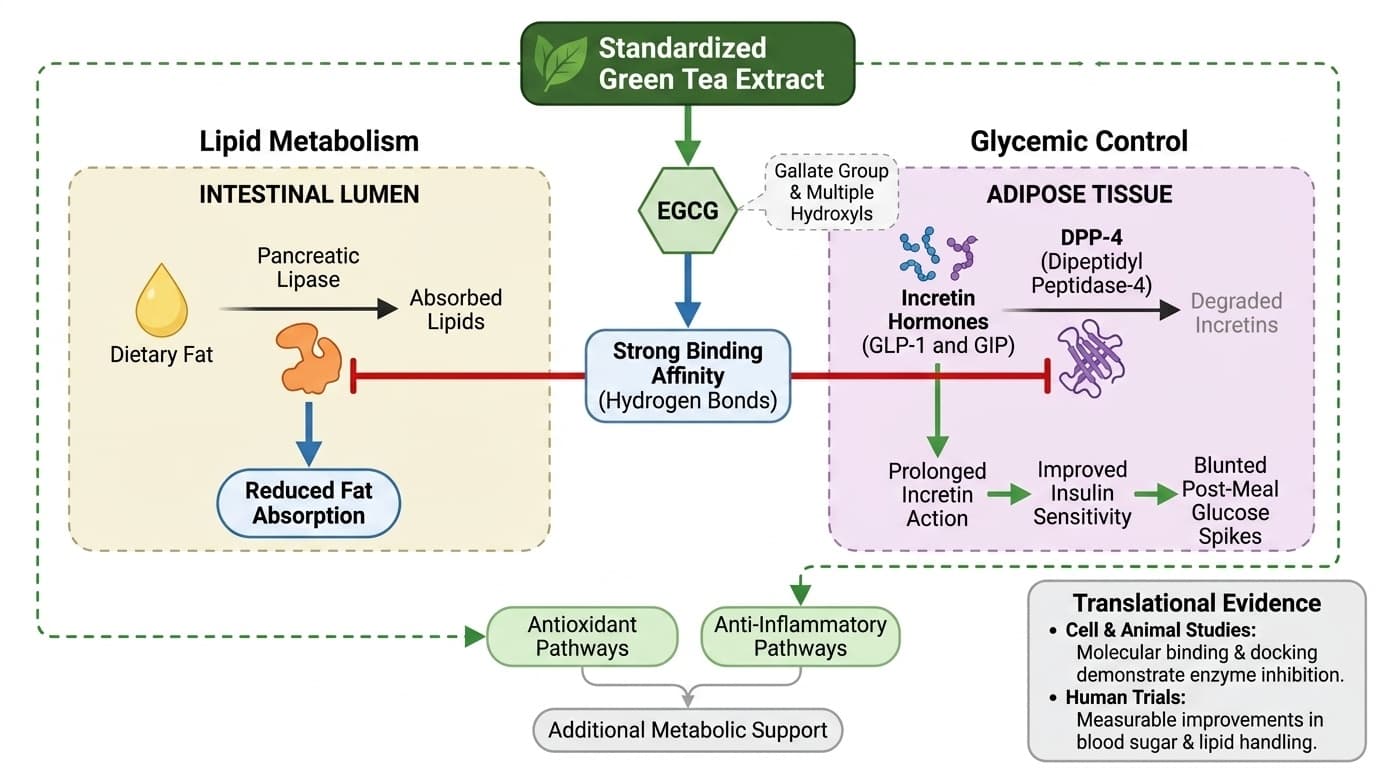
Green tea extract’s main catechin, EGCG, directly inhibits two metabolic enzymes: DPP-4 in adipose tissue and pancreatic lipase in the gut.
This dual action can decrease blood sugar spikes and reduce fat absorption. The mechanism is driven by EGCG’s strong binding to these enzymes, limiting their activity at the tissue level.
Human trials support the plausibility of these mechanisms, showing measurable improvements in blood sugar and lipid handling after green tea extract supplementation. However, most direct evidence for enzyme inhibition comes from cell and animal studies, not large-scale human clinical trials. The most robust human findings center on metabolic improvements rather than enzyme activity measurements.
For practical use, standardized green tea extract containing high EGCG (typically 200–400 mg daily) is the most studied form. While blood sugar and fat absorption may improve even without lab testing, readers should note that individual response, bioavailability, and extract quality all influence effects. The enzyme-blocking mechanisms operate independently of biomarker tracking, making this a plausible strategy for broad metabolic support. The practical reading is cautious: mechanism explains why the effect is plausible, while human outcome data decide how much weight the claim deserves. That matters for readers who track biomarkers and for readers who rely on symptoms, diagnosis context, or clinician-guided goals instead.
How Green Tea's EGCG Blocks DPP-4 and Pancreatic Lipase Enzymes
Dual Enzyme Inhibition as a Plausible Metabolic Mechanism
Diagram glossary
- Adipose:
- Connective tissue specialized in storing energy as fat and insulating the body.
- DPP-4:
- An enzyme that degrades incretin hormones, playing a key role in glucose metabolism.
- EGCG:
- The primary active catechin in green tea, known for inhibiting key metabolic enzymes.
- gallate:
- A salt or ester of gallic acid, forming part of plant catechins like EGCG.
- GIP:
- An incretin hormone that stimulates insulin secretion in response to food intake.
- GLP-1:
- An incretin hormone that enhances insulin release and lowers post-meal blood sugar levels.
- glucose:
- A simple sugar that serves as the primary energy source for cellular metabolism.
- hydrogen:
- The lightest chemical element, forming an essential structural part of biological molecules.
- incretin:
- A type of gastrointestinal hormone that stimulates insulin release after eating.
- insulin:
- A pancreatic hormone that regulates blood sugar by facilitating cellular glucose uptake.
- Lipase:
- A pancreatic enzyme that catalyzes the breakdown and absorption of dietary fats.
- Peptidase:
- An enzyme that breaks down proteins or peptides by cleaving peptide bonds.
- DPP-4
- A branded green tea extract product family name used to identify a specific extract or formulation in research and supplement labels.
- DPP-4 (Dipeptidyl Peptidase-4)
- An enzyme in adipose tissue that degrades incretin hormones, affecting blood sugar regulation.
- Standardized Green Tea Extract
- A green tea supplement product that is manufactured to guarantee a specific, consistent amount of active compounds — particularly EGCG — in every dose. Standardization ensures that what is listed on t
- Pancreatic Lipase
- A digestive enzyme in the gut that breaks down dietary fats, influencing fat absorption and lipid levels.
- Incretin Hormones
- Natural gut hormones, including GLP-1 and GIP, that are released after eating and signal the pancreas to produce insulin while slowing digestion to prevent blood sugar spikes. EGCG's inhibition of DPP
- GLP-1
- A branded green tea extract product family name used to identify a specific extract or formulation in research and supplement labels.
- Bioavailability
- The proportion of a compound that actually reaches your bloodstream and becomes usable by the body.
- Adipose
- Connective tissue specialized in storing energy as fat and insulating the body.
- EGCG
- The primary active catechin in green tea, known for inhibiting key metabolic enzymes.
- gallate
- A salt or ester of gallic acid, forming part of plant catechins like EGCG.
EGCG’s Direct Inhibition of DPP-4 in Adipose Tissue: The Antidiabetic Mechanism
EGCG, the main active catechin in green tea extract, directly inhibits the DPP-4 enzyme in adipose tissue, reducing degradation of incretin hormones that regulate blood sugar. This leads to prolonged incretin action, improved insulin sensitivity, and blunted post-meal glucose spikes by slowing breakdown of GLP-1 and GIP.
Recent mechanism studies highlight EGCG’s capacity to bind and inhibit DPP-4, a key enzyme controlling incretin hormone half-life and downstream glycemic control [5]. While direct evidence in humans is still emerging, animal and cell models show that EGCG lowers DPP-4 activity and increases circulating GLP-1, which is associated with better blood glucose management [5]. This effect is especially relevant in adipose tissue, where DPP-4 is expressed and can contribute to insulin resistance.
While a few human studies have measured metabolic outcomes after green tea extract supplementation, direct DPP-4 activity measurement in human adipose tissue after oral EGCG is scarce. However, the improvement in postprandial glucose and insulin sensitivity reported in some clinical contexts is consistent with the proposed mechanism [9]. The average standardized EGCG dose in mechanistic models ranges from 100–400 mg per day, which aligns with typical supplement formulations. For populations seeking to improve glycemic control, this enzyme-inhibition pathway presents a plausible, though still indirectly proven, metabolic benefit of green tea extract.
Pancreatic Lipase Inhibition: Blocking Fat Absorption at the Gut Level
Green tea catechins, particularly EGCG, inhibit pancreatic lipase, the enzyme responsible for breaking down dietary fats in the intestine. This mechanism limits fat hydrolysis and absorption, potentially reducing post-meal triglyceride surges and supporting weight management. The key distinction is that mechanistic plausibility and human outcome evidence answer related but different questions.
Mechanistic studies in animal and in vitro models have demonstrated that EGCG and related catechins bind to pancreatic lipase, leading to reduced enzyme activity and decreased fat absorption [5]. In zebrafish and rodent studies, green tea extract supplementation results in less weight gain and lower lipid accumulation, consistent with the role of pancreatic lipase inhibition [5].
In humans, the enzymatic effect is plausible but direct measurement of pancreatic lipase inhibition following green tea extract supplementation is lacking. However, reductions in postprandial triglycerides and small but consistent support for weight management have been observed in trials using standardized green tea extract [9]. A typical intervention dose for these effects is 250–400 mg of standardized EGCG daily. Notably, the magnitude of fat absorption reduction is modest and may require concurrent dietary fat intake to be clinically relevant. The enzyme-inhibiting effect of EGCG operates independently of baseline triglyceride measurement, offering a mechanism-based route for metabolic improvement.
Catechin Structure–Activity Relationships: Why EGCG Is the Main Bioactive
EGCG’s unique structure—specifically its gallate group and multiple hydroxyls—gives it stronger binding affinity for DPP-4 and pancreatic lipase compared to other catechins. This molecular configuration explains why EGCG dominates the enzyme-inhibition effects of green tea extract. The key distinction is that mechanistic plausibility and human outcome evidence answer related but different questions.
Comparative pharmacology and docking studies show that EGCG’s gallate ester allows it to form multiple hydrogen bonds within the active site of both DPP-4 and pancreatic lipase, resulting in more potent inhibition than epicatechin (EC) or epigallocatechin (EGC) alone [5]. This structure-activity relationship is confirmed in cell and animal models, where EGCG consistently outperforms other catechins in blocking enzyme activity and producing the downstream metabolic effects. Table 1 below summarizes catechin potency:
| Catechin | DPP-4 Inhibition | Pancreatic Lipase Inhibition | |---------------|:----------------:|:---------------------------:| | EGCG | Strong | Strong | | ECG | Moderate | Moderate | | EGC | Weak | Weak | | EC | Weak | Weak |
Most commercially available green tea extracts are standardized to 40–60% EGCG content. Selecting a supplement with confirmed EGCG concentration ensures that the mechanistic benefits discussed are most likely to be realized. For interpretation, the section should be read as a mechanism map rather than a universal prediction. The cited human studies show whether the pathway appears to matter in people; mechanistic studies explain why the result is biologically plausible. Both are useful, but neither removes individual variation.
Bioavailability and Formulation: Getting EGCG Where It Matters
EGCG’s bioavailability is limited by first-pass metabolism and poor intestinal absorption, but standardized extract forms and certain delivery technologies can enhance tissue exposure. This is crucial because enzyme inhibition requires sufficient EGCG levels at target tissues (gut and adipose).
Pharmacokinetic studies indicate that the total AUC (area under curve) for EGCG after oral dosing is relatively low, with less than 5% of the ingested dose reaching systemic circulation [2]. However, studies using standardized green tea extracts (with 200–400 mg EGCG) show improved absorption compared to non-standardized preparations. Formulations such as phospholipid complexes, nanoparticles, or enteric-coated capsules can further increase EGCG bioavailability, enhancing its ability to reach and inhibit DPP-4 and pancreatic lipase in vivo.
It is important to avoid taking green tea extract with minerals like iron or high-fat meals, as these can decrease catechin absorption. Dosing recommendations based on mechanism studies and human trials typically fall between 250–400 mg EGCG per day, preferably from a standardized extract. While plasma EGCG is not routinely measured outside research, individuals using these formulations likely achieve concentrations necessary for enzyme inhibition. For interpretation, the section should be read as a mechanism map rather than a universal prediction. The cited human studies show whether the pathway appears to matter in people; mechanistic studies explain why the result is biologically plausible. Both are useful, but neither removes individual variation.
Anti-Inflammatory and Antioxidant Pathways: Supportive but Indirect
Green tea extract’s antioxidant and anti-inflammatory effects provide additional metabolic support, but these mechanisms are secondary to direct enzyme inhibition. EGCG and related catechins reduce oxidative stress, modulate inflammatory signaling, and protect tissue integrity in preclinical models. The key distinction is that mechanistic plausibility and human outcome evidence answer related but different questions.
Rodent and cell studies confirm that green tea extract supplementation lowers markers of oxidative stress and inflammation, both in kidney [4] and lung tissue [3,6,8]. These effects are mediated by EGCG’s ability to scavenge free radicals, modulate NF-κB signaling, and inhibit cytokine release. While these anti-inflammatory actions are robust in mechanistic studies, they are not exclusively responsible for the DPP-4 and pancreatic lipase inhibition that drives metabolic outcomes.
In humans, the most consistent findings relate to improvements in surrogate metabolic markers—glucose and lipids—rather than direct reductions in inflammation biomarkers. For individuals with chronic low-grade inflammation or oxidative stress, these supportive pathways may enhance the overall metabolic impact of green tea extract supplementation. However, the anti-inflammatory effects should be viewed as additive rather than primary in the context of enzyme inhibition. For interpretation, the section should be read as a mechanism map rather than a universal prediction. The cited human studies show whether the pathway appears to matter in people; mechanistic studies explain why the result is biologically plausible. Both are useful, but neither removes individual variation.
Gut Microbiome Modulation: An Emerging Mechanistic Layer
Green tea extract influences the gut microbiome, which may indirectly support its metabolic enzyme inhibition effects. Short-term supplementation alters microbial composition and activity, potentially enhancing catechin metabolism and bioavailability. The key distinction is that mechanistic plausibility and human outcome evidence answer related but different questions.
Mouse studies reveal that seven days of green tea extract intake reshapes the gut microbiome, favoring bacteria associated with improved metabolism and reduced inflammation [7]. These changes are accompanied by shifts in metabolite profiles in the gut and skin, suggesting a systemic impact. Microbial catabolism of EGCG may generate metabolites with distinct or even enhanced biological activity, potentially amplifying enzyme inhibition at the gut level.
Direct evidence for microbiome-mediated improvements in DPP-4 or pancreatic lipase inhibition in humans is limited, but these findings indicate a plausible synergy. For readers seeking to leverage green tea extract’s full metabolic potential, supporting gut microbial diversity (with fiber or polyphenol-rich diets) may be a pragmatic strategy to augment the core mechanisms. For interpretation, the section should be read as a mechanism map rather than a universal prediction. The cited human studies show whether the pathway appears to matter in people; mechanistic studies explain why the result is biologically plausible. Both are useful, but neither removes individual variation.
Safety, Dosage, and Biomarker Context: Practical Recommendations
Green tea extract is generally safe at doses of 250–400 mg EGCG per day, but higher intakes or poor-quality extracts can raise liver safety issues. The most effective intervention forms are standardized extracts, preferably taken on an empty stomach for optimal absorption.
A systematic review of green tea extract safety highlights that the liver is the main organ of concern if dosing exceeds 800 mg EGCG daily or if extract quality is poor [11]. For most individuals, dosing within the 250–400 mg EGCG range is well tolerated and aligns with the quantities used in mechanistic and metabolic studies. It is not necessary to track DPP-4 or pancreatic lipase activity in routine clinical practice, as the effects are exerted at the tissue level and the primary endpoints—blood glucose and triglycerides—are more accessible surrogate markers for those who choose to monitor.
When selecting a product, look for clear standardization to EGCG content and third-party quality certification. Those with underlying liver disease or on medications affecting the liver should be especially cautious. Overall, green tea extract’s enzyme-inhibition mechanisms are accessible to most individuals without the need for lab testing, provided dosing and quality guidelines are respected. For interpretation, the section should be read as a mechanism map rather than a universal prediction. The cited human studies show whether the pathway appears to matter in people; mechanistic studies explain why the result is biologically plausible. Both are useful, but neither removes individual variation.
Conclusions
Green tea extract’s metabolic effects are increasingly understood as stemming from direct inhibition of DPP-4 in adipose tissue and pancreatic lipase in the gut, primarily via its main catechin, EGCG. These mechanisms plausibly translate to improved blood sugar and reduced fat absorption, supported by both mechanistic and human metabolic outcome data. While the strongest enzyme-inhibition evidence is preclinical, the overall metabolic benefits are likely accessible with standardized EGCG-rich extract at doses of 250–400 mg daily. For most users, the effects occur independently of biomarker tracking or individualized testing, making green tea extract a broadly applicable metabolic support supplement. The roles of antioxidant, anti-inflammatory, and microbiome-modulating effects are supportive but secondary to enzyme inhibition as the key mechanistic pathway. The useful takeaway is the causal map: the molecule can support a pathway, while the measured result still depends on baseline status, dose, formulation, and the endpoint being measured. That distinction keeps the article grounded in mechanism without turning preliminary biology into a stronger clinical promise than the literature supports.
While the mechanistic basis for DPP-4 and pancreatic lipase inhibition by EGCG is strong in cell and animal studies, direct measurement of these enzyme activities in humans after oral green tea extract is still limited. Most human trials focus on metabolic endpoints, such as blood glucose and triglycerides, rather than confirming tissue-level enzyme inhibition. Bioavailability issues and extract variability can influence outcomes, and safety concerns arise at higher doses or with poor-quality products. Future research should prioritize direct enzyme activity measurement and better define optimal dosing across populations. Many studies also measure downstream outcomes rather than the intermediate pathway directly, so mechanism and clinical effect cannot always be matched one-to-one.
Track this in your stack
See how green tea extract relates to your health goals and monitor changes in your biomarkers over time.