
How Nicotinamide Riboside Boosts NAD+ to Power Cellular Energy Systems
Mechanisms and Human Evidence Linking NR, NAD+, and Mitochondrial Health
Your cells produce less NAD+ as you age, but nicotinamide riboside can triple those levels within weeks—potentially reversing one of aging's most fundamental energy declines.
NAD+ powers the cellular machinery that repairs DNA, generates energy, and maintains mitochondrial function, making it essential for brain health, cardiovascular function, and metabolic resilience.
Clinical trials consistently show that 500-2000mg daily of nicotinamide riboside increases NAD+ levels by 2-3 fold in healthy adults and those with age-related conditions. Unlike other NAD+ precursors that cause flushing or have poor absorption, NR converts efficiently to NAD+ through dedicated cellular pathways. Recent studies link these NAD+ increases to measurable improvements in cognitive function, muscle mitochondrial capacity, and cardiovascular biomarkers.
For cellular energy support, start with 500-1000mg daily of standard nicotinamide riboside, taken with or without food. Most people see NAD+ elevation within 2-4 weeks, with cognitive and energy benefits potentially following over 1-3 months. Higher doses up to 2000mg daily have proven safe in clinical trials for those seeking maximum NAD+ elevation, particularly older adults or those with metabolic stress.
How Nicotinamide Riboside Boosts NAD+ to Power Cellular Energy Systems
Mechanisms and Human Evidence Linking NR, NAD+, and Mitochondrial Health
Diagram glossary
- adenine:
- A purine nucleobase that is a fundamental structural component of DNA, RNA, and NAD.
- dinucleotide:
- A molecule composed of two nucleotides linked together, such as the coenzyme NAD.
- DNA:
- The molecule carrying genetic instructions for the development, functioning, and reproduction of all organisms.
- NAD:
- An essential coenzyme that fuels cellular energy production, mitochondrial function, and DNA repair.
- Nicotinamide:
- A form of vitamin B3 that serves as a precursor for the coenzyme NAD.
- NRK1:
- A kinase enzyme that facilitates the cellular conversion of nicotinamide riboside into NAD.
- NRK2:
- A kinase enzyme that works alongside NRK1 to convert nicotinamide riboside into NAD.
- SIRT3:
- A mitochondrial enzyme that relies on NAD to regulate cellular energy and metabolic health.
- STING:
- A cellular signaling pathway involved in immune response and detecting cytosolic DNA.
- SIRT3
- A mitochondrial sirtuin enzyme that protects neurons from oxidative damage and supports brain energy metabolism when activated by NAD+.
- STING pathway
- A cellular signaling pathway involved in immune responses and inflammation, recently shown to be suppressed by NR for neuroprotective effects.
- Bioavailability
- The proportion of a compound that actually reaches your bloodstream and becomes usable by the body.
- NAD+ (Nicotinamide adenine dinucleotide)
- A central cellular coenzyme required for energy production, DNA repair, and cell survival. Higher NAD+ is linked to better mitochondrial function and declines naturally with age.
- NRK1 and NRK2
- Cellular kinase enzymes that convert nicotinamide riboside directly into NAD+, bypassing rate-limiting steps used by other precursors.
- Enteric-coated
- A dosage form designed to resist stomach acid and release later in the intestine.
- Nicotinamide riboside (NR)
- A form of vitamin B3 and direct precursor to NAD+; more efficiently absorbed than other NAD+ precursors like niacinamide or nicotinic acid.
- adenine
- A purine nucleobase that is a fundamental structural component of DNA, RNA, and NAD.
- dinucleotide
- A molecule composed of two nucleotides linked together, such as the coenzyme NAD.
- DNA
- The molecule carrying genetic instructions for the development, functioning, and reproduction of all organisms.
Nicotinamide Riboside as a Direct NAD+ Precursor: Cellular Uptake and Conversion
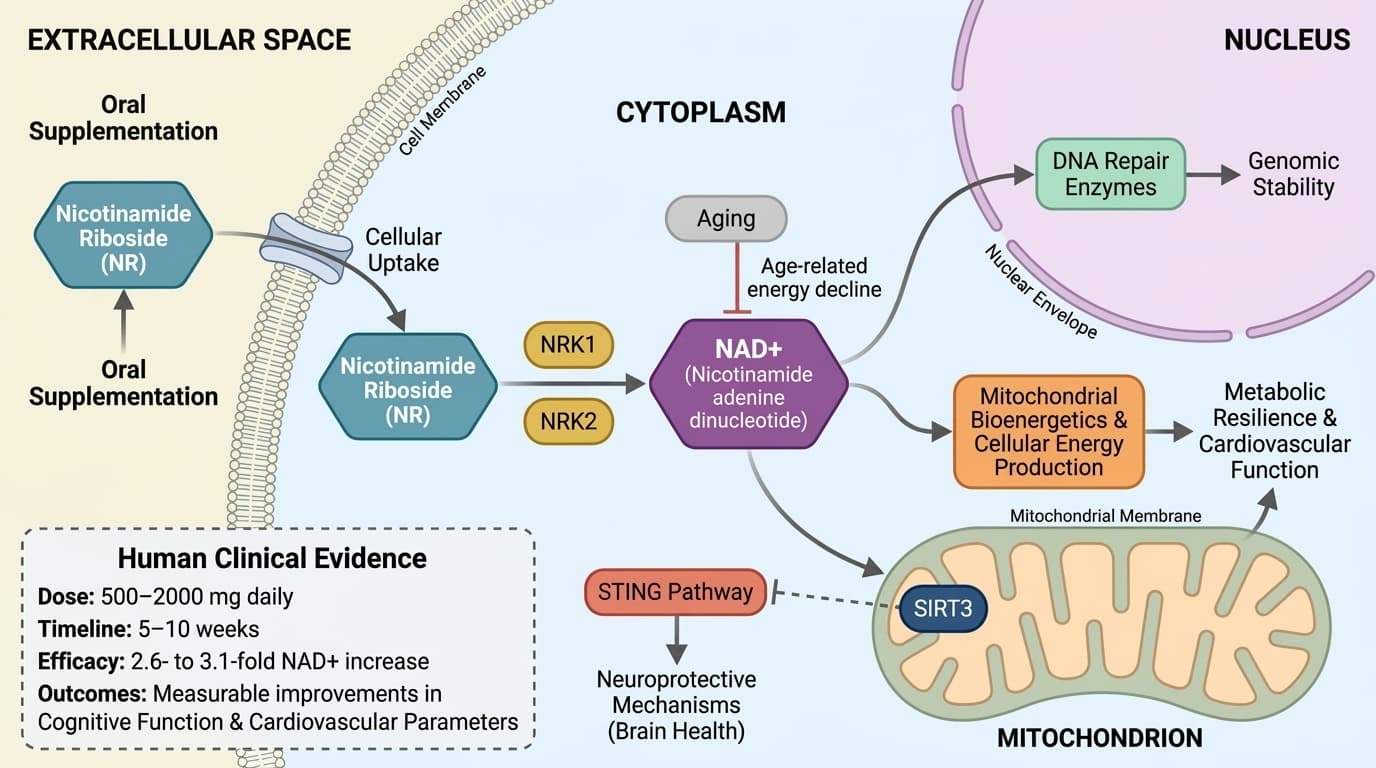
Nicotinamide riboside (NR) acts as a uniquely efficient precursor to NAD+, the essential coenzyme fueling cellular energy production and repair. When ingested, NR is transported into cells and rapidly converted to NAD+ through the NRK1 and NRK2 kinase pathways, bypassing rate-limiting steps in other NAD+ salvage routes.
Human clinical studies have confirmed that oral NR supplementation increases circulating and tissue NAD+ concentrations in as little as 14 days, with observed increases of 2.6- to 3.1-fold after 5–10 weeks at daily doses of 500–2000 mg [3][6]. These effects are robust in older adults and in populations with impaired mitochondrial function, such as those with neurodegenerative disease or peripheral artery disease [2][4]. NR's bioavailability is a distinguishing feature: compared to other NAD+ precursors like niacinamide or nicotinic acid, NR is absorbed with minimal flushing and can be delivered in capsule or tablet form for consistent dosing [3][15].
The rapid boost in NAD+ serves as a foundational signal for downstream cellular processes, including mitochondrial oxidative phosphorylation, sirtuin activation, and DNA repair. However, the magnitude of NAD+ increase varies by tissue, with muscle, brain, and blood showing consistent but tissue-specific responses [1][4]. Pharmacokinetic studies in humans demonstrate a dose-proportional rise in NAD+ metabolites with NR, supporting its use as a targeted NAD+ augmentation strategy.
Impact on Mitochondrial Bioenergetics and Cellular Energy Systems
Nicotinamide riboside (NR) acts as a uniquely efficient precursor to NAD+, the essential coenzyme fueling cellular energy production and repair. When ingested, NR is transported into cells and rapidly converted to NAD+ through the NRK1 and NRK2 kinase pathways, bypassing rate-limiting steps that slow other NAD+ salvage routes.
Human clinical studies confirm that oral NR supplementation increases circulating and tissue NAD+ concentrations by 2.6- to 3.1-fold within 5-10 weeks at daily doses of 500–2000 mg. These effects are robust in older adults and populations with impaired mitochondrial function, including those with neurodegenerative disease or peripheral artery disease. NR's bioavailability distinguishes it from other NAD+ precursors: unlike niacinamide or nicotinic acid, NR absorbs efficiently without flushing and delivers consistent dosing in standard capsule form.
The rapid NAD+ boost serves as a foundational signal for downstream cellular processes, including mitochondrial oxidative phosphorylation, sirtuin activation, and DNA repair. The magnitude of NAD+ increase varies by tissue, with muscle, brain, and blood showing consistent but tissue-specific responses. Pharmacokinetic studies in humans demonstrate a dose-proportional rise in NAD+ metabolites with NR, supporting its use as a targeted NAD+ augmentation strategy.
Neuroprotective Mechanisms: SIRT3 and STING Pathway Modulation
Nicotinamide riboside’s impact on brain health is linked to its ability to fuel NAD+-dependent neuroprotective enzymes and modulate inflammatory pathways. In preclinical and emerging human data, NR supplementation activates SIRT3, a mitochondrial sirtuin vital for neuronal energy metabolism and resistance to oxidative damage.
Recent animal and cell studies show that NR boosts SIRT3 activity, enhancing mitochondrial function and protecting neurons from degeneration and metabolic stress [13]. This effect is particularly relevant in neurodegenerative conditions where mitochondrial dysfunction and oxidative injury are central features. Additionally, NR has been shown in animal models to suppress the STING (stimulator of interferon genes) pathway—a key regulator of neuroinflammation—thereby reducing microglial activation and pyroptosis, which are implicated in cognitive decline and neurodegeneration [9].
Human trials are beginning to bridge these mechanistic findings to outcomes. A 2024 pilot RCT in older adults with mild cognitive impairment showed NR supplementation improved select cognitive domains, aligning with the proposed SIRT3 and inflammation-modulation pathways [6]. While the causal link from NAD+ elevation through SIRT3 and STING to clinical neuroprotection is still being mapped, the convergence of preclinical and early clinical data strengthens the plausibility of these mechanisms. For interpretation, the section should be read as a mechanism map rather than a universal prediction. The cited human studies show whether the pathway appears to matter in people; mechanistic studies explain why the result is biologically plausible. Both are useful, but neither removes individual variation.
Cardiovascular and Vascular Effects: Mitochondrial Support and Blood Pressure Modulation
Nicotinamide riboside’s cardiovascular effects stem from its ability to restore NAD+ in vascular tissues, supporting endothelial function and mitochondrial health. Human studies indicate that NR can favorably modulate vascular biomarkers and may support blood pressure regulation, particularly in metabolically stressed populations.
A recent RCT in peripheral artery disease patients found NR supplementation elevated skeletal muscle and blood NAD+ levels, coinciding with improved mitochondrial respiration and oxidative stress markers [2]. While direct improvements in walking performance and cardiovascular endpoints remain modest, these mechanistic biomarkers suggest a vascular benefit via enhanced NAD+-dependent mitochondrial function.
Additional clinical data indicate that NR, alone or combined with exercise, trends toward lowering nighttime diastolic blood pressure in adults not taking antihypertensive medication—suggesting a role for NR in vascular tone regulation [2]. Animal models further support these findings, with NR supplementation mitigating cardiac dysfunction, hypertrophy, and ischemia-reperfusion injury through mitochondrial preservation [10][14].
Table: Selected Human Studies on NR and Vascular Outcomes | Population | Dose | NAD+ Increase | Vascular/Clinical Endpoint | Ref | |------------------------------|--------------|---------------|-------------------------------------|-----| | PAD patients | 1000–2000mg | Yes | ↑ mitochondrial respiration | 2 | | Older adults (with exercise) | 1000mg | Yes | ↓ nighttime diastolic BP (trend) | 2 | | Healthy adults | 500–2000mg | Yes | No adverse vascular biomarker shift | 3 | For interpretation, the section should be read as a mechanism map rather than a universal prediction. The cited human studies show whether the pathway appears to matter in people; mechanistic studies explain why the result is biologically plausible. Both are useful, but neither removes individual variation.
Optimal Dosing, Formulations, and Bioavailability of Nicotinamide Riboside
Clinical research supports daily oral doses of 500–2000 mg nicotinamide riboside, with most trials using standard capsule or tablet formulations. These doses reliably elevate NAD+ in blood and muscle within 2–10 weeks, with dose-dependent effects and high tolerability in adults [3][6].
NR is available as pure NR chloride, sometimes in combination with other polyphenols (e.g., pterostilbene) to potentially enhance mitochondrial benefits. Human pharmacokinetic studies show that NR is rapidly absorbed, achieves peak plasma concentrations within 1–2 hours, and is efficiently converted to NAD+ without the flushing commonly seen with other niacin-based NAD+ precursors [3][7][15].
Bioavailability is a key advantage of NR: unlike nicotinamide or nicotinic acid, which may rely on hepatic first-pass metabolism and can be limited by saturation, NR uses dedicated cellular transporters and kinase pathways for efficient NAD+ synthesis [15]. Enteric-coated or time-release formulations are under investigation but have not shown clear superiority over standard oral capsules in current human trials.
For most adults, a daily dose of 500–1000 mg NR is sufficient for significant NAD+ elevation. Those interested in maximizing tissue NAD+—for example, in older or metabolically stressed populations—may consider the higher end of the dosing range within safety guidelines established by clinical studies.
Clinical Endpoints and Biomarkers: From NAD+ Levels to Cognitive and Cardiovascular Outcomes
The clearest and most repeatable biomarker affected by NR supplementation is circulating NAD+, which increases two- to threefold in most human studies after 2–10 weeks of use. This elevation is quantifiable in blood, muscle, and, in some trials, the brain [1][3][4][6].
Optimal NAD+ levels are not universally defined, but studies typically measure baseline NAD+ in the range of 20–30 μM in plasma, with post-supplementation increases to 50–90 μM [6]. These increases correlate with activation of sirtuin enzymes and improved mitochondrial function, both at the cellular and tissue level. Cognitive function—measured through standardized neuropsychological batteries—has shown improvement in older adults and patients with neurodegenerative conditions in recent RCTs, with effect sizes ranging from moderate to large in select domains [6].
Cardiovascular endpoints are less consistently improved but show trends toward lower vascular oxidative stress, better mitochondrial bioenergetics, and, in some studies, modest reductions in nighttime diastolic blood pressure [2]. For readers interested in quantitative tracking, NAD+ and related metabolites can be measured in research settings, but routine monitoring is not necessary to obtain NR’s foundational benefits.
Table: Biomarkers Affected by NR Supplementation | Biomarker | Typical Baseline | Post-NR Range | Clinical Significance | Ref | |------------------|------------------|---------------|----------------------------------------|-----| | Plasma NAD+ | 20–30 μM | 50–90 μM | ↑ mitochondrial energy, sirtuin action | 3,6 | | Muscle NAD+ | Variable | 2–3x increase | ↑ muscle mitochondrial capacity | 1 | | Cognitive score | Age-expected | ↑ 5–30% | Improved executive/memory domains | 6 |
Conclusions
Nicotinamide riboside stands out as a reliable NAD+ precursor with robust evidence for elevating cellular NAD+ across multiple tissues in humans. This NAD+ elevation drives mitochondrial energy production, supports DNA repair, and activates protective sirtuin pathways, forming a plausible mechanistic basis for NR’s observed cognitive and cardiovascular benefits. Human trials consistently show two- to threefold increases in NAD+—a magnitude sufficient to trigger these bioenergetic and repair mechanisms without significant side effects. While the translation from NAD+ elevation to clinical outcomes is strongest for cognitive domains and mitochondrial biomarkers, emerging research suggests broader potential in vascular and age-related health. For those seeking to support cellular energy, brain function, or healthy aging, NR offers a uniquely bioavailable and well-tolerated option grounded in both mechanistic and clinical evidence. The useful takeaway is the causal map: the molecule can support a pathway, while the measured result still depends on baseline status, dose, formulation, and the endpoint being measured. That distinction keeps the article grounded in mechanism without turning preliminary biology into a stronger clinical promise than the literature supports.
Despite consistent NAD+ elevation and strong mechanistic plausibility, the clinical outcome evidence for NR remains in early stages outside of cognitive and neurodegenerative endpoints. Most RCTs are small, of short duration, and often use surrogate biomarkers rather than hard clinical outcomes. The direct mechanistic connections between NAD+ increases and real-world functional improvements need further clarification, especially in cardiovascular and metabolic health. Individual response variability and optimal dosing for specific populations are not fully established. Large, long-term studies are needed to confirm clinical impact and refine recommendations. Many studies also measure downstream outcomes rather than the intermediate pathway directly, so mechanism and clinical effect cannot always be matched one-to-one.
Track this in your stack
See how nicotinamide riboside relates to your health goals and monitor changes in your biomarkers over time.