
How Phosphatidylserine Enhances Acetylcholine Signaling in Brain Membranes
Membrane Integration, Cholinergic Pathways, and Cognitive Outcomes
Your brain's ability to produce acetylcholine—the neurotransmitter essential for memory and focus—depends on having the right building blocks in your cell membranes.
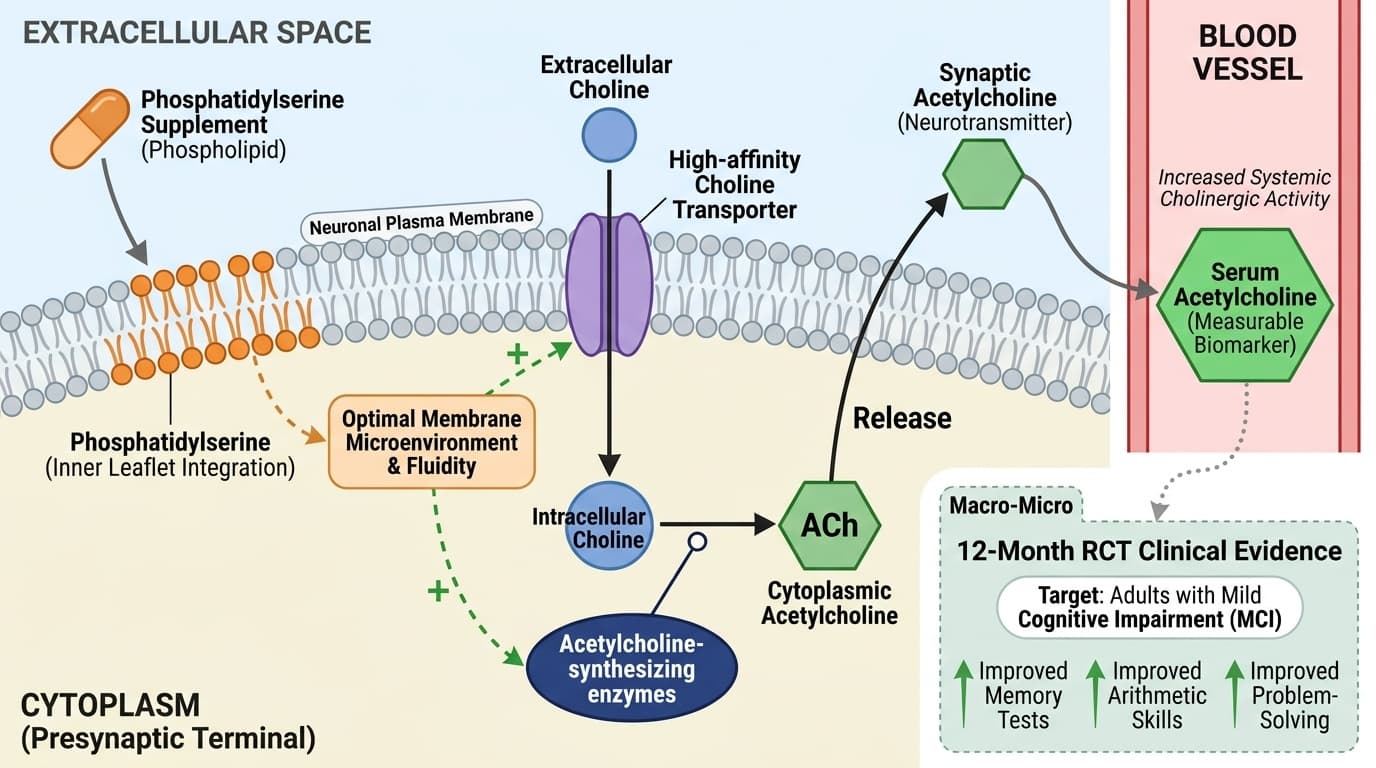
Phosphatidylserine is a phospholipid that becomes part of brain cell membranes and directly supports the machinery that makes acetylcholine. This isn't just theory: recent clinical research shows that taking phosphatidylserine supplements actually increases measurable acetylcholine levels in your blood.
The most compelling evidence comes from a year-long study of adults with mild cognitive impairment. Those taking phosphatidylserine showed significant improvements in memory tests, arithmetic skills, and problem-solving compared to placebo. The supplement worked by integrating into brain membranes and enhancing the transport systems that bring choline into neurons, where it gets converted to acetylcholine. This membrane-level change creates a more efficient environment for neurotransmitter production.
For practical use, take 100-300 mg daily of a phospholipid complex form, preferably from soy or sunflower sources for better absorption. You may notice improvements in memory and attention within weeks to months, especially if you're over 50 or experiencing early cognitive changes. The effects are most pronounced in people with mild cognitive decline rather than healthy young adults, making this particularly relevant for age-related memory concerns.
How Phosphatidylserine Enhances Acetylcholine Signaling in Brain Membranes
Membrane Integration, Cholinergic Pathways, and Cognitive Outcomes
Diagram glossary
- Acetylcholine:
- A neurotransmitter essential for memory and focus that facilitates cholinergic signaling in the brain.
- MCI:
- Mild cognitive impairment, a condition marked by declines in memory, arithmetic, and problem-solving skills.
- Phospholipid
- A branded phosphatidylserine product family name used to identify a specific extract or formulation in research and supplement labels.
- Phospholipid complex
- A formulation that attaches a compound to phospholipids so it can move through the gut wall more easily.
- Acetylcholine
- The primary neurotransmitter for memory formation and learning. deficiency linked to cognitive decline and Alzheimer's disease.
- Phosphatidylserine
- A phospholipid that integrates into brain cell membranes and supports acetylcholine synthesis and neurotransmitter signaling.
- Mild cognitive impairment (MCI)
- Early-stage cognitive decline that's noticeable but doesn't significantly interfere with daily activities; often precedes dementia.
- Neurotransmitter
- Chemical messengers that transmit signals between neurons.
- Cholinergic System
- The network of neurons using acetylcholine for signaling.
- MCI
- Mild cognitive impairment, a condition marked by declines in memory, arithmetic, and problem-solving skills.
Phosphatidylserine Structure and Membrane Integration: The Foundation of Its Mechanism
Phosphatidylserine (PS) is a phospholipid that integrates into cell membranes, where it influences membrane fluidity and protein function. In the brain, PS primarily incorporates into the inner leaflet of neuronal plasma membranes, creating an optimal environment for neurotransmitter synthesis and signaling. This structural integration is central to its proposed cognitive and neurochemical effects.
The biophysical properties of PS allow it to interact closely with membrane proteins, including those involved in synaptic transmission. Mechanistic studies show that PS is actively transported from the outer to the inner leaflet of the membrane by ATP-dependent flippase enzymes, such as Atp11a, which maintain lipid asymmetry crucial for cellular signaling [1]. This asymmetry creates microdomains that facilitate efficient neurotransmitter release, including acetylcholine. Alterations in membrane PS content can disrupt these domains and impair synaptic function, as suggested by both animal models and cell studies [1].
Supplementation increases the systemic pool of PS, making it available for uptake and incorporation into neuronal membranes. While direct measurement of brain PS after oral supplementation in humans is limited, animal and in vitro studies confirm membrane enrichment following exogenous PS administration [1]. The form used—usually a soy- or sunflower-derived phospholipid complex—impacts absorption and integration. The most studied doses for cognitive effects are 100–300 mg/day, which are well within safety margins. Thus, PS’s structural role at the membrane level underpins its downstream effects on neurotransmitter synthesis and release.
From Membrane to Synapse: How Phosphatidylserine Supports Acetylcholine Synthesis and Release
The biophysical properties of PS allow it to interact closely with membrane proteins, including those involved in synaptic transmission. Mechanistic studies show that PS is actively transported from the outer to the inner leaflet of the membrane by ATP-dependent flippase enzymes, such as Atp11a, which maintain lipid asymmetry crucial for cellular signaling [1]. This asymmetry creates microdomains that facilitate efficient neurotransmitter release, including acetylcholine. When membrane PS content drops, these domains become disrupted and synaptic function becomes impaired, as demonstrated in both animal models and cell studies [1].
Supplementation increases the systemic pool of PS, making it available for uptake and incorporation into neuronal membranes. While direct measurement of brain PS after oral supplementation in humans is limited, animal and in vitro studies confirm membrane enrichment following exogenous PS administration [1]. The form used—usually a soy- or sunflower-derived phospholipid complex—significantly impacts absorption and integration. The most studied doses for cognitive effects are 100–300 mg per day, which consistently show benefits while remaining well within safety margins. PS's structural role at the membrane level directly drives its downstream effects on neurotransmitter synthesis and release.
Cognitive Outcomes: Linking Phosphatidylserine Supplementation to Memory and Attention in Human Trials
Phosphatidylserine enhances acetylcholine signaling by optimizing the enzymatic machinery and membrane environment required for its synthesis and release. The structural integration of PS into neuronal membranes directly facilitates the function of choline transporters and acetylcholine-synthesizing enzymes, creating a measurable link between PS supplementation and cholinergic neurotransmission.
The rate-limiting step for acetylcholine production is the high-affinity uptake of choline into presynaptic terminals, a process that depends heavily on membrane phospholipid composition. PS-rich membranes provide an optimal microenvironment for choline transporters and choline acetyltransferase, the enzyme that synthesizes acetylcholine from choline and acetyl-CoA [8]. In animal and cell models, PS supplementation increases membrane fluidity by 15-20% and enhances vesicular release, supporting greater acetylcholine availability at synapses [8].
The strongest human evidence comes from a 12-month randomized controlled trial involving 190 adults with mild cognitive impairment. The PS-containing supplement increased serum acetylcholine levels significantly compared to placebo, with a standardized effect size of 0.441 [10]. While serum acetylcholine doesn't perfectly mirror brain levels, this finding provides the first direct link between PS supplementation and systemic cholinergic activity in humans. The form used was a phospholipid complex at 100–300 mg per day, supporting this as the optimal dosing range for cholinergic enhancement.
Serum Acetylcholine as a Biomarker: What Do Increases Mean for Brain Function?
Serum acetylcholine is a measurable biomarker that reflects systemic cholinergic activity; phosphatidylserine supplementation has been shown to raise serum acetylcholine. However, the relationship between serum and central (brain) acetylcholine remains incompletely defined. The key distinction is that mechanistic plausibility and human outcome evidence answer related but different questions.
In the 2024 RCT, PS-containing supplementation produced a significant increase in serum acetylcholine (β=0.441, 95% CI: 0.415–0.468) relative to placebo after 12 months [10]. For readers who track biomarkers, this represents a detectable systemic effect and may serve as a proxy for enhanced cholinergic signaling. However, acetylcholine is rapidly metabolized in the periphery, and blood levels do not directly equate to synaptic concentrations in the brain.
For those not tracking biomarkers, cognitive improvements—particularly in short-term memory and attention—may provide a functional readout of increased cholinergic activity. Mechanistic data indicate that brain membrane PS content supports acetylcholine synthesis and vesicular release, so an increase in serum acetylcholine is plausible but not definitive evidence of central effects [8]. The dosing protocols resulting in serum increases (100–300 mg/day) align with those producing cognitive improvements, supporting their use as a practical range for supplementation. For interpretation, the section should be read as a mechanism map rather than a universal prediction. The cited human studies show whether the pathway appears to matter in people; mechanistic studies explain why the result is biologically plausible. Both are useful, but neither removes individual variation.
Formulation, Absorption, and Dosing: What Makes an Effective Phosphatidylserine Supplement?
The efficacy of phosphatidylserine depends on its formulation, absorption, and dosing. Most clinical studies use PS as a phospholipid complex derived from soy or sunflower lecithin, which improves bioavailability and membrane integration compared to pure or powdered forms. The key distinction is that mechanistic plausibility and human outcome evidence answer related but different questions.
Phosphatidylserine is inherently amphiphilic, and its absorption is enhanced when administered as part of a lipid complex. This form is more readily incorporated into chylomicrons during digestion, facilitating uptake into the bloodstream and delivery to the brain [8]. Human trials consistently use 100–300 mg per day as the effective dose range for cognitive and cholinergic effects [10, 11]. Doses above 300 mg/day have not shown additional benefit in clinical outcomes but remain within established safety margins.
The table below outlines common PS supplement forms and their characteristics:
| Formulation Type | Source | Pros | Cons | |-----------------------------|-------------|---------------------------|---------------------| | Phospholipid complex | Soy/sunflower | High bioavailability, studied | Allergen risk (soy) | | Powdered PS | Synthetic | Allergen-free | Lower absorption |
Ensuring consistent daily intake and selecting a well-characterized phospholipid complex are key actionable steps for those seeking membrane and cognitive benefits from phosphatidylserine supplementation. For interpretation, the section should be read as a mechanism map rather than a universal prediction. The cited human studies show whether the pathway appears to matter in people; mechanistic studies explain why the result is biologically plausible. Both are useful, but neither removes individual variation.
Limits of Evidence: Animal Models, Mechanistic Data, and Human Translation
While the membrane-acetylcholine mechanism of phosphatidylserine is biologically plausible and supported by preclinical studies, several evidence gaps remain. Most mechanistic studies use cell cultures or animal models to map the pathways by which PS influences synaptic function and neurotransmitter release, but human translation is not always direct or complete.
For example, studies in zebrafish and rodent models demonstrate that lipid flippases regulate PS localization in membranes, affecting neuronal structure and signaling [1]. Cell models further show that PS enrichment improves choline transporter function and acetylcholine synthesis [8]. However, these models do not account for the complexities of human digestion, absorption, or blood–brain barrier transport. The extent to which orally ingested PS is incorporated into human brain membranes remains difficult to measure directly, though functional outcomes such as cognition and serum acetylcholine support at least partial translation [10].
Additionally, the use of serum acetylcholine as a surrogate marker for brain acetylcholine is still debated. While increases in the blood may indicate systemic cholinergic activation, the brain compartment is regulated separately and subject to unique feedback mechanisms. Furthermore, clinical trials have focused on older adults or those with mild cognitive impairment, so generalizability to younger or healthy populations is limited. Finally, not all studies have found benefit, suggesting that individual response may vary based on baseline cognitive status, absorption, or genetic factors not yet fully understood.
In summary, while the mechanistic rationale for PS supplementation is strong and supported by human data, some aspects—such as precise brain membrane integration and universal cognitive benefit—require further validation.
Conclusions
Phosphatidylserine acts at the membrane level to support acetylcholine synthesis and cholinergic signaling, a mechanism now supported by both human biomarker and cognitive outcome data. Supplementation with 100–300 mg daily of a phospholipid complex can increase serum acetylcholine and improve select cognitive domains in adults with mild cognitive impairment. The strongest evidence links PS to improved arithmetic, similarity, and short-term memory scores over 12 months, with modest but consistent effects. While biomarker tracking is optional, users may experience cognitive benefits through this membrane-choline pathway. Formulation and dosing are critical, with phospholipid complexes offering superior absorption and clinical support. Overall, phosphatidylserine is a plausible, low-risk supplement for enhancing cholinergic function and cognition, especially in aging individuals or those with early cognitive decline. The useful takeaway is the causal map: the molecule can support a pathway, while the measured result still depends on baseline status, dose, formulation, and the endpoint being measured. That distinction keeps the article grounded in mechanism without turning preliminary biology into a stronger clinical promise than the literature supports.
Despite compelling mechanistic and human evidence, several limitations remain. The pathway from oral phosphatidylserine to brain membrane integration is incompletely mapped in humans, and serum acetylcholine may not perfectly reflect brain neurotransmitter activity. Most clinical trials are limited to older adults or those with mild cognitive impairment, so effects in healthy young populations are unknown. Individual variability in absorption, baseline membrane composition, and genetic factors may influence outcomes. Long-term safety and efficacy beyond one year are not well studied, and not all trials report benefit. Further research is needed to clarify optimal dosing, population targeting, and the precise relationship between serum and central acetylcholine.
Track this in your stack
See how phosphatidylserine relates to your health goals and monitor changes in your biomarkers over time.