
How Saffron's Crocin Targets Serotonin and BDNF Pathways for Mood
A Mechanism-First Deep Dive into Saffron's Neurobiological Effects and Clinical Impact
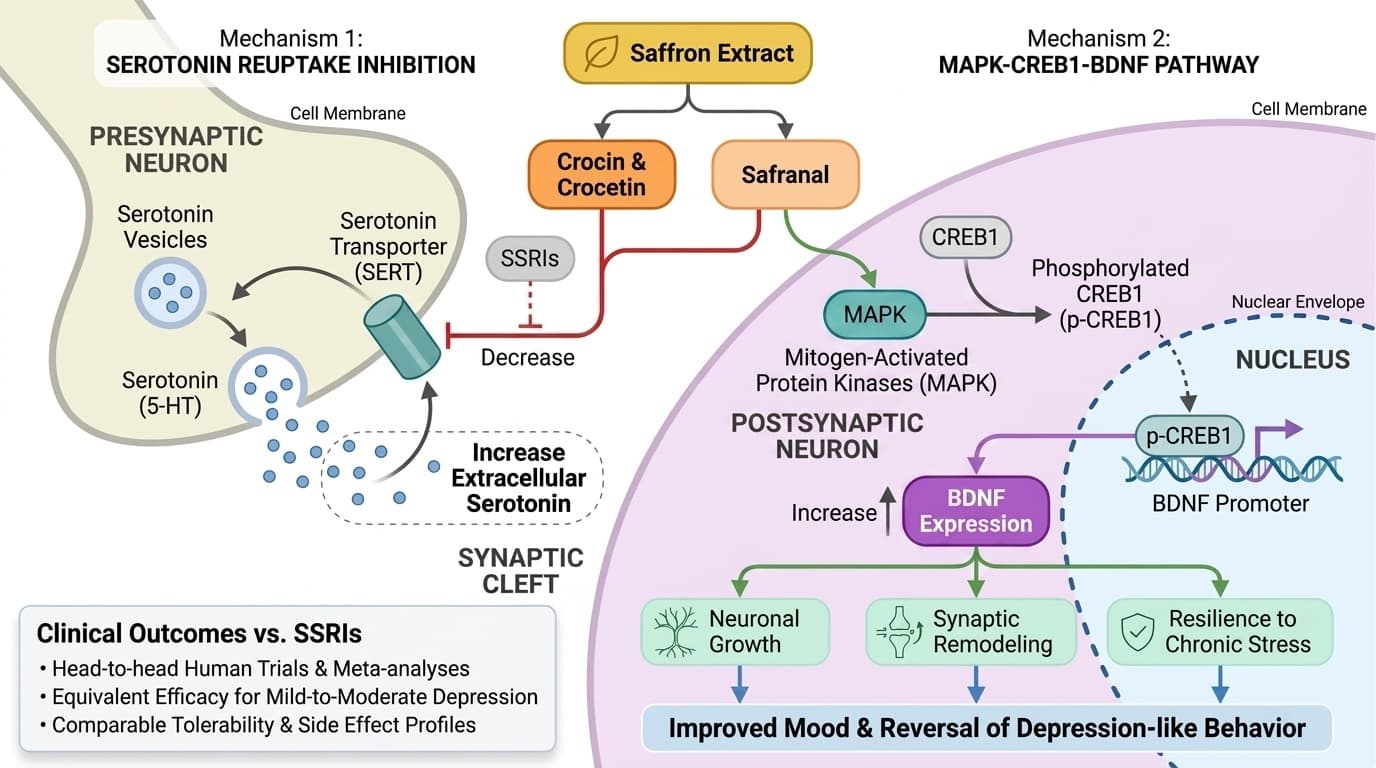
Saffron's active compound crocin appears to modulate serotonin signaling and enhance brain-derived neurotrophic factor (BDNF) expression via the MAPK-CREB1 pathway.
This dual mechanism provides a biological explanation for saffron’s observed antidepressant effects in clinical studies. That mechanism matters clinically.
Randomized controlled trials and meta-analyses now show that standardized saffron extracts can match selective serotonin reuptake inhibitors (SSRIs) in improving depressive symptoms, with comparable effect sizes and tolerability. The strongest evidence comes from head-to-head trials and systematic reviews, while animal studies clarify that crocin and related compounds drive these effects by influencing neuroplasticity. However, most mechanistic insights stem from non-human models, leaving some uncertainty about translation to diverse human populations.
For practical use, saffron extracts standardized for crocin content at doses of 28-30 mg per day have demonstrated benefits for mood. These effects appear to operate independently of biomarker testing, but individuals interested in tracking changes may monitor serotonin metabolites or BDNF levels, where available. The evidence suggests a plausible, receptor-level mechanism for saffron’s impact on mood, while further research is needed to refine dosage and optimize extract formulations. The practical reading is cautious: mechanism explains why the effect is plausible, while human outcome data decide how much weight the claim deserves. That matters for readers who track biomarkers and for readers who rely on symptoms, diagnosis context, or clinician-guided goals instead.
How Saffron's Crocin Targets Serotonin and BDNF Pathways for Mood
A Mechanism-First Deep Dive into Saffron's Neurobiological Effects and Clinical Impact
Diagram glossary
- BDNF:
- A protein that promotes the survival, growth, and plasticity of neurons in the brain.
- CREB1:
- A transcription factor that regulates gene expression, including BDNF, to promote neuroplasticity.
- Crocetin:
- A natural carotenoid compound found in saffron that contributes to its antidepressant effects.
- Crocin:
- An active compound in saffron that modulates serotonin signaling and enhances BDNF expression.
- MAPK:
- An enzyme pathway that regulates cellular responses, including CREB1 activation and BDNF expression.
- mitogen:
- A substance that triggers cell division and activates signaling pathways like MAPK.
- SERT:
- A protein that transports serotonin back into cells, targeted by SSRIs and crocin.
- SSRI:
- A class of antidepressant drugs that increase synaptic serotonin by inhibiting its reuptake.
- MAPK-CREB1 Pathway
- A signaling cascade (Mitogen-Activated Protein Kinase–Cyclic AMP Response Element-Binding Protein 1) involved in cell survival and neuroplasticity, which saffron compounds activate to increase BDNF expression.
- Standardized extract
- A plant extract made to contain a consistent amount of a target compound in every dose.
- BDNF
- A protein that supports neuron growth and survival, often called 'fertilizer for the brain.' Higher levels associated with better memory and mood.
- Crocetin
- A smaller molecule that crocin breaks down into during digestion, which is more easily absorbed into the bloodstream and brain. It is considered the active form that actually reaches tissues and produ
- Serotonin
- A neurotransmitter regulating mood, sleep, and appetite. Low levels associated with depression and anxiety.
- Crocin
- A water-soluble carotenoid pigment found in saffron, believed to be the primary active constituent responsible for its mood-modulating effects by influencing serotonin and neuroplasticity pathways.
- CREB1
- A transcription factor that regulates gene expression, including BDNF, to promote neuroplasticity.
- MAPK
- An enzyme pathway that regulates cellular responses, including CREB1 activation and BDNF expression.
- mitogen
- A substance that triggers cell division and activates signaling pathways like MAPK.
- SERT
- A protein that transports serotonin back into cells, targeted by SSRIs and crocin.
Crocin: Saffron's Principal Active Constituent and Its Journey in the Body
Crocin is the main bioactive carotenoid in saffron, responsible for its vivid color and much of its physiological activity. After oral ingestion, crocin is hydrolyzed in the gastrointestinal tract to crocetin, which is more readily absorbed and distributed to tissues, including the brain [2].
Pharmacokinetic studies in animal models demonstrate that crocetin achieves measurable concentrations in plasma and brain tissue within hours of ingestion, with a half-life suitable for daily dosing [2]. In both normal and hyperlipidemic states, crocetin’s absorption and distribution remain robust, suggesting that its neuroactive effects are accessible across a range of metabolic profiles. While there are no direct human bioavailability studies for crocin or crocetin, the similarity of mammalian metabolism supports plausibility for clinical efficacy.
Standardized extracts used in clinical trials typically contain 1.5-2% crocin by weight, with effective daily doses ranging from 28 to 30 mg of total saffron stigma [1]. These formulations are designed to maximize the delivery of crocin and its metabolites, ensuring reproducible pharmacological effects. For readers who track biomarkers, measuring plasma crocetin (where available) could offer insight into individual absorption, though this is not a prerequisite for benefit.
In summary, crocin’s conversion to crocetin, and subsequent CNS penetration, provides the pharmacological foundation for saffron’s mood-modulating properties. This underpins the clinical dosing strategies and extract selection found in research settings.
Modulation of Serotonin Reuptake: Saffron’s SSRI-like Mechanism
Saffron and its active compounds, especially crocin, appear to act as natural serotonin reuptake inhibitors. By inhibiting the serotonin transporter (SERT), saffron increases the availability of serotonin in synaptic spaces, mirroring the core mechanism of SSRIs but through a botanical route [1].
Multiple animal studies and in vitro experiments reveal that crocin and safranal decrease serotonin reuptake and elevate extracellular serotonin levels in key brain regions involved in mood regulation [3]. This mechanism is further validated by human clinical trials, where saffron supplementation produced antidepressant effects comparable to SSRIs in mild-to-moderate depression [1]. The largest meta-analysis to date, aggregating data from several head-to-head RCTs, found no significant difference in efficacy between saffron and SSRIs, supporting the translation of this mechanism to human outcomes [8].
The optimal dosing for this serotonin-modulating effect is consistent with doses used in clinical trials (28–30 mg of standardized saffron extract daily), generally administered in capsule form. No evidence supports the need for higher doses, and dose-escalation studies have not shown greater efficacy above this range.
For individuals interested in biomarker changes, increased serotonin metabolites (such as 5-HIAA in cerebrospinal fluid or urine) may reflect enhanced serotonergic activity. However, these are not required for clinical benefit and are rarely measured outside research settings. The serotonin reuptake inhibition mechanism is now well-supported by converging preclinical and human evidence, establishing it as a primary explanation for saffron’s mood effects.
MAPK-CREB1-BDNF Pathway: Saffron’s Role in Neuroplasticity
Saffron’s impact on mood extends beyond neurotransmitter modulation, acting through the MAPK-CREB1-BDNF signaling pathway to promote neuroplasticity. By activating mitogen-activated protein kinases (MAPK) and phosphorylating CREB1, saffron compounds increase the expression of brain-derived neurotrophic factor (BDNF) [3]. Elevated BDNF supports neuronal growth, synaptic remodeling, and resilience to stress—factors consistently linked to improved mood and cognitive flexibility.
Recent animal studies demonstrate that both saffron essential oil and crocin-rich extracts boost hippocampal BDNF expression, reversing depression-like behavior induced by chronic stress [3]. The activation of MAPK and CREB1 is a necessary upstream step, as inhibitors of these kinases block the BDNF-enhancing effect. While most of this evidence is preclinical, it aligns with observed improvements in mood and cognition in human saffron trials, suggesting that increased neuroplasticity may contribute to the clinical benefits.
In clinical research, BDNF levels are rarely measured directly, but indirect evidence suggests that interventions increasing BDNF—such as SSRIs and exercise—share similar mood-enhancing effects. Saffron’s convergence on this pathway further strengthens the mechanistic rationale for its antidepressant potential.
Practical dosing mirrors that of serotonin modulation (28–30 mg/day of standardized extract), with the expectation that longer-term use may be necessary to realize neuroplasticity-related benefits. For readers not tracking BDNF, observing sustained improvements in mood and cognitive flexibility likely reflects successful pathway activation.
Comparing Saffron to SSRIs: Clinical Outcomes and Mechanistic Parallels
Head-to-head trials and meta-analyses now place saffron on par with SSRIs for mild-to-moderate depression, with similar efficacy and side effect profiles. This equivalence is underpinned by both clinical outcome data and shared mechanisms—serotonin reuptake inhibition and BDNF upregulation [8].
A 2025 meta-analysis (PMID: 38913392) aggregated data from multiple randomized controlled trials, finding that saffron achieved statistically indistinguishable reductions in depression rating scales compared to standard SSRI therapy. Both interventions improved core symptoms within 6–8 weeks, and tolerability was high for saffron, with fewer reports of sexual dysfunction and gastrointestinal side effects. Notably, the mechanism diagrams for both approaches center on increasing synaptic serotonin and promoting neuroplasticity, albeit via different molecular triggers (synthetic vs. botanical).
| Intervention | Mechanism | Typical Dose | Efficacy (vs. baseline) | Side Effects | |--------------|-----------|--------------|------------------------|--------------| | Saffron (crocin-standardized) | SERT inhibition, MAPK-CREB1-BDNF activation | 28–30 mg/day | Comparable to SSRIs | Mild (headache, GI upset) | | SSRI (sertraline, fluoxetine, etc.) | SERT inhibition, BDNF upregulation | Standard Rx dosing | Well-established | Sexual dysfunction, GI upset |
These findings reinforce saffron’s position as a plausible, supplement-based option targeting the same neurochemical systems as leading antidepressant medications, while offering a distinct botanical profile. For interpretation, the section should be read as a mechanism map rather than a universal prediction. The cited human studies show whether the pathway appears to matter in people; mechanistic studies explain why the result is biologically plausible. Both are useful, but neither removes individual variation.
Dosage, Formulation, and Practical Use: Translating Mechanism to Action
For mood support, the most evidence-backed saffron interventions use standardized extracts providing 28–30 mg per day of dried stigma, typically in capsule or tablet form. Standardization for crocin content (1.5–2%) ensures consistency of clinical outcomes and mechanism engagement [1].
Clinical trials and preclinical studies consistently use this dosing range to elicit both serotonin and BDNF-mediated effects. Non-standardized or culinary saffron is not interchangeable, as variable crocin content leads to unpredictable results. When comparing commercial products, look for labeling that specifies crocin or total saffron content and third-party testing for purity. Enteric-coated or microencapsulated formulations may improve bioavailability, though head-to-head data are limited.
No evidence suggests improved outcomes with higher doses; indeed, the risk of mild side effects (headache, nausea) increases above 30 mg/day. Saffron’s mood benefits typically emerge within 2–4 weeks of daily use, paralleling the timeline for SSRIs, and may strengthen with continued use. Individuals interested in objective tracking may monitor mood questionnaires or, where feasible, BDNF or serotonin metabolite levels, but these are not required for benefit.
Practical recommendations center on daily, crocin-standardized supplementation, with attention to product quality and adherence for optimal neurobiological engagement. For interpretation, the section should be read as a mechanism map rather than a universal prediction. The cited human studies show whether the pathway appears to matter in people; mechanistic studies explain why the result is biologically plausible. Both are useful, but neither removes individual variation.
Beyond Mood: Secondary Pathways and Broader Neuroprotective Effects
While saffron’s best-validated effects relate to mood, its active compounds—crocin and crocetin—also modulate other pathways relevant to brain health. In preclinical studies, crocetin confers neuroprotection and reduces inflammation in models of neurodegeneration and oxidative stress [7]. These actions may be secondary to its primary mood mechanisms but suggest broader potential for cognitive resilience.
For example, crocetin activates antioxidant signaling cascades, such as the Nrf2 pathway, and attenuates pro-inflammatory cytokine production. Animal studies show reduced neuronal damage and improved behavioral outcomes following experimentally induced neurotoxic insults [7]. While these studies provide mechanistic insights, they remain preliminary for direct human application.
In clinical contexts, these secondary pathways may contribute to the overall tolerability and ancillary benefits of saffron but should not be considered primary drivers of its mood effects until further human evidence emerges. Nonetheless, the convergence of neurotransmitter, neurotrophic, and anti-inflammatory effects sets saffron apart as a multi-modal botanical intervention for brain health. For interpretation, the section should be read as a mechanism map rather than a universal prediction. The cited human studies show whether the pathway appears to matter in people; mechanistic studies explain why the result is biologically plausible. Both are useful, but neither removes individual variation.
Conclusions
Saffron, standardized for crocin content, exerts mood-enhancing effects through dual modulation of serotonin reuptake and neuroplasticity pathways, specifically activating the MAPK-CREB1-BDNF axis. These mechanisms are supported by both preclinical and robust clinical evidence, including meta-analyses directly comparing saffron to SSRIs. For practical use, a daily dose of 28–30 mg of standardized saffron extract reliably engages these pathways, offering a botanical approach to mood support that is both evidence-based and well-tolerated. While the strongest evidence centers on mood, emerging data suggest additional neuroprotective actions. Saffron’s reproducible mechanisms, clinical efficacy, and favorable safety profile make it a leading candidate among supplement interventions for mood regulation. The useful takeaway is the causal map: the molecule can support a pathway, while the measured result still depends on baseline status, dose, formulation, and the endpoint being measured. That distinction keeps the article grounded in mechanism without turning preliminary biology into a stronger clinical promise than the literature supports.
Despite compelling mechanistic and clinical evidence, some limitations remain. Most mechanistic studies are conducted in animal or cell models, leaving residual uncertainty about full translation to diverse human populations. Biomarker tracking (e.g., BDNF, serotonin metabolites) is infrequent in clinical trials, so the direct biochemical impact in humans is inferred rather than confirmed. Additionally, optimal extract formulations and long-term safety require further study, and individual variability in absorption or response is not yet well-characterized. These gaps highlight the need for continued research, particularly in larger and more diverse human cohorts. Many studies also measure downstream outcomes rather than the intermediate pathway directly, so mechanism and clinical effect cannot always be matched one-to-one.
Track this in your stack
See how saffron relates to your health goals and monitor changes in your biomarkers over time.