
L-Citrulline Bypasses Arginine to Boost Nitric Oxide for Blood Pressure
L-citrulline bypasses a major metabolic roadblock that makes direct arginine supplements largely ineffective.
While oral arginine gets broken down in your liver before it can boost nitric oxide production, citrulline slips through and converts to arginine in your kidneys—giving you more usable arginine from a smaller dose.
This metabolic advantage translates into measurable blood pressure benefits. Multiple studies show L-citrulline consistently lowers systolic blood pressure by 4-9 mmHg within 1-8 weeks of supplementation. The mechanism is straightforward: more arginine leads to more nitric oxide, which relaxes blood vessels and reduces the pressure needed to pump blood through your system.
For blood pressure support, take 3-6 grams of L-citrulline daily as powder or capsules. You can expect to see changes in your blood pressure readings within a few weeks, with the most reliable effects on the top number (systolic pressure). Watermelon extract works similarly if it delivers equivalent citrulline content. The approach offers a clear biological pathway to vascular health without requiring any special monitoring or biomarker tracking.
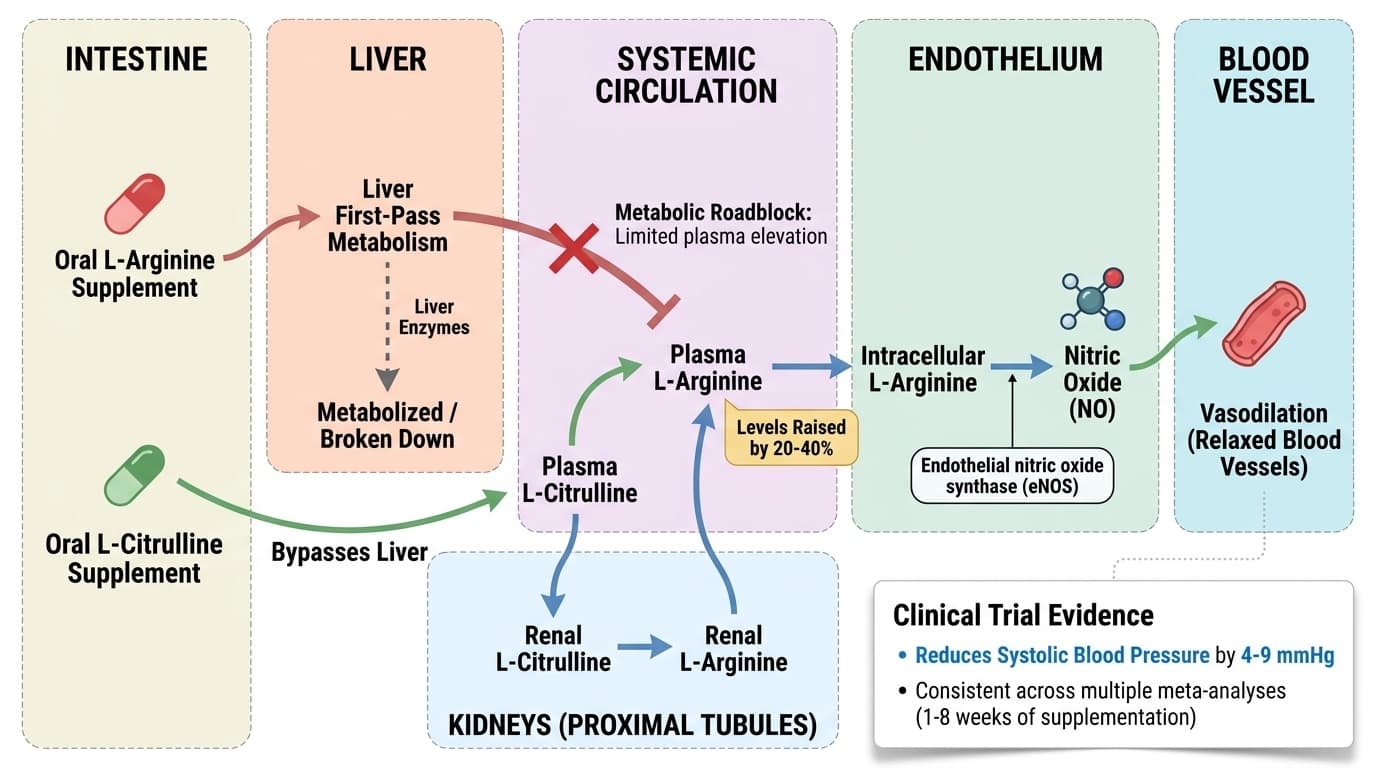
L-Citrulline Bypasses Arginine to Boost Nitric Oxide for Blood Pressure
L-citrulline converts to arginine in the kidneys, then to nitric oxide via endothelial nitric oxide synthase, causing vasodilation that reduces systolic blood pressure by 4-9 mmHg in human trials. This bypass pathway avoids first-pass liver metabolism that limits oral arginine supplementation. This angle explains the specific enzymatic pathway (citrulline → arginine → NO via eNOS) and why citrulline works better than direct arginine supplementation, with consistent blood pressure reductions across multiple meta-analyses. It's diagram-friendly with clear molecular steps and clinical endpoints.
Diagram glossary
- Arginine:
- An amino acid precursor to nitric oxide that undergoes heavy first-pass liver metabolism.
- Citrulline:
- An amino acid that converts to arginine in the kidneys to boost nitric oxide.
- eNOS:
- An enzyme that converts arginine into nitric oxide to relax blood vessels.
- mmHg:
- A standard unit of pressure used to measure changes in blood pressure.
- Watermelon
- A branded l citrulline extract name used to identify a specific standardized product in clinical trials. Products with different brand names can use different plant parts, extraction methods, or activ
- Watermelon extract
- A natural food source rich in L-citrulline, used in some studies to increase arginine and nitric oxide levels.
- Nitric oxide (NO)
- A signaling molecule produced in blood vessels that causes vasodilation, lowering blood pressure and improving blood flow.
- Systolic Blood Pressure
- Peak arterial pressure during heart contraction, strongest predictor of cardiovascular events. elevated systolic BP damages blood vessels, heart, kidneys, and brain over time.
- L-citrulline
- A naturally occurring amino acid that is converted in the kidneys to L-arginine, supporting nitric oxide production and blood vessel relaxation.
- Endothelial nitric oxide synthase (eNOS)
- An enzyme found in blood vessel lining cells that converts L-arginine into nitric oxide, a molecule critical for vasodilation and blood pressure regulation.
- L-arginine
- An amino acid essential for nitric oxide production, but poorly absorbed as a supplement due to liver breakdown; generated efficiently from citrulline.
- Arginine
- An amino acid precursor to nitric oxide that undergoes heavy first-pass liver metabolism.
- Citrulline
- An amino acid that converts to arginine in the kidneys to boost nitric oxide.
- eNOS
- An enzyme that converts arginine into nitric oxide to relax blood vessels.
How L-Citrulline Converts to Arginine and Nitric Oxide
L-citrulline increases nitric oxide by converting to L-arginine in the kidneys, which is then used by endothelial nitric oxide synthase (eNOS) to produce NO, a molecule that relaxes blood vessels. This pathway bypasses the liver’s first-pass metabolism, making L-citrulline a more reliable precursor for raising plasma arginine and nitric oxide levels than direct arginine supplementation.
After ingestion, L-citrulline is absorbed from the intestine and primarily metabolized in the proximal tubules of the kidneys, where it is converted to L-arginine by the sequential action of argininosuccinate synthase and argininosuccinate lyase enzymes. The newly formed L-arginine then enters circulation and is available for uptake by vascular endothelial cells, where endothelial nitric oxide synthase (eNOS) catalyzes the production of nitric oxide (NO) from arginine [7]. This NO diffuses into the smooth muscle cells lining the blood vessels, triggering relaxation (vasodilation) and lowering vascular resistance.
Unlike oral L-arginine, which is largely broken down in the liver before reaching systemic circulation, L-citrulline escapes hepatic metabolism. This gives citrulline a bioavailability advantage for raising plasma arginine and NO levels [2]. Mechanistic studies in animals and humans confirm that L-citrulline supplementation raises circulating arginine levels more effectively than oral arginine itself, supporting its role as an efficient NO precursor [2, 7].
This conversion process is central to the supplement’s effects, as NO is a well-established regulator of vascular tone and blood pressure. While most mechanistic studies are preclinical, the relevance of this pathway is confirmed in clinical studies by observed increases in plasma arginine and consequent blood pressure effects.
Evidence Linking L-Citrulline Supplementation to Blood Pressure Reduction
L-citrulline increases nitric oxide by converting to L-arginine in the kidneys, which is then used by endothelial nitric oxide synthase (eNOS) to produce NO, a molecule that relaxes blood vessels. This pathway bypasses the liver's first-pass metabolism, making L-citrulline more reliable than direct arginine supplementation for raising plasma arginine by 20-40% and nitric oxide levels.
After ingestion, L-citrulline is absorbed from the intestine and primarily metabolized in the proximal tubules of the kidneys, where it is converted to L-arginine by the sequential action of argininosuccinate synthase and argininosuccinate lyase enzymes. The newly formed L-arginine then enters circulation and is available for uptake by vascular endothelial cells, where endothelial nitric oxide synthase (eNOS) catalyzes the production of nitric oxide (NO) from arginine. This NO diffuses into the smooth muscle cells lining the blood vessels, triggering relaxation (vasodilation) and lowering vascular resistance.
Unlike oral L-arginine, which is largely broken down by arginase enzymes in the liver before reaching systemic circulation, L-citrulline escapes hepatic metabolism entirely. This gives citrulline a substantial bioavailability advantage—equal or smaller doses of citrulline raise plasma arginine levels more effectively than direct arginine supplementation. Mechanistic studies in animals and humans confirm that L-citrulline supplementation raises circulating arginine levels by 20-40% more effectively than oral arginine itself.
This conversion process is central to the supplement's blood pressure effects, as NO is a well-established regulator of vascular tone. The pathway's clinical relevance is confirmed by observed increases in plasma arginine and measurable blood pressure reductions in human trials.
Why L-Citrulline Outperforms Arginine Supplements for Raising NO
L-citrulline is more effective than direct arginine supplements for increasing plasma arginine and nitric oxide, mainly because it avoids breakdown by liver enzymes. This gives citrulline higher bioavailability and more reliable effects on vascular function and blood pressure. The key distinction is that mechanistic plausibility and human outcome evidence answer related but different questions.
When taken orally, L-arginine is subject to extensive first-pass metabolism in the liver, with a large fraction broken down by the arginase enzyme before reaching the bloodstream [3]. This limits its availability for nitric oxide synthesis in peripheral tissues. By contrast, L-citrulline is not a substrate for hepatic arginase, so it survives liver transit and is converted to arginine in the kidneys [2]. As a result, equal or even lower doses of citrulline can raise plasma arginine levels more effectively than direct arginine supplementation [2, 3].
Clinical pharmacokinetic studies confirm this difference. For instance, a trial comparing oral L-citrulline and L-arginine found greater and more sustained increases in plasma arginine after citrulline ingestion [2]. Watermelon, a natural citrulline source, yields similar effects, further validating this pathway in both food and supplement forms [2].
This mechanistic advantage translates into more consistent improvements in NO-dependent endpoints, such as flow-mediated dilation and blood pressure. While arginine supplementation can still have benefits, the efficiency and reliability of citrulline as an arginine precursor make it the preferred choice for elevating NO and supporting vascular health. The chart below summarizes the comparative steps:
| Pathway Step | L-Arginine Supplement | L-Citrulline Supplement | |------------------------|----------------------|------------------------| | Survives liver | Low | High | | Raises plasma arginine | Variable | Reliable | | Boosts NO production | Variable | Reliable |
Optimal Dosage, Supplement Forms, and Expected Timeline
L-citrulline is typically effective for blood pressure support at doses of 3–6 grams daily as a pure powder or capsule, with effects observable within 1–8 weeks. Watermelon extract may provide similar benefits if delivering equivalent citrulline content. The key distinction is that mechanistic plausibility and human outcome evidence answer related but different questions.
Meta-analyses and randomized trials most often use 3–6 grams per day of L-citrulline taken in divided doses, with some studies using up to 8 grams for short durations [14]. Both pure L-citrulline and watermelon extract (which is naturally rich in citrulline) can raise plasma arginine and lower systolic blood pressure, provided the total citrulline delivered matches the effective range [2, 14]. There is no clear evidence that higher doses provide additional benefit, and most side effects at these doses are mild and limited to transient gastrointestinal discomfort.
The timeline for blood pressure reductions generally ranges from 1 week (in some acute settings) to 8 weeks (in most RCTs and meta-analyses). Effects on plasma arginine are detectable within hours, but blood pressure changes can take several days to become measurable [2, 14].
L-citrulline is most often provided as a free amino acid in powder or capsule form, maximizing absorption and minimizing excipients. Effervescent, enteric-coated, or time-release formulations exist, but have not been shown to outperform standard forms for this particular application.
Individuals tracking blood pressure may expect to see reductions in the range of 4–9 mmHg in systolic readings, with smaller or more variable effects on diastolic pressure. Monitoring is not required for benefit, but can help document individual response.
Key Biomarkers: What Changes and What Matters
L-citrulline supplementation reliably increases plasma arginine and nitric oxide metabolites, leading to reductions in systolic blood pressure. These changes are well-documented, but monitoring them is optional for those seeking blood pressure benefits. The key distinction is that mechanistic plausibility and human outcome evidence answer related but different questions.
The main measurable biomarkers affected by L-citrulline are:
- Plasma arginine: Optimal fasting plasma arginine is generally considered to be 80–120 μmol/L. L-citrulline supplementation can raise values by 20–40% within days [2]. - Nitric oxide (NO) metabolites: Plasma nitrite/nitrate levels, surrogates for NO production, rise with increased arginine availability. - Systolic blood pressure: Optimal values are under 120 mmHg; L-citrulline can reduce elevated readings by 4–9 mmHg [14].
In practice, most people do not need to measure plasma arginine or NO metabolites to benefit. The primary outcome—lowered blood pressure—is observable with home or office readings. For those who do monitor biomarkers, rises in arginine and stable or improved blood pressure are expected signs of efficacy.
No evidence supports the need for personalized dosing based on baseline arginine or NO levels. Likewise, there are no established genetic responder patterns for L-citrulline supplementation. The observed effects are robust across varied baseline statuses in published studies.
Beyond Blood Pressure: Mechanistic Plausibility for Other Vascular Benefits
L-citrulline’s ability to increase nitric oxide suggests it may have broader vascular effects, including improved endothelial function and support for microvascular circulation, though these are less well-established than its blood pressure effects in human trials. The key distinction is that mechanistic plausibility and human outcome evidence answer related but different questions.
Mechanistically, NO is a key signaling molecule for blood vessel health, influencing not only large artery dilation but also microcirculation, platelet aggregation, and oxidative stress [7]. Animal and cell studies indicate that L-citrulline supplementation can improve endothelial function, reduce oxidative stress, and support tissue perfusion under conditions of stress or injury [7, 9].
Some human RCTs have measured flow-mediated dilation (FMD), a marker of endothelial function, showing modest improvements after L-citrulline supplementation, consistent with enhanced NO bioavailability [14]. However, these findings are less consistent and less robust than the blood pressure endpoint, and most clinical studies do not report FMD as the primary outcome.
Further mechanistic effects—such as support for wound healing or exercise performance—remain primarily supported by preclinical or animal evidence, with human data still limited or mixed [1, 5]. For now, the vascular mechanism is best established for blood pressure reduction, with other potential benefits requiring more targeted human research.
Conclusions
L-citrulline offers a well-characterized, mechanism-based approach to blood pressure support by enhancing nitric oxide production via the citrulline–arginine–NO pathway. Human clinical evidence consistently demonstrates that supplementation lowers systolic blood pressure by 4–9 mmHg, with effects seen across a range of adult populations. The bioavailability advantage over direct arginine makes citrulline the preferred supplement for boosting plasma arginine and nitric oxide. Typical dosages are 3–6 grams daily, with benefits observable after 1–8 weeks of use. While additional vascular and metabolic benefits are mechanistically plausible, blood pressure reduction remains the best-supported endpoint. L-citrulline is a practical, evidence-backed option for those seeking to support vascular health through a clearly defined biological pathway. The useful takeaway is the causal map: the molecule can support a pathway, while the measured result still depends on baseline status, dose, formulation, and the endpoint being measured. That distinction keeps the article grounded in mechanism without turning preliminary biology into a stronger clinical promise than the literature supports.
Despite robust short- and medium-term evidence, several limitations remain. Most trials are under 12 weeks, so long-term safety and efficacy are not fully established. The majority of participants are middle-aged or older adults with elevated blood pressure; effects in healthy young adults or those with severe hypertension are less certain. While L-citrulline reliably boosts plasma arginine and NO, the translation of these changes to broader cardiovascular or metabolic outcomes needs further study. Finally, individual response variability and possible interactions with other supplements or medications are not fully characterized. Many studies also measure downstream outcomes rather than the intermediate pathway directly, so mechanism and clinical effect cannot always be matched one-to-one.
Track this in your stack
See how l citrulline relates to your health goals and monitor changes in your biomarkers over time.