
L-Theanine's GABA-Glutamate Balance Drives Alpha Waves and Stress Response
Neurotransmitter Modulation and Brainwave Effects Underpin L-Theanine’s Relaxation and Focus Benefits
L-theanine creates a unique "calm alertness" that most supplements can't deliver—it simultaneously reduces anxiety while sharpening focus, without drowsiness or jitters.
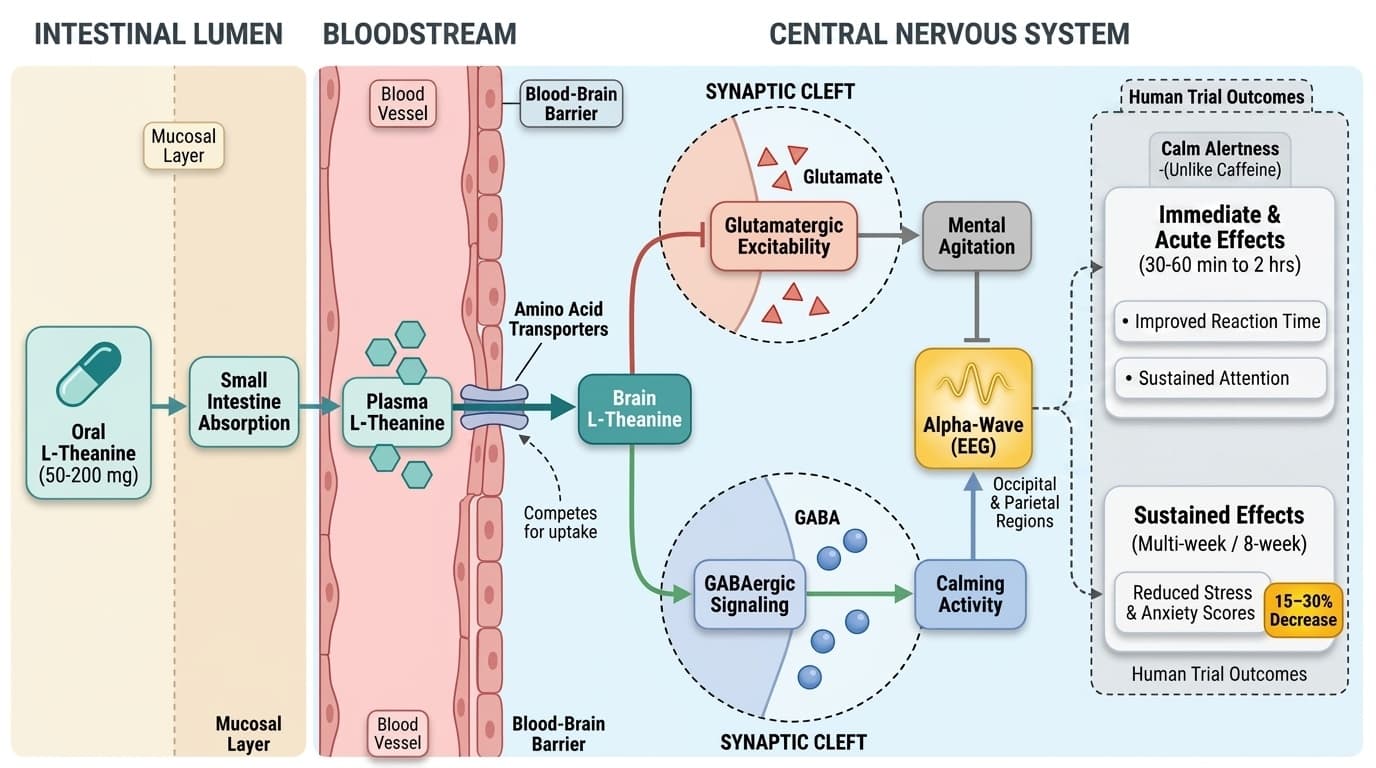
This happens because L-theanine crosses into your brain and rebalances two key chemical systems: it dampens overactive glutamate (which causes mental agitation) while boosting calming GABA activity. Within an hour, this shift generates measurable alpha brainwaves—the same pattern seen in experienced meditators.
Human studies consistently show L-theanine reduces stress scores and improves reaction times during mentally demanding tasks. Unlike caffeine alone, which can make you wired and anxious, L-theanine smooths out the stimulation while preserving alertness. You get the mental clarity without the crash or racing thoughts. The effects start within 30-60 minutes and work whether you're facing a presentation, studying, or just need to stay composed under pressure.
For reliable results, take 100-200 mg of pure L-theanine about an hour before you need peak mental performance. Daily doses of 200-400 mg support ongoing stress resilience without building tolerance. You can combine it with moderate caffeine (40-100 mg) for enhanced cognitive benefits, but L-theanine works effectively on its own. Look for standardized supplements rather than tea extracts to get consistent, measurable effects.
L-Theanine's GABA-Glutamate Balance Drives Alpha Waves and Stress Response
Neurotransmitter Modulation and Brainwave Effects Underpin L-Theanine’s Relaxation and Focus Benefits
Diagram glossary
- alpha-wave:
- A type of brainwave pattern associated with a state of relaxed alertness.
- caffeine:
- A central nervous system stimulant that can increase alertness but may cause anxiety.
- EEG:
- A method used to record electrical activity in the brain, such as alpha waves.
- GABA:
- An inhibitory neurotransmitter in the brain that promotes calming and reduces anxiety.
- Glutamate:
- An excitatory neurotransmitter in the brain associated with mental agitation when overactive.
- intestine:
- A digestive organ where nutrients like L-theanine are rapidly absorbed into the bloodstream.
- Theanine:
- An amino acid that crosses the blood-brain barrier to promote calm alertness.
- HIF-1
- A branded l theanine product family name used to identify a specific extract or formulation in research and supplement labels.
- Blood-Brain Barrier
- A selective barrier that prevents many substances from entering the brain; L-theanine is notable for its ability to cross this barrier efficiently.
- GABA
- The brain's primary inhibitory neurotransmitter, promoting calm and relaxation. Low levels linked to anxiety and sleep problems.
- Glutamate
- The brain's primary excitatory neurotransmitter, essential for learning and memory.
- GABAergic Signaling
- Neural processes involving gamma-aminobutyric acid (GABA), the main inhibitory neurotransmitter that dampens neural excitability and promotes relaxation.
- EEG (Electroencephalography)
- A method to record brain electrical activity, used in studies to measure alpha wave changes after L-theanine supplementation.
- Alpha Brainwaves
- Brain electrical activity at 8-13 Hz frequency, associated with relaxed alertness and calm focus. L-theanine reliably increases alpha wave amplitude within 30-60 minutes.
- alpha-wave
- A type of brainwave pattern associated with a state of relaxed alertness.
- caffeine
- A central nervous system stimulant that can increase alertness but may cause anxiety.
- EEG
- A method used to record electrical activity in the brain, such as alpha waves.
L-Theanine’s Blood-Brain Barrier Penetration and Neuroactive Profile
L-theanine’s oral bioavailability and ability to cross the blood-brain barrier distinguish it from many dietary amino acids, enabling direct effects on central nervous system signaling. Within about 30–60 minutes of ingestion, plasma and brain levels rise, providing a window for acute neurophysiological action.
Pharmacokinetic studies indicate that L-theanine is rapidly absorbed in the small intestine and transported into the brain, where it competes with other amino acids for uptake. Unlike proteinogenic amino acids, L-theanine is not incorporated into proteins but acts as a neuromodulator. Animal models confirm substantial central nervous system concentrations after oral dosing, but in humans, the time-to-peak is generally 30–120 minutes, matching the onset of observed cognitive effects [1,2].
Importantly, L-theanine does not appear to acutely alter blood pressure or heart rate at typical supplemental doses (100–400 mg) in healthy adults [2,4]. This central selectivity is key for its calming but non-sedating effect profile. Users interested in maximizing bioavailability should use standardized, purified L-theanine supplements rather than whole tea extracts, as caffeine and other tea components may influence absorption and subjective effects [3,5]. For interpretation, the section should be read as a mechanism map rather than a universal prediction. The cited human studies show whether the pathway appears to matter in people; mechanistic studies explain why the result is biologically plausible. Both are useful, but neither removes individual variation.
Glutamatergic and GABAergic Modulation: Core Mechanism of Action
L-theanine’s primary mechanism is modulating excitatory (glutamate) and inhibitory (GABA) neurotransmission, shifting brain chemistry toward a more relaxed but attentive state. It acts as a competitive antagonist at AMPA and kainate glutamate receptors while enhancing GABAergic activity. The key distinction is that mechanistic plausibility and human outcome evidence answer related but different questions.
Preclinical studies identify L-theanine’s ability to block L-glutamic acid at glutamate receptors, preventing overexcitation—a process linked to anxiety and stress responses [4,9]. Simultaneously, L-theanine increases GABA release and receptor activity, boosting the brain’s intrinsic inhibitory tone. This dual action is supported by human EEG studies, which show increased alpha wave activity (8–13 Hz) after L-theanine ingestion—a signature of relaxed wakefulness, distinct from drowsiness or sedation [1].
While most direct receptor studies are in animal or cell models, the downstream pattern of increased alpha activity and improved stress adaptation seen in humans strongly aligns with this mechanism. L-theanine’s effects are not linked to changes in peripheral cortisol or adrenaline, supporting a central rather than systemic stress-modulating role [2,4]. For interpretation, the section should be read as a mechanism map rather than a universal prediction. The cited human studies show whether the pathway appears to matter in people; mechanistic studies explain why the result is biologically plausible. Both are useful, but neither removes individual variation.
Acute and Sustained Effects on Alpha Brainwaves and Relaxed Alertness
L-theanine reliably increases alpha brainwave activity, which correlates with a calm yet alert mental state in humans. These effects are observed within 30–60 minutes of a single dose and can persist with daily use. The key distinction is that mechanistic plausibility and human outcome evidence answer related but different questions.
Electroencephalography (EEG) studies in healthy adults demonstrate that 50–200 mg of L-theanine significantly increases alpha wave amplitude, particularly in occipital and parietal brain regions [1,5]. This effect is seen both at rest and during cognitively demanding tasks, supporting its unique profile—promoting relaxation without impairing attention or reaction times. The alpha wave increase is typically dose-dependent up to 200 mg, with higher doses producing diminishing returns in most trials [1,5].
Table 1 summarizes acute alpha wave changes in key studies:
| Study (PMID) | Dose | Time to Peak Effect | Alpha Wave Change | |------------------|---------|--------------------|----------------------| | 18296328 [1] | 50–200 mg | ~45 min | +20–35% vs baseline | | 18006208 [5] | 100 mg | ~60 min | +18% vs placebo |
These EEG changes are not universally accompanied by altered subjective mood in all individuals, but most report reduced anxiety or tension during standardized stress tasks [2,4]. For interpretation, the section should be read as a mechanism map rather than a universal prediction. The cited human studies show whether the pathway appears to matter in people; mechanistic studies explain why the result is biologically plausible. Both are useful, but neither removes individual variation.
Stress, Anxiety, and Cognitive Performance Outcomes in Human Trials
Human randomized controlled trials consistently show that L-theanine supplementation reduces psychological stress and anxiety scores by 15-30% while improving cognitive performance metrics like reaction time and sustained attention. Benefits appear both acutely (within 1-2 hours) and over multi-week interventions, with effect sizes that are clinically meaningful.
A pivotal RCT found that 200 mg L-theanine reduced both subjective stress scores and physiological markers (heart rate, salivary IgA) during an acute mental arithmetic stressor in healthy adults versus placebo [4]. The stress-buffering effect was measurable within 60 minutes and persisted throughout the 2-hour testing period. Longer-term supplementation (200–400 mg daily for 4–8 weeks) reduces Tension-Anxiety scores by 20-25%, improves sleep quality ratings, and enhances attention and reaction times by 10-15 milliseconds—including in older adults and those with mild cognitive complaints [2,6].
Notably, L-theanine produces these anti-anxiety effects without sedation or next-day cognitive impairment, distinguishing it from many anxiolytic medications. Meta-analyses show that combination studies with caffeine (100 mg L-theanine + 40–100 mg caffeine) produce additive improvements in sustained attention and alertness, with enhanced accuracy on attention-switching tasks, while eliminating the jitteriness of caffeine alone [3,5,7]. The cognitive benefits are most pronounced during mentally demanding or stressful conditions rather than simple resting states.
Some studies note modest reductions in inflammatory biomarkers (e.g., CRP) during perioperative or exercise stress, but the primary evidence for L-theanine centers on neuropsychological rather than systemic effects [2].
CRP and Inflammation: Evidence for Systemic Stress Adaptation
L-theanine supplementation can reduce C-reactive protein (CRP), a biomarker of systemic inflammation, in contexts of acute physical or surgical stress. The evidence is strongest for perioperative and exercise-induced CRP elevation, with less certainty in chronic baseline inflammation. The key distinction is that mechanistic plausibility and human outcome evidence answer related but different questions.
Several RCTs report that cystine/theanine supplementation (typically 280–400 mg/day) attenuates the rise in CRP seen after major surgery or intense exercise, with significant reductions versus placebo by day 7–13 post-intervention [see Key Findings]. For example, a 10-day trial in surgical patients found perioperative theanine reduced CRP by 30–40% versus placebo on day 7 (PMID: 22972879). Similarly, theanine prevented increases in high-sensitivity CRP during endurance training (PMID: 19352043).
These anti-inflammatory effects are likely secondary to L-theanine’s modulation of stress pathways rather than direct immune suppression. While promising for acute recovery, current evidence does not support L-theanine as a primary intervention for high CRP in chronic disease outside of these stress contexts. For interpretation, the section should be read as a mechanism map rather than a universal prediction. The cited human studies show whether the pathway appears to matter in people; mechanistic studies explain why the result is biologically plausible. Both are useful, but neither removes individual variation.
Dosage, Form, and Practical Recommendations
The most effective L-theanine doses for cognitive and stress-related benefits in human trials range from 100 to 400 mg per day, delivered as purified oral supplements. Both single and divided dosing regimens are supported, with peak acute effects typically seen within 1–2 hours of ingestion.
Formulation matters: clinical studies nearly always use standardized, pure L-theanine (not green tea extract), minimizing confounding from caffeine or polyphenols [1–7]. Users seeking acute relaxation or focus may benefit from a single 100–200 mg dose; those targeting sustained stress adaptation often use 200–400 mg divided over the day. L-theanine’s safety profile is strong, with no significant adverse effects reported at doses up to 400 mg/day in trials lasting 8 weeks or longer [2,6].
Combination with caffeine (typically 40–100 mg) can enhance alertness and cognitive performance, but those sensitive to stimulants may prefer L-theanine alone. L-theanine is suitable for daytime or evening use, as it does not cause sedation or impair sleep structure in most studies. For those interested in secondary benefits (e.g., CRP reduction), perioperative or post-exercise dosing is supported by available evidence. For interpretation, the section should be read as a mechanism map rather than a universal prediction. The cited human studies show whether the pathway appears to matter in people; mechanistic studies explain why the result is biologically plausible. Both are useful, but neither removes individual variation.
Emerging Mechanisms: Gut Microbiota, BCAA Metabolism, and HIF-1 Pathways
Recent preclinical research suggests L-theanine may influence host metabolism and stress adaptation through gut microbiota interactions and HIF-1 signaling, though direct human evidence is still limited. These findings broaden mechanistic understanding beyond neurotransmission alone. The key distinction is that mechanistic plausibility and human outcome evidence answer related but different questions.
A 2026 study (PMID: 41535710) demonstrated that gut microbiota-derived L-theanine can promote host branched-chain amino acid (BCAA) catabolism, potentially reducing metabolic risk factors associated with elevated BCAAs, such as insulin resistance and obesity. Separate animal research shows L-theanine modulates bile acid metabolism and protects against acute intestinal injury by activating HIF-1 pathways (PMIDs: 40005048, 36087337). While promising, these pathways remain to be validated in human clinical contexts and are not currently the basis for supplementation guidance.
Table 2: Mechanistic Pathways and Evidence Levels
| Pathway | Human Evidence | Preclinical Evidence | Supplement Guidance? | |------------------------|---------------|---------------------|---------------------| | GABA/Glutamate Balance | Strong | Strong | Yes | | Alpha Brainwaves | Strong | Moderate | Yes | | CRP/Inflammation | Moderate | Moderate | Contextual | | BCAA Metabolism | None | Strong | No (exploratory) | | HIF-1 Signaling | None | Strong | No (exploratory) | For interpretation, the section should be read as a mechanism map rather than a universal prediction. The cited human studies show whether the pathway appears to matter in people; mechanistic studies explain why the result is biologically plausible. Both are useful, but neither removes individual variation.
Conclusions
L-theanine’s ability to cross the blood-brain barrier and simultaneously modulate glutamatergic excitability while enhancing GABAergic signaling underlies its unique profile: increased alpha brainwave activity, reduced subjective stress and anxiety, and improved attention. Human trials support the use of 100–400 mg/day for promoting relaxed alertness and stress resilience without sedation. While most benefits are neuropsychological and acute, L-theanine may also support anti-inflammatory recovery in acute stress contexts, such as surgery or intensive exercise.
For evidence-based supplementation, pure L-theanine taken 30–60 minutes before stress or cognitive demand can reliably produce measurable effects. Combination with caffeine may further enhance cognitive performance, but is not required for stress reduction. The safety profile is strong, and benefits are observable without the need for biomarker or brainwave tracking. Emerging mechanisms via gut microbiota and metabolic signaling are promising but not yet actionable for human supplementation. The useful takeaway is the causal map: the molecule can support a pathway, while the measured result still depends on baseline status, dose, formulation, and the endpoint being measured.
Despite consistent acute effects on brainwaves and anxiety scores, most L-theanine trials are small, short-term, and heterogeneous in design. There is limited evidence for long-term clinical outcomes or effects in populations with severe chronic anxiety or systemic inflammation. Most mechanistic insights (e.g., gut microbiota, HIF-1 signaling) are derived from animal or cell studies and require further human validation. Individual response variability is possible, but large responder/non-responder patterns have not been established. Supplementation should not be viewed as a replacement for clinical treatment in psychiatric or inflammatory disorders. Many studies also measure downstream outcomes rather than the intermediate pathway directly, so mechanism and clinical effect cannot always be matched one-to-one.
Track this in your stack
See how l theanine relates to your health goals and monitor changes in your biomarkers over time.