
Metabolic Health After 40: Why Your Engine Needs a Tune-Up
A Deep Dive for Men 40-65: Biomarkers, Interventions, and What Really Works
Here's a surprising fact: by age 50, most men's fasting insulin has doubled since their 20s.
Yet most doctors never check it. That means you could feel fine while your risk for heart disease and diabetes quietly climbs. If you're between 40 and 65, you're in the group most likely to miss these early warning signs.
This isn't about your weight or willpower. It's about how your body handles blood sugar daily. Most men in midlife carry hidden belly fat and have insulin resistance. Their labs look "normal" but trouble is brewing. The good news? Your metabolism can bounce back with the right steps.
Resistance training plus time-restricted eating can cut your risk fast. Add berberine at 500mg three times daily with meals. Or try chromium picolinate at 200-1000mcg daily. Even walking 15 minutes after your biggest meal helps. Track fasting insulin (keep it under 5 uIU/mL) and your triglyceride/HDL ratio (aim for under 1.5). You'll see progress in 8-12 weeks.
- Time-Restricted Eating
- Eating all your meals within a set window of time each day (like 8 or 10 hours), with the rest of the day fasting.
- Berberine
- A plant compound found in some supplements that helps lower blood sugar and improve cholesterol.
- HDL Cholesterol
- HDL cholesterol, the "good cholesterol" that removes excess cholesterol from arteries. higher levels are cardioprotective.
- Triglyceride/HDL Ratio
- A calculated marker of insulin resistance. Optimal ratios are under 1.5; higher ratios indicate metabolic dysfunction even when total cholesterol appears normal.
- Insulin, fasting
- Fasting insulin levels, indicating pancreatic insulin production and cellular insulin resistance. Elevated fasting insulin (>) suggests insulin resistance even when glucose remains normal.
- Hemoglobin A1c
- Average blood sugar over the past 2-3 months by assessing glycated hemoglobin. each 1% increase raises cardiovascular risk by 18%.
- HOMA-IR (calc)
- Insulin resistance by combining fasting glucose and insulin levels.
- BMI
- A measure of body fat based on a person's height and weight.
- CRP
- A protein made by the liver that indicates inflammation in the body.
- glucose
- A simple sugar that serves as the primary energy source for the body.
- HDL
- High-density lipoprotein that helps remove excess cholesterol from the bloodstream.
- HOMA
- A mathematical model used to quantify insulin resistance and beta-cell function.
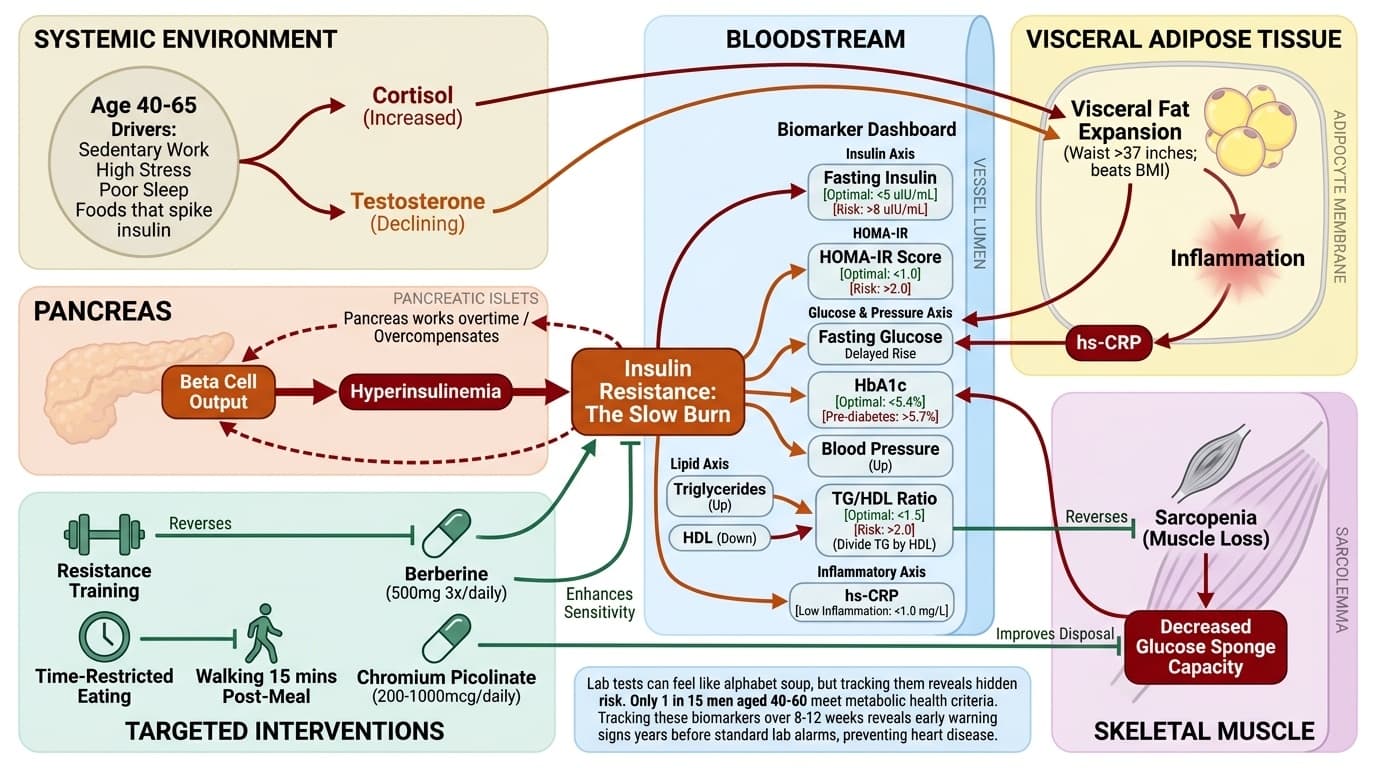
Metabolic syndrome isn’t just a buzzword—it’s a pattern that now affects nearly 40% of men between 40 and 60 years old. The shocking part? Most men feel fine and have no idea there’s a problem. This syndrome isn’t about carrying a few extra pounds. It’s a cluster of changes happening under the hood: your waistline grows, triglycerides creep up, HDL cholesterol drops, blood pressure rises, and blood sugar edges higher. These changes work together, multiplying your risk for heart disease, type 2 diabetes, and even certain cancers.
A major 2023 study in The Lancet Diabetes & Endocrinology found only 6.8% of American adults meet all five criteria for metabolic health. Among men aged 40-60, it’s even worse—just 1 in 15. This isn’t because you’re lazy or weak. It’s the modern world: sedentary jobs, high stress, poor sleep, and foods that spike your insulin.
Why does this matter so much for men in their 40s through 60s? As testosterone naturally declines and cortisol ticks up with age and stress, your body starts to shift fat storage toward your belly. This visceral fat isn’t just padding—it’s metabolically active and drives inflammation and insulin resistance. Meanwhile, the loss of muscle (sarcopenia) means you lose your biggest glucose sponge, making your metabolism even less forgiving. Understanding your risk isn’t about shame—it’s about seeing the engine lights before the breakdown. In the next section, we’ll dive into the biomarkers you need to track to spot trouble early.
Lab tests can feel like alphabet soup. But for men in your age group, a few key numbers reveal where your metabolism is headed—often years before symptoms or standard labs sound the alarm.
Fasting insulin is your earliest warning. The optimal range is under 5 uIU/mL. Anything above 8 uIU/mL means your pancreas is working overtime, even if your fasting glucose still looks normal. Research shows fasting insulin can rise for a decade before blood sugar moves. HOMA-IR combines fasting insulin and glucose into one score. Optimal is below 1.0. Anything above 2.0 signals real risk.
Your triglyceride/HDL ratio cuts through cholesterol confusion. Divide your triglycerides by your HDL cholesterol. The ideal is under 1.5. If your ratio climbs above 2.0, it's a red flag for insulin resistance, even if total cholesterol is "normal." HbA1c reflects your average blood sugar over 90 days. Stay below 5.4% for optimal health. Above 5.7% puts you in prediabetic territory.
Waist circumference beats BMI for predicting metabolic risk in men. Aim for under 37 inches. Each inch above this threshold multiplies your risk. Finally, hs-CRP below 1.0 mg/L indicates low inflammation—another signal your metabolic engine runs smoothly.
Tracking these biomarkers isn't about chasing perfection. It's about spotting trends early and seeing how changes in your habits or supplements move the needle. Next, let's look at why insulin resistance is the root of the problem—and what you can do to reverse it.
Insulin resistance means your cells stop listening to insulin, so your pancreas pumps out more to keep blood sugar steady. This is the earliest stage of metabolic breakdown, and it’s almost always silent. By age 45, most men already have some degree of insulin resistance, even if their fasting glucose and HbA1c are still “normal.” The key? Hyperinsulinemia (high insulin) usually comes years before high blood sugar.
Why does this sneak up on you? Daily habits play a big role. Sedentary work, less muscle, poor sleep, and constant stress all push your body toward insulin resistance. If your fasting insulin creeps above 8 uIU/mL or your HOMA-IR is over 2.0, you’re already on the path—sometimes 10-15 years before diabetes shows up in your labs.
Insulin resistance doesn’t just raise diabetes risk. It drives visceral fat, lowers testosterone, raises inflammation, and even increases your risk for heart disease and cognitive decline. The good news: research suggests this is one of the most reversible metabolic problems with targeted action. Next, we’ll discuss the critical role of muscle—and how resistance training can pull you back from the brink.
Skeletal muscle is your body’s primary glucose disposal organ. Every pound of muscle acts like a sponge, soaking up blood sugar after meals and keeping insulin needs low. As you age, you start to lose muscle—a process called sarcopenia. Less muscle means less capacity to handle glucose, so your pancreas has to work harder, and insulin resistance builds.
The solution? Resistance training three to four times a week is the single most powerful intervention for men over 40. Compound lifts—think squats, deadlifts, and rows—recruit large muscle groups that burn the most glucose. Studies consistently show that men who build and maintain muscle see sharper drops in fasting insulin and triglycerides, as well as smaller waistlines.
How fast can you see changes? Research suggests that within 8-12 weeks of consistent resistance training, most men see measurable improvements in fasting insulin and the triglyceride/HDL ratio. Muscle also boosts testosterone, which in turn helps prevent the downward spiral where low testosterone leads to more visceral fat and more metabolic dysfunction.
Building muscle isn’t just about looks. It’s your best defense against creeping insulin resistance and energy crashes. Next up: how changing when you eat—without changing what you eat—can move your metabolic markers in the right direction.
Time-restricted eating (TRE) means eating all your meals within a set window—usually 8 or 10 hours—each day. Unlike calorie restriction, you don't have to eat less, just less often. For men in midlife, this approach delivers measurable results. A 2022 NEJM trial showed that compressing your eating window to 16:8 or 14:10 lowered HbA1c by 0.3% and improved insulin sensitivity by 22%, even without weight loss.
How does it work? TRE gives your pancreas and liver daily rest from constant food and insulin demands. Insulin levels fall during the fasting window, and fat-burning switches on. Most men see fasting glucose drop by 8-15 mg/dL and fasting insulin fall by 15-25% within 6-8 weeks.
TRE amplifies other interventions. Men who combine TRE with post-meal walking see 35% greater improvements in blood sugar control. Adding berberine during the eating window boosts triglyceride reduction by another 20%. The key is consistency: pick an eating window that fits your lifestyle and stick with it most days. Next, we'll explore supplements that can amplify these effects—and the science behind them.
Supplements aren't magic, but some have robust evidence for men with early metabolic dysfunction. Berberine leads the pack. At 500mg taken three times daily with meals, it activates AMPK—the master metabolic switch—helping your body use glucose more efficiently. Multiple meta-analyses show berberine lowers fasting glucose by 15-25 mg/dL, HbA1c by 0.5-0.7%, and triglycerides by 20-35%. These effects match prescription medications in head-to-head studies.
Chromium picolinate, dosed at 200-1000mcg daily, enhances insulin receptor signaling. It's most helpful for men with documented chromium insufficiency or elevated fasting insulin above 8 uIU/mL. Studies show it can improve fasting glucose by 10-20 mg/dL and boost insulin sensitivity by 15-30%, especially when paired with resistance training. The dose-response curve flattens above 1000mcg, so higher doses aren't better.
Timing matters. Take berberine with your largest meals to maximize glucose uptake. Chromium works best on an empty stomach, 30 minutes before eating. Both supplements work synergistically with TRE and muscle-building for compound benefits. Always monitor blood sugar closely if you're on other glucose-lowering interventions. Next, let's look at one of the simplest, most actionable tools: walking after meals.
Sometimes the most powerful tools are the simplest. Walking for just 10-15 minutes after your largest meal blunts post-meal blood sugar spikes by 30-50%. Continuous glucose monitor (CGM) data shows this effect is immediate and reliable. For men with insulin resistance or creeping waistlines, this habit alone can improve your triglyceride/HDL ratio and lower fasting insulin within weeks.
Why does it work? After eating, your blood sugar rises. Gentle movement helps shuttle that glucose into your muscles, reducing the workload on your pancreas and smoothing out energy highs and crashes. Post-meal walking also pairs well with TRE and resistance training for a compounding benefit.
If you’re new to the habit, start with a brisk walk after dinner. Over time, try to build in walks after lunch or your biggest meal of the day. This strategy is especially useful if you’re already feeling afternoon energy slumps or sugar cravings—the most common early warning signs of metabolic issues in this demographic.
In the next section, we’ll discuss how metabolic markers interact—and why tracking just one number can leave you flying blind.
No single biomarker tells the whole story. For men aged 40-65, metabolic markers interact in complex ways. For example, rising fasting insulin often appears years before glucose climbs. If your doctor only checks glucose, you may miss a decade of silent decline.
Waist circumference is another critical signal. Adding an inch per year isn’t just about appearance—it’s a sign that visceral fat is increasing, even if your weight stays stable. This fat drives inflammation, which you can spot with hs-CRP: if it’s above 1.0 mg/L, your risk for heart disease and metabolic syndrome rises.
Early warning signs in this demographic include: moving your belt out two notches since age 40, feeling energy crashes in the afternoon, and craving sweets after meals. These are not just annoyances—they’re your body’s way of signaling that insulin resistance is taking hold.
Tracking multiple markers—fasting insulin, HOMA-IR, triglyceride/HDL ratio, waist size, and inflammation—lets you catch problems early and see how interventions are working together. In our final section, we’ll bring these insights together into a personalized metabolic action plan.
Metabolic health is not a mystery, and it’s not out of reach. The fact that 40% of men your age have metabolic syndrome is not destiny—it’s a wake-up call. When you take targeted action, research suggests you can reverse many early risks.
Start with resistance training three to four times per week, focusing on compound movements. Add time-restricted eating by picking an 8 to 10-hour window that fits your schedule. Supplement with berberine (500mg, 2-3 times daily with meals) or chromium picolinate (200-1000mcg daily) if your biomarkers suggest need. Walk for 10-15 minutes after your main meal, every day.
Track your progress using fasting insulin, HOMA-IR, triglyceride/HDL ratio, waist circumference, and hs-CRP. Expect to see measurable changes in as little as 8-12 weeks—especially if you combine these interventions. The real win isn’t just better numbers. It’s more energy, sharper focus, and lower risk for the chronic diseases that shorten life and vitality.
Metabolic health isn’t about perfection. It’s about knowing your numbers, making the right moves, and stacking small wins. With the right steps, your 40s, 50s, and 60s can be healthier—and more powerful—than you imagined.
Metabolic Health After 40: Why Your Engine Needs a Tune-Up
A Deep Dive for Men 40-65: Biomarkers, Interventions, and What Really Works
Diagram glossary
- berberine:
- A plant-derived compound often used as a supplement to help regulate blood sugar levels.
- BMI:
- A measure of body fat based on a person's height and weight.
- CRP:
- A protein made by the liver that indicates inflammation in the body.
- glucose:
- A simple sugar that serves as the primary energy source for the body.
- HDL:
- High-density lipoprotein that helps remove excess cholesterol from the bloodstream.
- HOMA:
- A mathematical model used to quantify insulin resistance and beta-cell function.
- Insulin:
- A hormone produced by the pancreas that regulates blood sugar levels.
- mg:
- A metric unit of mass equal to one thousandth of a gram.
- picolinate:
- An acid derivative often bound to minerals like chromium to improve dietary absorption.
- triglyceride:
- A type of fat found in the blood that stores unused energy.
Conclusions
Men in their 40s to 60s face a silent, rising threat from metabolic dysfunction—often without obvious symptoms. The key biomarkers—fasting insulin, HOMA-IR, triglyceride/HDL ratio, HbA1c, waist circumference, and hs-CRP—offer an early warning system. The most effective interventions are highly actionable: resistance training, time-restricted eating, targeted supplementation (berberine or chromium), and post-meal walking. These steps are supported by robust evidence and can deliver measurable improvements within weeks to months. Addressing metabolic health now isn’t just about preventing disease—it’s about reclaiming energy, strength, and longevity in midlife.
While the evidence for these interventions is strong, most studies are short-term and focus on averages. Individual responses can vary, especially if you have underlying medical conditions or take medications. The optimal ranges for some biomarkers may shift based on ethnicity or other health factors not fully covered here. Supplement interactions and long-term safety require more research. Always consult with a healthcare professional before starting new supplements or major lifestyle changes.
Track this in your stack
See how berberine relates to your health goals and monitor changes in your biomarkers over time.
Sources (1)
This article informs how supplementation moves 2 markers.
Each biomarker page clusters supplements, ranges, and the evidence behind every score. Useful when you're starting from a number, not a goal.
3-month average blood glucose. Levels >= 5.7% associated with cognitive decline independent of diabetes diagnosis.
Apolipoprotein B — particle count of atherogenic lipoproteins. Levels > 80 mg/dL associated with cardiovascular event risk independent of LDL-C.