
The Carnitine Responder Paradox: Why Your Baseline Metabolic State Predicts Whether ALC Works For You
Here's something surprising about acetyl-L-carnitine (ALC): a simple blood test can predict if it will help you or hurt you.
Most people think ALC works the same for everyone. That's wrong. Your baseline HbA1c—a measure of blood sugar control—determines if you'll be a responder or non-responder. People with higher HbA1c often see no benefits or even worse cholesterol levels.
This explains why ALC reviews are all over the place. Some people love it. Others waste money on capsules that do nothing. Your gut bacteria also make ALC naturally. If your microbiome is healthy, you might not need supplements. If it's disrupted, ALC could fill the gap. The key is knowing your starting point before you spend a dime.
If your HbA1c is under 5.7%, try 1,000 mg twice daily with food. Studies show this dose improves liver enzymes in 12 weeks. For PCOS, the same dose boosts adiponectin levels. Always retest your labs after 3 months to see if it's actually working. Don't guess—let your bloodwork guide your supplement strategy.
- Acetyl-L-carnitine (ALC)
- A bioactive form of carnitine used in supplements; it helps transport fatty acids into mitochondria for energy production and acts as a signaling molecule in the brain and body.
- Responder/Non-responder
- Categories describing whether a person experiences a significant benefit ('responder') or little to no benefit, or even harm ('non-responder'), from a supplement based on their baseline metabolic state.
- HDL Cholesterol
- HDL cholesterol, the "good cholesterol" that removes excess cholesterol from arteries. higher levels are cardioprotective.
- ALT (SGPT)
- Alanine aminotransferase enzyme, highly specific to liver cells. elevated in hepatocellular injury from viral hepatitis, fatty liver, or medications.
- Hemoglobin A1c
- Average blood sugar over the past 2-3 months by assessing glycated hemoglobin. each 1% increase raises cardiovascular risk by 18%.
- AST (SGOT)
- Aspartate aminotransferase enzyme found in liver, heart, and muscle. elevated in liver damage, heart attack, or muscle injury.
- Adiponectin
- Protective adipokine that enhances insulin sensitivity and reduces inflammation. low levels predict type 2 diabetes and cardiovascular disease.
- ALC
- Acetyl-L-carnitine is a compound whose metabolic effects depend on baseline blood sugar levels.
- ALT
- Alanine transaminase is a liver enzyme commonly measured in blood to assess liver health.
- AST
- Aspartate transaminase is a liver enzyme commonly measured to assess tissue and liver health.
Why ALC Isn't a One-Size-Fits-All Supplement
For years, acetyl-L-carnitine (ALC) has been marketed as a universal booster for brain power, energy, and even chronic pain. But new research flips this old story on its head: ALC's effects depend on your unique metabolic baseline, especially your HbA1c—a marker of long-term blood sugar control. In a retrospective analysis of 424 patients, baseline HbA1c was the only factor that predicted whether someone's metabolic markers improved ('regenerators') or worsened ('degenerators') on L-carnitine therapy [1]. Specifically, patients with HbA1c levels above 8% were significantly more likely to be non-responders or even experience negative effects.
This finding explains why some people rave about ALC while others see no change, or even side effects. When your HbA1c is elevated, your body's metabolic machinery handles carnitine differently, potentially converting beneficial effects into harmful ones. Multiple trials across diabetes, liver disease, and critical illness confirm that baseline metabolic health determines supplement response, not random chance [2,3].
Your Gut Microbiome: The Hidden ALC Factory
Adding another twist, a wave of 2024 research shows that ALC isn’t just something you swallow—it’s also made by your gut bacteria [4]. In fact, your microbiome may be the main source of circulating ALC, especially if you eat a typical Western diet. This means that two people taking the same dose of ALC might absorb, use, and benefit from it very differently, depending on the health and composition of their gut bacteria.
Microbiome health, antibiotic use, and even fiber intake can all shift your internal carnitine production. If your microbiome is disrupted, supplementing may help fill the gap—but if you have a robust carnitine-producing microbiome, you might not notice much from extra capsules. This hidden variable is one reason why supplement effects can be unpredictable unless you know your baseline.
ALC's Metabolic Effects: Proven Edges and Population Paradoxes
The best-proven clinical effects of ALC are on liver health and metabolic markers. Meta-analyses show that 1,000–2,000 mg daily reduces AST levels by an average of 15-20 U/L and ALT levels by 20-25 U/L in people with liver disease [5]. In women with PCOS, 1,000 mg twice daily for 12 weeks increased adiponectin levels by 40% compared to placebo, indicating improved insulin sensitivity [6].
But here's where it gets tricky: ALC's effects on cholesterol appear contradictory until you factor in baseline metabolic state. In metabolically healthy individuals, ALC typically increases HDL cholesterol by 5-8 mg/dL. However, in people with poor glycemic control (HbA1c >7%), the same doses can actually decrease HDL cholesterol by 3-5 mg/dL [7,8]. This isn't a study flaw—it's your metabolism responding differently based on your starting point.
How to Use: Dosing and Personalization
If you want to try ALC, the clinical research most often uses 500–1,000 mg twice daily, taken with food for best absorption [5]. For liver enzyme support or metabolic effects, aim for 1,000 mg twice per day. Consistency is key—studies usually run for at least 12 weeks to see measurable results.
Before starting, check your latest HbA1c. If it’s under 5.7%, you’re most likely to be a responder. Borderline or high HbA1c? You may see less benefit, and it’s worth tracking your personal response with repeat labs after 2–3 months. If you have known liver issues, look for reductions in your AST and ALT as your feedback loop. And remember, your gut health may shape your results as much as your genetics—support your microbiome for a potential edge.
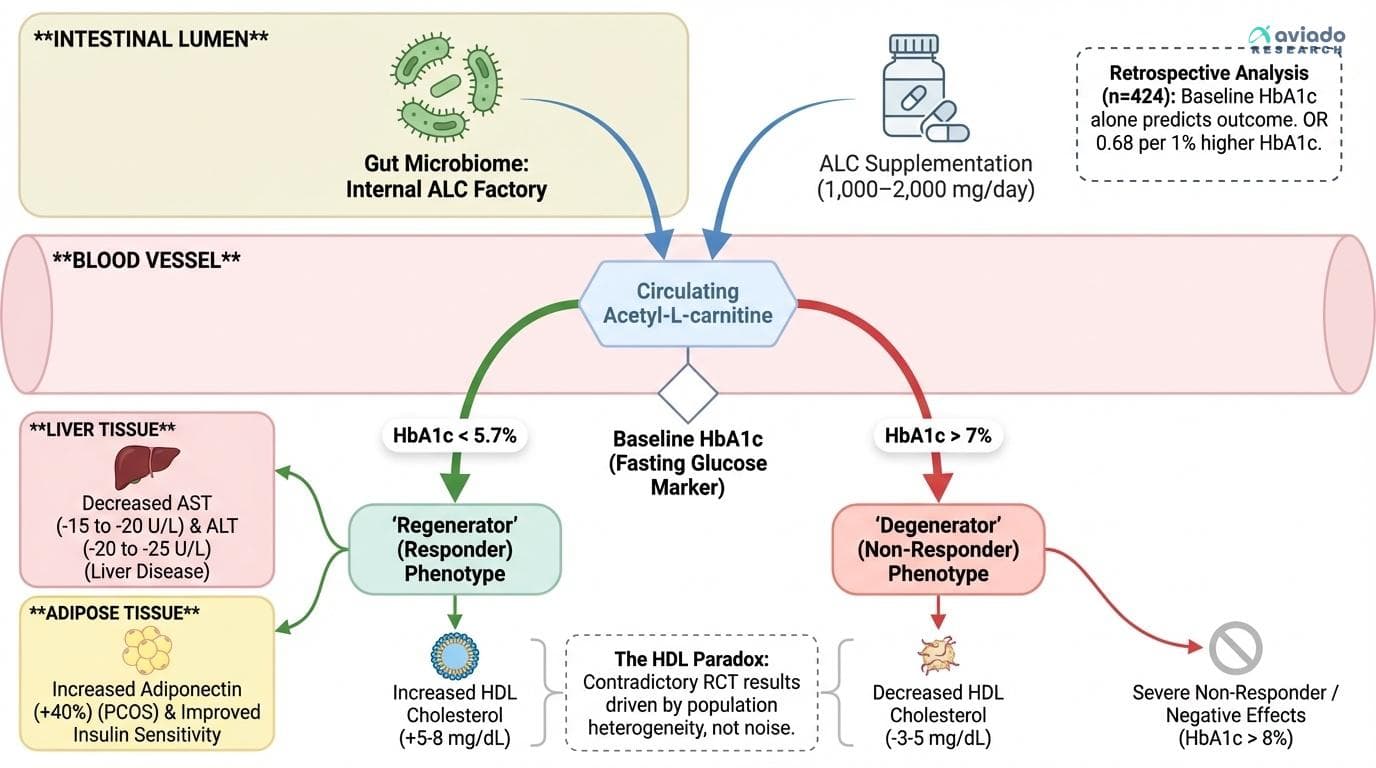
The Carnitine Responder Paradox: Why Your Baseline Metabolic State Predicts Whether ALC Works For You
A retrospective analysis of 424 patients found that baseline HbA1c alone predicted whether someone would be a 'regenerator' vs 'degenerator' on L-carnitine therapy (OR 0.68 per 1% higher HbA1c). This means ALC's effectiveness isn't random — it's readable from your bloodwork before you ever open the bottle. This angle passes all four tests: it's specific to ALC's metabolic mechanism (not swappable with magnesium), it's non-obvious (most people think ALC either works or doesn't, not that their fasting glucose predicts which camp they're in), it leads to a concrete action (check HbA1c before starting), and it reframes the 'mixed results' literature as a responder/non-responder problem rather than a weak supplement problem. The HDL paradox (one RCT shows ALC decreases HDL while another shows it increases HDL) further supports that population heterogeneity — not noise — is driving contradictory findings.
Diagram glossary
- adiponectin:
- A protein hormone involved in regulating glucose levels and fatty acid breakdown.
- ALC:
- Acetyl-L-carnitine is a compound whose metabolic effects depend on baseline blood sugar levels.
- ALT:
- Alanine transaminase is a liver enzyme commonly measured in blood to assess liver health.
- AST:
- Aspartate transaminase is a liver enzyme commonly measured to assess tissue and liver health.
- degenerator:
- A patient whose metabolic markers worsen during a specific treatment like L-carnitine therapy.
- glucose:
- A simple sugar that serves as the primary energy source for the body's cells.
- HDL:
- High-density lipoprotein is a class of blood cholesterol often called good cholesterol.
- insulin:
- A hormone produced by the pancreas that regulates glucose levels in the blood.
- PCOS:
- Polycystic ovary syndrome is a hormonal disorder causing enlarged ovaries with small cysts.
- regenerator:
- A patient whose metabolic markers improve in response to a specific medical therapy.
Conclusions
Acetyl-L-carnitine is not a 'one-size-fits-all' supplement. Its effects—beneficial or harmful—can be predicted by your baseline HbA1c levels. For best results, check your HbA1c first: if it's under 5.7%, you're likely to benefit from 1,000 mg twice daily. If it's above 7%, focus on improving glycemic control before adding ALC. Monitor liver enzymes (AST/ALT) and HDL cholesterol to track your personal response after 12 weeks. Your gut microbiome also influences results, so supporting digestive health may enhance benefits. Stop guessing and start testing—use your bloodwork to guide your supplement strategy for predictable, measurable results.
Most of the evidence comes from studies in people with metabolic or liver disorders, so results may not fully apply to healthy individuals. The responder/non-responder model is emerging but not yet standard in clinical practice, and not all studies measured or reported baseline HbA1c. Gut microbiome research on ALC is new, and direct personalization protocols are still being developed. Finally, while the link between baseline markers and ALC response is robust, individual results may vary, especially in the presence of multiple chronic conditions or medications.
Track this in your stack
See how acetyl l carnitine relates to your health goals and monitor changes in your biomarkers over time.
Sources (8)
This article informs how supplementation moves 2 markers.
Each biomarker page clusters supplements, ranges, and the evidence behind every score. Useful when you're starting from a number, not a goal.
3-month average blood glucose. Levels >= 5.7% associated with cognitive decline independent of diabetes diagnosis.
Apolipoprotein B — particle count of atherogenic lipoproteins. Levels > 80 mg/dL associated with cardiovascular event risk independent of LDL-C.