
The Cognitive Reserve Buffer: Why Two Brains with the Same Damage Age So Differently
How Lifestyle, Biomarkers, and Interventions Build a Brain That Resists Decline
Surprising truth: Two people with identical Alzheimer's brain damage can have completely different outcomes. One stays sharp and functional. The other struggles with basic tasks. The difference isn't luck—it's cognitive reserve, your brain's hidden buffer against decline.
This means you have real control over how your brain ages. Cognitive reserve is your brain's ability to adapt and compensate when damage occurs. You build it through specific lifestyle choices that create flexible neural networks. High-reserve people are 46% less likely to develop dementia, even with brain pathology present.
Start with aerobic exercise 3-5 times weekly to boost hippocampus size by 2% annually. Add omega-3s targeting an index above 8%. Consider magnesium L-threonate at 1-2 grams daily for synaptic plasticity. HIIT training can triple BDNF levels compared to steady cardio. Every choice in your 40s and 50s builds protection for decades ahead.
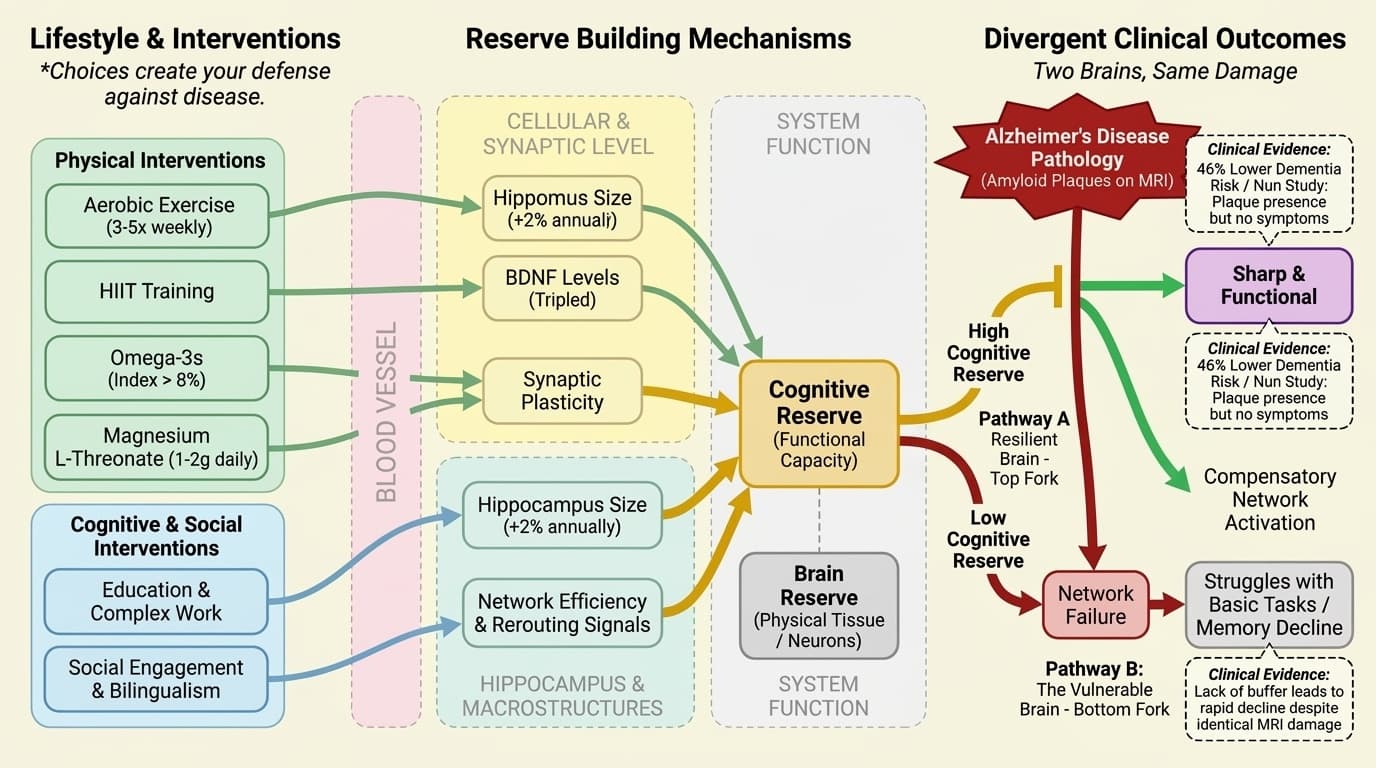
The Cognitive Reserve Buffer: Why Two Brains with the Same Damage Age So Differently
How Lifestyle, Biomarkers, and Interventions Build a Brain That Resists Decline
Diagram glossary
- BDNF:
- A brain protein that promotes neural growth and is boosted by intense exercise.
- HIIT:
- High-intensity interval training, an exercise method that significantly boosts brain-derived neurotrophic factor.
- MRI:
- A medical imaging technique used to visualize internal structures like brain tissue and plaques.
- threonate:
- A compound often combined with magnesium to support and enhance brain synaptic plasticity.
- Magnesium L-Threonate
- A specific form of magnesium that crosses the blood-brain barrier more effectively than other forms, supporting memory and cognitive function by enhancing synaptic plasticity at research doses of 1-2 grams daily.
- BDNF
- A protein that supports neuron growth and survival, often called 'fertilizer for the brain.' Higher levels associated with better memory and mood.
- DHA
- Docosahexaenoic acid, the primary omega-3 fatty acid found in the brain that supports cell membrane flexibility and neural communication; it is the key active component measured when targeting an omeg
- Cognitive Reserve
- Your brain's functional ability to maintain performance despite damage by using flexible networks, adapting pathways, and recruiting different regions when needed.
- Omega-3 Index
- The percentage of EPA and DHA in red blood cell membranes, measuring omega-3 status. Optimal levels above 8% support brain health, while standard levels are 4-8%.
- BDNF (Brain-Derived Neurotrophic Factor)
- A protein that acts like fertilizer for brain cells, supporting neuron growth, survival, and connection formation. Higher levels (7-20 ng/mL range, optimal at higher end) indicate active cognitive reserve building.
- HIIT (High-Intensity Interval Training)
- Exercise alternating intense bursts with recovery periods. Can boost BDNF levels 2-3 times more than steady cardio, supporting neuroplasticity and cognitive reserve.
- HIIT
- High-intensity interval training, an exercise method that significantly boosts brain-derived neurotrophic factor.
- MRI
- A medical imaging technique used to visualize internal structures like brain tissue and plaques.
- threonate
- A compound often combined with magnesium to support and enhance brain synaptic plasticity.
Two Brains, Same Damage—Opposite Outcomes
Picture two people, both in their seventies, both with MRI scans showing the same heavy buildup of amyloid plaques—a hallmark of Alzheimer’s disease. One of them is still running his law practice, mentally sharp and quick-witted, while the other can barely remember his grandchildren’s names. This isn’t just a story—it’s a real-world medical mystery that researchers have studied for decades. The answer is cognitive reserve: the difference between simply having a brain and having a brain that can adapt, compensate, and keep you functioning well even as damage sets in [1][1].
Why does this matter for you? Because it means your risk of cognitive decline isn’t just set by your genes or random chance. It’s shaped by your life choices, habits, and environment. Two people can have the same amount of brain damage but completely different outcomes depending on the buffer they’ve built up. This buffer is the reason that everything you’ve been learning about—exercise, nutrition, mental stimulation—matters so much more than you might think.
The rest of this article will explore what cognitive reserve is, how you build it, and how every intervention you choose can make a long-term difference.
What Is Cognitive Reserve—and How Is It Different from Brain Reserve?
Cognitive reserve is not something you can see on a standard brain scan. It isn’t about having more brain cells or a bigger brain—that’s brain reserve, which is the backup supply of physical brain tissue (neurons and synapses) you start with. Cognitive reserve is your brain’s functional capacity: how well it can use networks, adapt to challenges, and keep performing even as damage builds up [1][1].
Think of it like a company: brain reserve is how many employees you have on the payroll, and cognitive reserve is how well those employees can fill in, improvise, and keep the business running if someone leaves or a crisis hits. High cognitive reserve means your brain can reroute signals, recruit different regions, and dial up efficiency when parts get damaged. This is why some people show no symptoms despite having major Alzheimer’s pathology on MRI or autopsy [1][1].
Research by Yaakov Stern and others has shown that this functional reserve is built through a lifetime of mentally stimulating activities—like education, challenging work, and social engagement. It’s why cognitive reserve is now considered one of the strongest protective factors against cognitive decline [1][1]. In the next section, you’ll see exactly how reserve gets built—and why it’s never too late to start.
How Reserve Gets Built: Experiences, Education, and the Nun Study
Cognitive reserve builds up across your lifespan through a combination of education, complex work, ongoing learning, physical activity, and social engagement. Each of these factors adds to your brain’s ability to compensate when damage occurs, and they work independently—so you don’t need to be a professor to build reserve; a factory worker who reads daily, stays active, and keeps up meaningful relationships can have more reserve than a sedentary, isolated PhD [1][1][1].
The Nun Study is a famous example. Researchers followed a group of nuns over decades, collecting everything from early-life essays to medical records and, eventually, brain autopsies. They found that nuns who wrote more complex, idea-rich sentences at age 22 were far less likely to show cognitive symptoms of Alzheimer’s, even if their brains were full of plaques and tangles at death [1][1]. This study powerfully demonstrates that reserve is built early and can last a lifetime.
Other research shows that years of education, complex jobs, bilingualism, and regular social activity each contribute to reserve. Even late-life interventions—like learning a new language or joining a club—can provide benefits. In a large meta-analysis, high cognitive reserve was linked to a 46% lower risk of developing dementia [1].
As you keep reading, you’ll discover how these experiences change your brain at the molecular level, especially through growth factors like BDNF.
The BDNF Connection: How Exercise and Nutrition Build Reserve
Brain-derived neurotrophic factor, or BDNF, is a key protein that supports the growth, maintenance, and flexibility of your brain's networks. BDNF acts like fertilizer for your brain cells, helping them grow new connections and recover from damage. Physical activity—especially high-intensity interval training (HIIT)—can boost BDNF levels two to three times more than steady-state cardio, with levels rising within weeks and peaking at 6-12 months. This BDNF surge directly builds cognitive reserve by enhancing your brain's adaptive capacity.
Nutrition amplifies these effects. Omega-3 fatty acids, particularly DHA, support BDNF production and maintain neuron membrane health. Your omega-3 index should be above 8% for optimal brain protection (standard range is 4-8%). Magnesium L-threonate enhances synaptic plasticity at research doses of 1-2 grams daily, helping your brain form and reshape connections more effectively.
The timing and stacking matter for maximum reserve building. Aerobic exercise 3-5 times weekly plus short HIIT sessions can increase hippocampal volume by 2% within one year—enough to reverse 1-2 years of normal age-related shrinkage. When you combine this exercise protocol with omega-3 supplementation and magnesium L-threonate, you target overlapping pathways that multiply the cognitive reserve benefits.
Next, we'll explore why your 40s and 50s represent the most critical window for these interventions.
Why Midlife Matters Most: The Window to Build Your Buffer
Most people don’t realize that Alzheimer’s pathology—like amyloid plaque buildup—begins 15 to 20 years before any symptoms appear. If someone is diagnosed at age 70, their brain damage likely started in their 50s or even late 40s [1]. The good news: this is exactly when your brain is most responsive to reserve-building interventions.
Every year you invest in physical, mental, and social activity during midlife pays off exponentially. Studies show that interventions in your 40s and 50s have a stronger impact on future cognitive health than those started in your 70s [1][1]. This is because reserve is still flexible—it can be built up quickly, and damage has not yet overtaken your brain’s adaptive capacity.
Early warning signs to watch for in midlife include mild forgetfulness, difficulty concentrating, or trouble recalling names. These are cues to double down on reserve-building strategies. For women, hormonal shifts around menopause can increase risk, while for men, midlife metabolic changes can accelerate decline. Tailoring your interventions to your demographic—such as combining aerobic exercise with social engagement for women, or adding cognitive training for men—can optimize results.
As you move into the next section, you’ll learn how to measure and track your cognitive reserve, including which biomarkers and lifestyle factors matter most.
Measuring and Building Your Reserve: Biomarkers, Behaviors, and Interactions
There is no single test for cognitive reserve, but researchers use lifestyle indicators and biological markers to estimate it. Key proxies include years of education, occupational complexity, weekly cognitively stimulating activities, physical activity volume, and social network size. These factors work independently—you don't need all of them to build strong reserve.
Biomarkers provide objective measures of reserve-building progress. BDNF levels in the 7-20 ng/mL range indicate active neuroplasticity, with optimal cognitive protection at the higher end. Regular aerobic exercise and HIIT can raise BDNF within weeks, with peak effects at 6-12 months. Your omega-3 index should target above 8% (versus standard 4-8%) for brain protection. Homocysteine below 10 μmol/L supports vascular brain health—elevated levels can interact with low BDNF to accelerate cognitive decline.
Stacking interventions creates synergistic effects. HIIT combined with omega-3 supplementation produces larger BDNF increases than either alone. Adding magnesium L-threonate (1-2 grams daily in research) further enhances synaptic plasticity, especially when paired with regular mental challenges. Social engagement and cognitive training amplify these biological pathways, offering compound protection against decline.
In the final section, you'll see how these evidence-based choices add up to build your strongest defense against cognitive decline.
The Bottom Line: Building Your Buffer Starts Now
You cannot fully control whether amyloid plaques build up in your brain. But you can shape the buffer that stands between damage and your daily mental sharpness. That buffer is cognitive reserve, and it’s built by everything you do—exercise, omega-3 intake, sleep quality, managing stress, and keeping your mind engaged [1][1][1][1].
The most important thing is that cognitive reserve is actionable. Every walk, every new skill you learn, every meaningful conversation or challenging task—these are real investments in your future self. The earlier and more consistently you stack these interventions, the more resilient your brain becomes, no matter what shows up on a scan years from now.
Cognitive reserve is not about luck or genetics alone. It’s about choices, stacked over a lifetime, that let you live sharper, longer, and with more independence. Start building your buffer today.
Conclusions
Cognitive reserve is your strongest defense against cognitive decline—even when your brain shows damage. Research demonstrates that education, challenging work, social activity, and especially regular physical exercise build this protective buffer. Midlife interventions have the greatest long-term impact. Specific protocols—aerobic exercise 3-5 times weekly, HIIT training, omega-3 supplementation targeting an index above 8%, and magnesium L-threonate at 1-2 grams daily—work synergistically to boost BDNF and enhance brain adaptability. Every evidence-based choice you make now strengthens your cognitive reserve for decades ahead.
No single test directly measures cognitive reserve; current assessments rely on proxy measures like lifestyle history and biomarkers. Most evidence comes from observational studies, not randomized controlled trials, so causation cannot be fully confirmed. Demographic factors such as sex, race, and socioeconomic status may influence both reserve-building opportunities and outcomes. The specific dose-response relationships for supplements like magnesium L-threonate and omega-3s are still being studied, and optimal ranges may vary by individual. Finally, the ability to build reserve may decrease with advanced age or severe disease, making early intervention key.
Track this in your stack
See how cognitive reserve relates to your health goals and monitor changes in your biomarkers over time.