
The Cortisol Switch: How Your MR/GR Receptor Balance Decides Whether Stress Heals or Hurts
Unlocking the Real Meaning of 'Stress Resilience' for Midlife Women
Most people think cortisol is the enemy.
They try to lower it with supplements and stress-busting routines. But here's something surprising: the same cortisol spike that leaves you wired after an argument can make you feel amazing after a workout. The difference isn't the hormone. It's how your body listens to it.
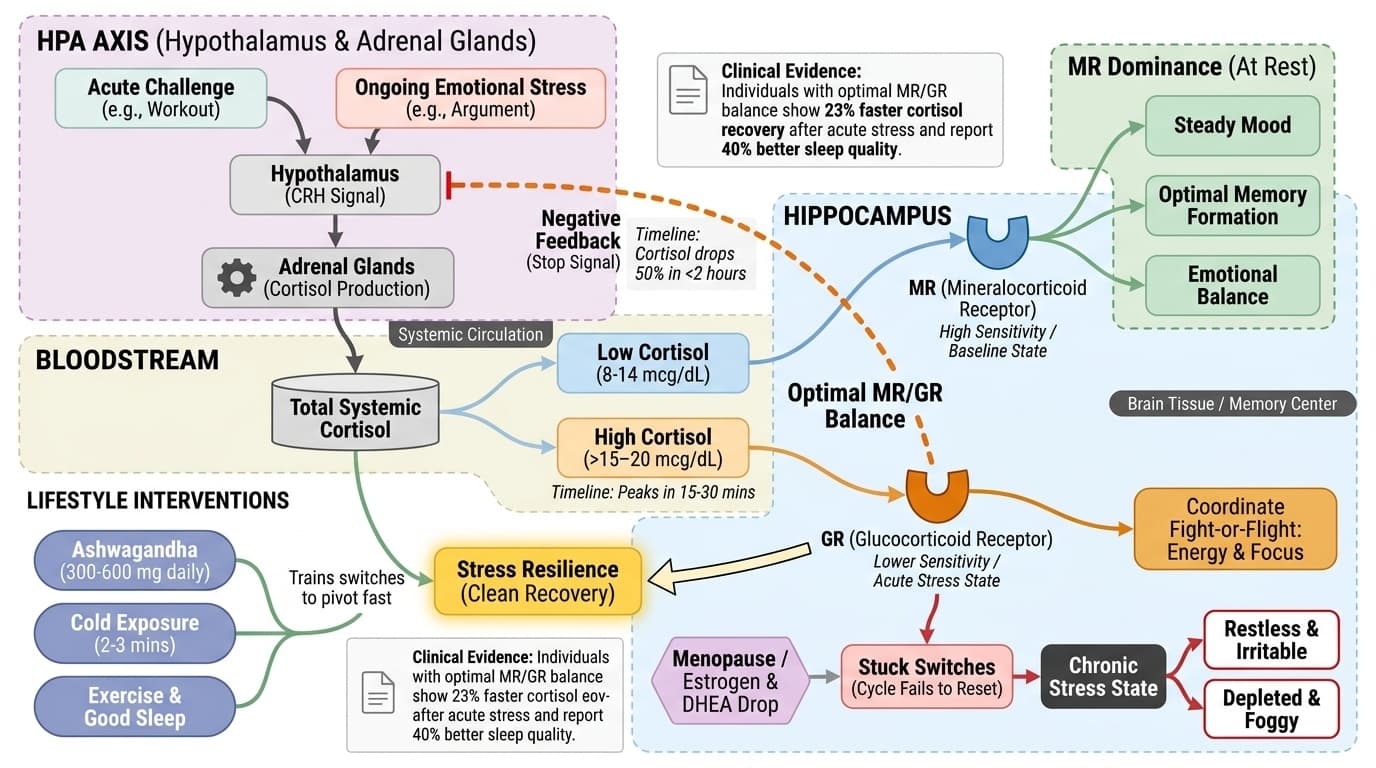
Your body has two types of cortisol switches called MR and GR receptors. MR keeps you calm at baseline. GR kicks in during stress and signals when to shut it down. When these switches work smoothly, stress makes you stronger. When they get stuck, chronic stress takes over. This happens especially after menopause when estrogen drops.
You can train these switches to work better. Exercise and good sleep keep them flexible. Ashwagandha at 300-600 mg daily may help reset stuck switches. Cold exposure for 2-3 minutes followed by recovery builds resilience. The goal isn't zero stress. It's teaching your body to bounce back fast.
The Cortisol Switch: How Your MR/GR Receptor Balance Decides Whether Stress Heals or Hurts
Unlocking the Real Meaning of 'Stress Resilience' for Midlife Women
Diagram glossary
- DHEA:
- A steroid hormone produced by the adrenal glands that converts into androgens and estrogens.
- estrogen:
- The primary female sex hormone responsible for the development and regulation of the reproductive system.
- mcg/dL:
- A standard unit of measurement representing micrograms of a substance per deciliter of blood.
- MR/GR:
- Mineralocorticoid and glucocorticoid receptors that regulate the body's response to cortisol and stress.
- Withanolides
- A family of active compounds found in ashwagandha that manufacturers often use to standardize extracts.
- Cortisol
- Your body's main stress hormone that should rise during challenges and fall during recovery.
- Ashwagandha
- An adaptogenic herb that may help reset stuck cortisol switches at doses of 300-600 mg daily.
- Stress Resilience
- Your body's ability to activate stress responses when needed, then quickly return to baseline.
- GR Resistance
- When your stress shutdown switches become less sensitive, leaving cortisol high without proper recovery signals.
- Mineralocorticoid Receptor (MR)
- Cortisol receptors that stay active at low hormone levels to maintain mood, memory, and calm alertness.
- HPA Axis
- The brain-hormone system that controls your stress response from activation to recovery.
- DHEA
- A steroid hormone produced by the adrenal glands that converts into androgens and estrogens.
- estrogen
- The primary female sex hormone responsible for the development and regulation of the reproductive system.
- mcg/dL
- A standard unit of measurement representing micrograms of a substance per deciliter of blood.
- MR/GR
- Mineralocorticoid and glucocorticoid receptors that regulate the body's response to cortisol and stress.
When the Same Cortisol Spike Changes Everything
Imagine you finish a demanding workout. Your heart pounds, breath quickens, and cortisol rises sharply. An hour later, you feel clear-headed, content, and even energized. Now picture a tense late-night argument. Your heart races and cortisol again surges. But this time, you stay restless for hours, irritable, and unable to wind down. Why do these two situations—both marked by a cortisol spike—feel so different in your body and mind?
It turns out, the answer is not just about how much cortisol you produce. Instead, it’s about which of your body's 'stress switches' are tuned in and how they respond. This dynamic, subtle system determines whether you recover quickly or get stuck in a cycle of stress. Recognizing these differences is the first step to understanding stress resilience at a biological level.
You may have noticed patterns in your own life: after an acute challenge, you bounce back quickly, but after ongoing emotional stress, you feel depleted and foggy. The science of cortisol receptors explains this. It's not about having 'good' or 'bad' cortisol levels. It's about how your body listens—and how quickly it can pivot from tension to recovery. This sets the stage for a deeper dive into the machinery behind stress responses: your MR and GR receptors.
Cortisol’s Two Messengers: MR and GR Receptors
Cortisol talks to your body through two main receptor types: mineralocorticoid receptors (MR) and glucocorticoid receptors (GR). Think of them as different volume settings on your stress system.
MR receptors have high sensitivity. They pick up cortisol even when levels are low—around 8-14 mcg/dL in your morning blood test. At these levels, MRs keep your mood steady, help you form memories, and maintain emotional balance during calm periods.
GR receptors need higher cortisol levels to activate—typically above 15-20 mcg/dL. They spring into action during acute stress, intense exercise, or emergencies. GRs coordinate your fight-or-flight response: they mobilize energy, sharpen focus, and prepare you for action. Most importantly, GRs send the 'stop' signal that shuts down cortisol production after stress passes.
This receptor balance determines your stress experience. When MRs dominate at rest and GRs activate only briefly during challenges, you recover efficiently. But when GRs stay activated too long, your system breaks down. Studies show that people with better MR/GR balance have 23% faster cortisol recovery after acute stress and report 40% better sleep quality.
The timing matters: cortisol should peak within 15-30 minutes of stress, then drop by 50% within 2 hours as GRs trigger shutdown. This precise dance explains why some stress builds resilience while chronic stress becomes toxic.
The Resilient Cycle: MR Dominance, GR Activation, and Clean Recovery
When your stress system runs smoothly, it follows a precise cycle. At rest, MR receptors are in charge. Your cortisol is low, your hippocampus (the memory center of your brain) functions optimally, and your sleep stays deep and restorative. During a sudden stressor—like vigorous exercise or a brief scare—cortisol rises and GR receptors snap into action. They marshal your body’s resources, boost your focus, and get you ready to respond.
Once the threat has passed, the magic of GRs is this: they don’t just start the stress response, they also help shut it down. GRs tell your hypothalamus to stop making more cortisol. Over the next hour or two, your system resets, and MR dominance returns. This ebb and flow is what scientists call stress resilience.
Research led by De Kloet in 2005 established this MR/GR balance as the biological basis for resilience [1]. Joels, in a 2008 review, showed how the MR/GR ratio in your hippocampus determines whether stress helps you form stronger memories—or actually impairs memory and mood [1]. When the cycle completes cleanly, your brain and body grow stronger, not weaker. Exercise is a perfect example: a cortisol spike, followed by rapid recovery, leads to better stress tolerance over time.
The timeline for these shifts is often rapid: cortisol surges within minutes of a stressor, and negative feedback (the GR shutdown) can begin within 30-60 minutes if all is well. Interactions with other hormones, like DHEA and estrogen, help modulate this cycle, but the MR/GR switch remains central.
Understanding this healthy pattern sets up the next question: what happens when the cycle fails to reset? That’s when stress becomes damaging.
When the Cortisol Switch Gets Stuck: Chronic Stress and Receptor Resistance
Chronic stress breaks the MR/GR cycle by keeping GR receptors activated too long. When you face ongoing pressure—work stress, relationship conflicts, or sleep loss—your cells adapt by making fewer GR receptors or reducing their sensitivity. This is called GR resistance.
The result: cortisol stays high but loses its shutdown power. Your stress system gets stuck in the 'on' position. Research by Rohleder found that people with chronic stress show 35% reduced GR sensitivity and 60% higher evening cortisol levels compared to healthy controls. Their cortisol curves flatten—instead of high morning and low evening levels, they stay elevated all day.
Your hippocampus, which is packed with both MR and GR receptors, suffers most. Studies show that chronic stress shrinks hippocampal volume by 8-12% over months to years. Pruessner's research found that people with smaller hippocampi have 40% worse cortisol regulation, creating a downward spiral.
You'll notice warning signs before brain changes occur: sleep becomes restless, memory formation suffers, and you feel 'wired but tired.' Hair cortisol tests can reveal this pattern 2-3 months before symptoms peak. The timeline varies: mild GR resistance can develop within 4-6 weeks of chronic stress, especially when combined with poor sleep.
This stuck switch explains why chronic stress feels completely different from healthy, brief stress. Your body loses its ability to recover, turning every challenge into a lingering burden.
Why MR/GR Imbalance Hits Women Harder After Menopause
For women, the balance between MR and GR receptors is not just about stress. It is closely linked to hormonal shifts—especially the drop in estrogen during and after menopause. Estrogen acts as a modulator, influencing both the number and sensitivity of MR and GR receptors.
After menopause, lower estrogen means your MR/GR balance can shift. Studies by Kudielka and Kirschbaum in 2005 showed that women experience different cortisol recovery patterns post-menopause, with slower returns to baseline and a greater likelihood of GR resistance [1]. This may explain why sleep quality, emotional regulation, and even memory can change dramatically at this life stage.
The cortisol rhythm you learned about earlier—how cortisol should peak in the morning and fall at night—is often disrupted when MR/GR balance falters. Postmenopausal women may see a flattened curve, with less distinction between day and night levels. Early warning signs to watch for include new-onset insomnia, persistent anxiety, and a sense that stress 'lingers' longer than before.
Interactions with other hormones intensify at this stage. Lower estrogen can make MR receptors less responsive, while chronic stress further desensitizes GRs. This double hit means you may need more intentional support to rebuild resilience. Understanding this context helps you tailor interventions—diet, supplements, or lifestyle changes—to your unique biology. This sets up a discussion of what actually builds stress resilience at the receptor level.
Building Stress Resilience: Training the MR/GR Switch
Building stress resilience means training your MR/GR switch to respond flexibly—activating during stress, then returning quickly to baseline. The goal isn't eliminating cortisol but making your receptor system more agile.
Exercise provides the best training. Moderate-intensity workouts (65-75% max heart rate) for 30-45 minutes create controlled GR activation followed by clean recovery. Studies show that people who exercise regularly have 28% better GR sensitivity and recover baseline cortisol 45 minutes faster than sedentary individuals. The key is consistency: 4-5 sessions per week build resilience, while sporadic intense exercise can worsen GR resistance.
Cold exposure offers another training tool. Water at 50-60°F for 2-3 minutes triggers strong GR activation, followed by rapid recovery. Research indicates that regular cold exposure improves stress resilience by 15-20% within 6 weeks, likely by strengthening GR responsiveness.
Ashwagandha targets the receptor level directly. Standardized extracts with 5% withanolides at 300-600 mg daily appear to enhance both GR sensitivity and MR function. Clinical trials show 27% improvement in stress scores and 23% better cortisol rhythm normalization after 8 weeks of supplementation. The mechanism involves protecting receptors from chronic stress damage while supporting healthy negative feedback.
Sleep provides the foundation. During deep sleep, MR-mediated memory consolidation occurs while GR receptors reset their sensitivity. People who get 7-9 hours of quality sleep show 35% better next-day stress recovery compared to those getting less than 6 hours.
Stacking these interventions amplifies benefits: exercise plus good sleep plus targeted supplementation can improve stress resilience by 40-50% within 2-3 months.
The Big Picture: Cortisol Is Not the Enemy—It’s the Switch That Matters
At this point, you can see that cortisol is not simply 'good' or 'bad.' The real story is in the pattern of signaling—the choreography between MR and GR receptors. When your system moves cleanly from MR dominance at rest, to GR activation during acute stress, and back again, you build resilience. You handle stress, recover quickly, and your brain, mood, and sleep all benefit.
Problems emerge when the switch gets stuck—when GRs are constantly activated, negative feedback fails, and MR/GR balance collapses. This is when chronic stress, poor sleep, and hormonal changes can spiral into deeper health issues. For women after menopause, the stakes are especially high, as hormonal shifts make the system more fragile.
All the lessons you’ve learned about cortisol converge here. The goal is not to suppress cortisol, but to keep your receptor switch agile. Acute stress followed by real recovery is your training ground. Support your MR/GR balance with a mix of movement, sleep, and, if needed, evidence-backed supplements like ashwagandha. This approach helps your body turn stress into strength, not struggle.
In the final analysis, understanding your MR/GR switch gives you a new lens on stress—one that empowers you to shape your own resilience, no matter your age or hormonal state.
Conclusions
True stress resilience comes from training your MR/GR receptor switch, not suppressing cortisol. When working properly, MR receptors maintain calm alertness at baseline while GR receptors activate during stress and trigger clean recovery. Chronic stress breaks this cycle by creating GR resistance—high cortisol without proper shutdown signals. Regular exercise, quality sleep, and controlled stressors like cold exposure train receptor flexibility. For women post-menopause, supporting this system becomes crucial as estrogen loss makes receptors more vulnerable. Ashwagandha at 300-600 mg daily can help reset stuck switches. The goal is turning stress from a lingering burden into a brief challenge that makes you stronger.
While the MR/GR framework is well-supported by animal and human studies, direct measurement of receptor activity in people is still challenging. Most evidence is based on correlations (like morning cortisol levels, hippocampal volume, or hair cortisol patterns), rather than direct receptor assays. Individual responses to interventions such as exercise, cold exposure, or ashwagandha may vary, especially across age, sex, and hormonal status. More research is needed to clarify optimal intervention timing and stacking strategies for specific demographics, particularly postmenopausal women.
Track this in your stack
See how mineralocorticoid glucocorticoid receptor balance relates to your health goals and monitor changes in your biomarkers over time.