Drug-Supplement Interactions: What Aviado’s Warnings Actually Mean (And What To Do)
A Calm, Evidence-Based Guide to Navigating Your Stack Safely
You might be surprised to learn that most supplement-medication interactions don't require stopping anything.
Nearly half of adults over forty combine prescription drugs with supplements. Yet when Aviado shows an interaction warning, many people panic or abandon their health protocol entirely. That's the wrong move.
Most interactions are timing problems, not safety disasters. Your supplements and medications can work together safely with simple adjustments. The key is understanding what type of interaction you're dealing with and responding appropriately.
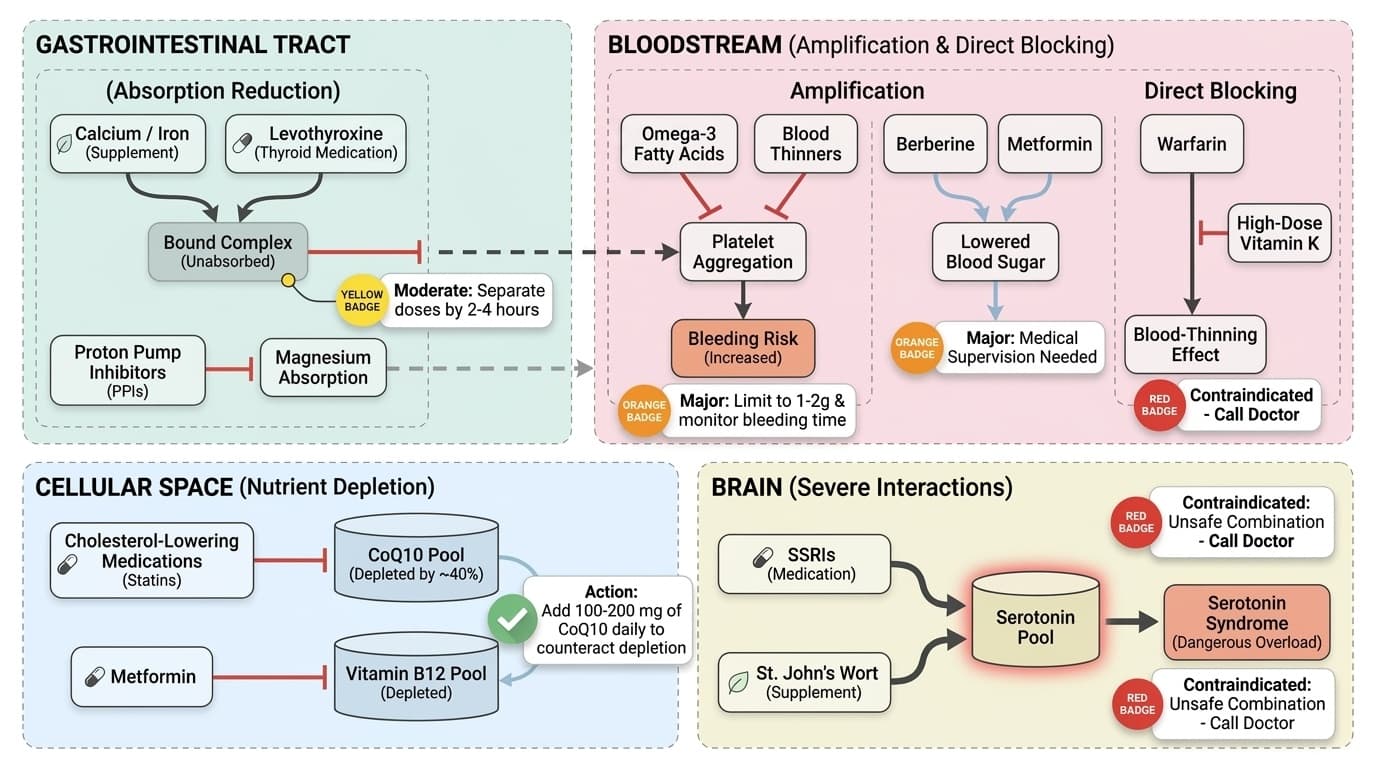
For calcium and thyroid medication, separate doses by 2-4 hours to prevent absorption blocking. If you take blood thinners, limit fish oil to 1-2 grams daily and monitor bleeding time. For those on cholesterol medications, add 100-200 mg of CoQ10 daily to replace what the drug depletes. These aren't restrictions—they're optimizations that keep your entire health protocol working effectively.
- CoQ10
- A nutrient important for energy production, often reduced by cholesterol-lowering medications.
- Drug-supplement interaction
- When a supplement and a medication affect each other's actions in your body.
- Calcium
- Total serum calcium, essential for bone health, muscle contraction, and nerve signaling. low levels cause muscle cramps and osteoporosis risk, while high values may indicate parathyroid disorders.
- Absorption
- How a substance moves from your gut into your bloodstream.
- FDA drug label
- Official prescribing information for medications, required by the U.S. Food and Drug Administration.
- Levothyroxine
- Synthetic thyroid hormone medication used to treat hypothyroidism.
- Vitamin B12
- Vitamin B12, essential for nerve function, DNA synthesis, and red blood cell formation. deficiency causes fatigue, neuropathy, and megaloblastic anemia.
- B12
- An essential water-soluble vitamin required for nerve function and red blood cell production.
- berberine
- A plant-derived alkaloid compound often used as a dietary supplement for metabolic health.
You’ve carefully built a supplement stack tailored to your health goals. Like many adults over forty, you might also rely on prescription medications—maybe for cholesterol, blood sugar, thyroid, mood, or blood pressure. When Aviado flashes an interaction warning, it can feel like a red flag or a sudden reason for concern. But that badge isn’t a stop sign; it’s an invitation to look deeper and take smart next steps.
Interaction warnings help you avoid problems that aren’t always obvious. For example, mixing certain supplements with medications can change how well either works—or even create new issues. Aviado’s system is designed to inform you, not to alarm you. Most interactions are manageable, and knowing about them lets you adjust your routine or consult your doctor before anything becomes a bigger issue. The goal is to keep you safe while empowering you to take an active role in managing your health stack.
A drug-supplement interaction is when one changes how the other works in your body. This can happen in several ways:
First, a supplement can reduce a medication's absorption. For example, calcium or iron can bind to levothyroxine (thyroid medication) in the gut, preventing your body from taking in the thyroid hormone if you take them together. The solution is simple: separate doses by two to four hours.
Second, a supplement can amplify a medication's effect. Taking omega-3 fatty acids with blood thinners increases bleeding risk, since both affect platelet aggregation. This doesn't always mean you must stop one, but your doctor should know so they can monitor you.
Third, some medications deplete key nutrients. Cholesterol-lowering medications, for instance, reduce CoQ10 levels by about forty percent. Metformin lowers vitamin B12 over time, and proton pump inhibitors (for heartburn) reduce magnesium absorption. In these cases, adding a supplement isn't a risk—it's a way to counteract a medication's side effects. Understanding which category your interaction fits into changes what you need to do: change timing, adjust your dosage, monitor a biomarker, or talk with your doctor about changing your regimen.
Not all interactions are equally serious. Aviado uses a color-coded badge system so you can quickly see the difference:
Red (Contraindicated): This is rare, but serious. The combination is generally unsafe. For example, St. John’s Wort and SSRIs can cause serotonin syndrome—a dangerous overload of serotonin in the brain. High-dose vitamin K with warfarin is another: vitamin K directly blocks warfarin’s blood-thinning effect. If you see red, don’t make changes alone—call your doctor.
Orange (Major): These are significant and need medical supervision. A common example is berberine plus metformin, which together can lower blood sugar more than intended. It’s often manageable with close monitoring, but your doctor should know.
Yellow (Moderate): This is the most common. Interactions here are usually manageable with simple steps, like separating doses. For example, magnesium can interfere with certain antibiotics if taken at the same time, but spacing them by two hours solves it.
Gray (Minor): Theoretical or only risky at high doses. These are for your awareness but rarely require action.
The badge color tells you how urgent the situation is and what kind of next step is needed.
Aviado’s interaction warnings are built on a database of over sixteen hundred validated drug-supplement pairs, covering more than nine hundred drugs. Every entry is sourced directly from FDA drug labels—the same official prescribing information your pharmacist checks when filling your medications. This is not crowd-sourced or AI-generated; it’s regulatory data, curated and reviewed by health professionals.
Each pairing in the database includes the severity level, the underlying mechanism (how the interaction works), and a recommended action—such as spacing out doses or monitoring a biomarker. However, the database is not exhaustive. Some supplements don’t have enough research to be included, so the absence of a warning doesn’t guarantee safety. It just means the FDA hasn’t documented an interaction. That’s why it’s important to keep your doctor informed about everything you take.
When you get an interaction alert in Aviado, you’ll see two options: Cancel or Add Anyway. Here’s how to respond, depending on the severity level:
For red (contraindicated) or orange (major) warnings: Don’t ignore the warning or change your regimen without medical advice. Take a screenshot of the alert and share it with your doctor or pharmacist. If you’re already taking both substances and weren’t aware of the risk, call your healthcare provider for guidance. Never stop a prescribed medication on your own based on an interaction warning—it’s usually riskier than the interaction itself.
For yellow (moderate) warnings: Read the recommended action carefully. Most can be managed by separating the timing by two to four hours, taking with food, or monitoring a specific biomarker. You can proceed with the addition while following these steps.
For gray (minor) warnings: Note the information and keep going. These are typically low-risk but good to know about.
If you’re ever unsure, it’s better to add the supplement (so you have a record) and discuss the interaction at your next doctor’s visit. That way, your entire care team is on the same page.
Interaction warnings are not designed to make you stop taking your supplements or medications. Instead, they help you and your doctor make better, more coordinated choices for your health. Most interactions can be managed with a bit of planning—whether that’s changing when you take something, adding a supplement to counteract a depletion, or simply being more aware of what’s in your regimen.
The aim is not to reduce the number of supplements or medications you use, but to take them in a way that’s both safe and effective. That awareness and intentionality turns a random collection of pills into a personalized, evidence-based protocol.
Drug-Supplement Interactions: What Aviado’s Warnings Actually Mean (And What To Do)
A Calm, Evidence-Based Guide to Navigating Your Stack Safely
Diagram glossary
- B12:
- An essential water-soluble vitamin required for nerve function and red blood cell production.
- berberine:
- A plant-derived alkaloid compound often used as a dietary supplement for metabolic health.
- levothyroxine:
- A synthetic thyroid hormone used to treat hypothyroidism and other thyroid disorders.
Conclusions
Aviado’s drug-supplement interaction warnings are there to guide your decision-making, not to alarm you. Most flagged interactions are manageable with timing adjustments, monitoring, or a doctor’s input—there’s rarely a need to panic or make drastic changes on your own. The most important thing is to use these warnings as a prompt for smart conversations with your healthcare providers. By being informed and proactive, you can keep your regimen both safe and effective.
Aviado’s database, while extensive, does not cover every possible drug-supplement interaction. The absence of a warning does not guarantee safety; it simply reflects what is currently available in FDA-approved drug labels. Some supplements lack robust research or documentation, and individual factors like genetics, health conditions, or other medications can also influence interactions. Always consult your healthcare provider for personalized advice.
Track this in your stack
See how interactions relates to your health goals and monitor changes in your biomarkers over time.
Sources (6)
This article informs how supplementation moves 2 markers.
Each biomarker page clusters supplements, ranges, and the evidence behind every score. Useful when you're starting from a number, not a goal.
% EPA + DHA in red-blood-cell membranes. Target >= 8% for cognitive protection; most US adults sit at 4-5%.
Apolipoprotein B — particle count of atherogenic lipoproteins. Levels > 80 mg/dL associated with cardiovascular event risk independent of LDL-C.