
Your Omega-3 Index: The One Number That Explains Why Fish Oil Works for Some People and Does Nothing for Others
Why supplementing blind with fish oil misses the real difference-maker: your Omega-3 Index
The surprising truth about fish oil?
Taking it without knowing your Omega-3 Index is like driving blindfolded. Most people supplement randomly and wonder why they see zero results. The Omega-3 Index measures EPA and DHA levels in your blood. It reveals who will benefit and who is wasting money.
Here's what this means for you. If your Omega-3 Index is below 8%, you'll likely see real benefits from fish oil. If you're already at 8% or higher, more supplements won't help. Most Americans sit around 4-5%, meaning they have huge room for improvement. People starting low get the biggest wins for heart health and brain function.
Start with 1,000-2,000 mg combined EPA and DHA daily. Choose triglyceride or phospholipid forms for better absorption. Test your Omega-3 Index after 12 weeks. If you're not at 8% yet, increase by 500 mg increments. This test-and-adjust approach ensures you hit the target zone where omega-3s actually work.
- Omega-3 Index
- A blood test that measures the percentage of EPA and DHA (the main marine omega-3s) in red blood cell membranes. It's the best marker for long-term omega-3 status and helps predict who will benefit from supplementation.
- EPA+DHA
- A combined formulation of the two main marine omega-3 fatty acids—EPA and DHA—commonly used in fish oil supplements. Different ratios or combinations of EPA and DHA may produce different effects in th
- EPA (Eicosapentaenoic Acid)
- One of the main types of omega-3 fatty acids found in fish oil. EPA is linked to heart health and influences inflammation in the body.
- Phospholipid complex
- Omega-3s bound to phospholipids (like in krill oil), which may enhance absorption and delivery to cell membranes compared to standard fish oil forms.
- Ethyl ester
- A chemical form used in some omega-3 supplements where fatty acids are attached to an ethanol backbone.
- DHA (Docosahexaenoic Acid)
- A key omega-3 fatty acid found in fish oil, vital for brain structure and function. DHA dominates in neural tissues like the brain and retina.
- Triglyceride form
- A natural chemical structure in which omega-3 fatty acids are attached to a glycerol backbone, similar to how they are found in whole fish. This form is often better absorbed by the body compared to s
- DHA
- A marine omega-3 fatty acid essential for brain function and cardiovascular health.
- EPA
- A marine omega-3 fatty acid that supports cardiovascular health and reduces inflammation.
- omega-6/omega-3
- The dietary ratio of omega-6 to omega-3 fatty acids, which impacts systemic inflammation.
Why the Omega-3 Index Is the Missing Link in Fish Oil Supplementation
Most people take fish oil assuming it’s a one-size-fits-all solution for heart health and inflammation. But recent research reveals that the benefits of omega-3s depend heavily on your baseline Omega-3 Index—a number most of us have never checked. The Omega-3 Index measures the percentage of EPA and DHA (the two most studied marine omega-3s) in your red blood cell membranes. This value reflects your long-term omega-3 intake and status, acting as a personalized health marker that predicts who will actually respond to supplementation [12,7,3].
Populations eating a traditional Western diet, with a typical omega-6/omega-3 ratio of 20:1, often have an Omega-3 Index below 5%, well below the optimal range seen in populations with high fish intake. This matters, because studies show that people starting with a low Omega-3 Index are the ones who see the largest improvements in cardiovascular, brain, and inflammatory health after supplementing [7,12].
Why Do Omega-3 Trials Have Conflicting Results? Baseline Status Explains It All
You might have heard that some omega-3 trials show major benefits, while others see little or nothing. The headline example is the REDUCE-IT trial (using EPA-only), which showed a 25% reduction in cardiovascular events, versus the STRENGTH trial (using EPA+DHA), which found no effect [12]. While debate continues about the precise reasons, one key factor is emerging: people with deficient baseline omega-3 status benefit far more than those already in the healthy range.
If you already have an Omega-3 Index above 8%, adding more fish oil is unlikely to move the needle. But for the majority in the 4-5% range (typical in the US and Europe), supplementation can fill a real gap and deliver measurable benefits. This also explains why omega-3s show more consistent benefits in populations or patient groups known to be depleted—such as those with low fish intake, certain metabolic or inflammatory conditions, and specific life stages like pregnancy or menopause [3,5,6,7].
How to Optimize Your Omega-3 Index: Dosage, Form, and Testing
Reaching the target Omega-3 Index (8% or higher) is now the best way to personalize your supplement strategy. Research indicates that supplementing with 1,000-2,000 mg per day of combined EPA and DHA—ideally in triglyceride or phospholipid form for enhanced absorption—can raise your Omega-3 Index into the optimal range within 3-4 months [12,7].
It’s not just about the dose; bioavailability matters. Omega-3s in triglyceride or phospholipid complexes (such as krill oil or re-esterified fish oil) are absorbed better than ethyl ester forms. Timing with a fatty meal also boosts absorption. After 3-4 months of daily supplementation, repeat your Omega-3 Index test. If you haven’t hit at least 8%, increase your dose in 500 mg increments until you do. This test-and-adjust approach is the only way to ensure you’re not wasting your supplement—or missing out on its full benefits.
The New Omega-3 Frontier: Personalization by Life Stage and Condition
Emerging research shows that omega-3 needs are not static. Pregnancy, menopause, PCOS, and athletic training all change the body’s demand and response to EPA and DHA [2,3,5,6]. For example, women in menopause and older adults at risk for cognitive decline may need to prioritize DHA for brain health [5], while those with cardiovascular risk may benefit from higher EPA intake [12]. Athletes and amateurs alike can see different responses to the same dose, depending on baseline status and training load [3].
This means the old advice of 'take fish oil for everyone' is being replaced by a model where you measure, target, and adjust based on your unique needs and current status. The Omega-3 Index makes it possible to get truly personalized, evidence-based results.
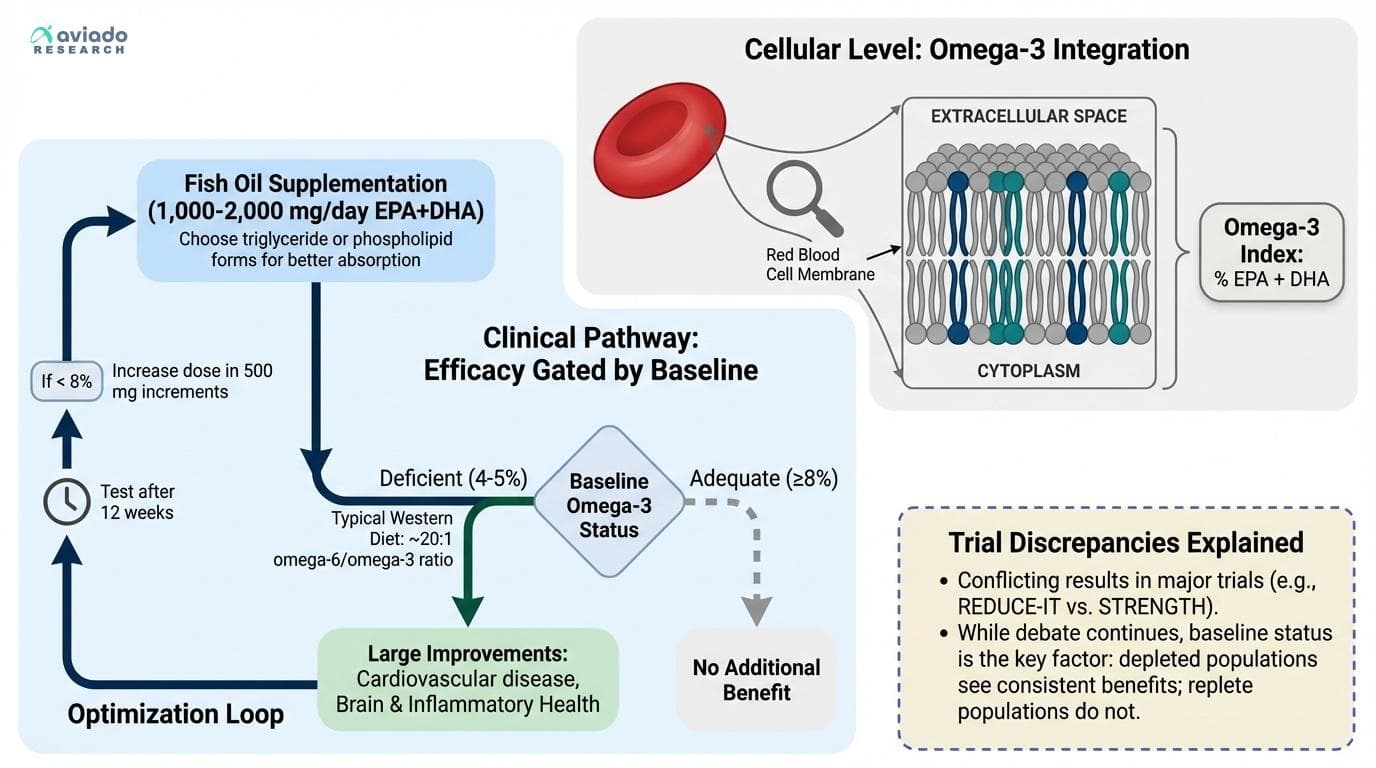
Your Omega-3 Index: The One Number That Explains Why Fish Oil Works for Some People and Does Nothing for Others
Why supplementing blind with fish oil misses the real difference-maker: your Omega-3 Index
Diagram glossary
- DHA:
- A marine omega-3 fatty acid essential for brain function and cardiovascular health.
- disease:
- An abnormal physiological condition that negatively affects the structure or function of an organism.
- EPA:
- A marine omega-3 fatty acid that supports cardiovascular health and reduces inflammation.
- omega-6/omega-3:
- The dietary ratio of omega-6 to omega-3 fatty acids, which impacts systemic inflammation.
- triglyceride:
- A common chemical form of dietary lipids and supplements that provides high bioavailability.
Conclusions
Fish oil isn't a magic bullet—but neither is it a placebo. The real difference comes from knowing your Omega-3 Index and supplementing to fill your specific gap. Most people in Western countries start with an Omega-3 Index around 4-5% and can benefit from 1,000-2,000 mg of combined EPA and DHA daily, but only regular testing shows if you're hitting the 8% target where benefits kick in. Personalizing your omega-3 intake based on your measured levels, rather than guessing, offers the best shot at unlocking the promised benefits for heart, brain, and whole-body health.
While the Omega-3 Index is a strong biomarker, not all labs offer this test, and standardized cutoffs are still being refined. Most evidence links higher Omega-3 Index to better outcomes, but some trials still show variable results due to differences in supplement form, population, and study design. More research is needed to fully define the best targets for specific health conditions and to clarify whether EPA and DHA should be dosed separately in all cases.
Track this in your stack
See how omega 3 relates to your health goals and monitor changes in your biomarkers over time.
Sources (6)
This article informs how supplementation moves 3 markers.
Each biomarker page clusters supplements, ranges, and the evidence behind every score. Useful when you're starting from a number, not a goal.
% EPA + DHA in red-blood-cell membranes. Target >= 8% for cognitive protection; most US adults sit at 4-5%.
High-sensitivity C-reactive protein. > 3 mg/L associated with chronic systemic inflammation affecting the brain and vasculature.
Apolipoprotein B — particle count of atherogenic lipoproteins. Levels > 80 mg/dL associated with cardiovascular event risk independent of LDL-C.